x




The U.S. Air Bridge Advances Eastward as Yemen Targets Two Tankers in the Red Sea. Talal Nahle
General Strategic Landscape
In the early hours of Thursday, July 23, 2026, the regional confrontation descended into the depths of strategic escalation as Washington inaugurated a new phase of the “war on electricity and critical infrastructure” by deliberately targeting a power station adjacent to the Bushehr Nuclear Power Plant.
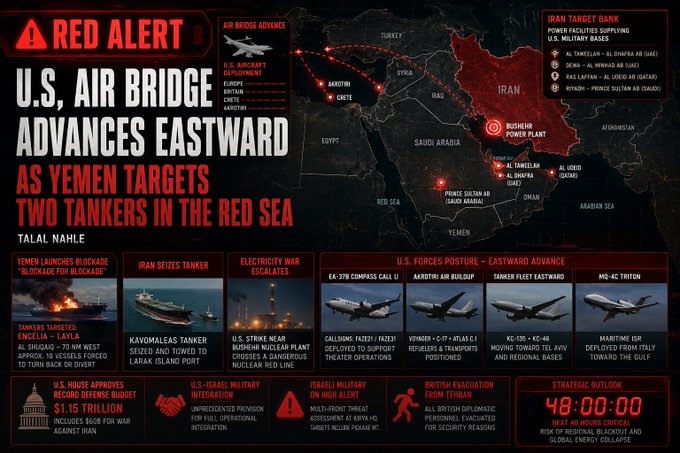
This qualitative escalation was met by the Islamic Revolutionary Guard Corps with the publication of a target bank that includes major Gulf power facilities supplying U.S. military bases. Meanwhile, Sana’a launched the first operations under its “blockade for blockade” strategy by targeting two Saudi vessels.
As electronic warfare aircraft and aerial refueling fleets move eastward from the United States and Europe toward the Middle East, and as Britain evacuates its diplomatic personnel from Tehran, Tel Aviv and Washington appear to be putting the final touches on a strategic strike aimed at undermining Iran’s nuclear and ballistic missile capabilities. This places the entire region on the brink of a descent into darkness and chaos.
Axis One: The “Electricity War” and the Breaching of Nuclear Red Lines. The Iranian-U.S. Theater
1. The Bushehr Nuclear Message and the Start of the Twelfth Round
U.S. Central Command, CENTCOM, announced, under Trump’s direction, the launch of a new series of strikes targeting Tabriz, Sirik, Mahshahr, and Ahvaz.
The most dangerous development was a U.S. missile strike against a power station located in the immediate vicinity of the Bushehr Nuclear Power Plant. This represented the immediate implementation of Trump’s threat to target bridges and electricity infrastructure, as well as a forceful message that the perimeter surrounding Iran’s nuclear facilities is no longer considered off-limits.
2. Iran’s Target Bank. Plunging U.S. Bases into Darkness
In response to the strike on Bushehr’s electricity infrastructure, Iran’s Fars News Agency published an official list of strategic power stations threatened with destruction because of their role in supplying U.S. military bases.
The list included:
Al Taweelah Power Plant, which supplies Al Dhafra Air Base in the United Arab Emirates.
DEWA power facilities, which supply Al Minhad Air Base in the United Arab Emirates.
Ras Laffan Power Plant, which supplies Al Udeid Air Base in Qatar.
Riyadh Power Plant, which supplies Prince Sultan Air Base in Saudi Arabia.
3. The Seizure of the “Dyanakom Kavomaleas”
Intelligence sources reported that Iran had completed the effective seizure of the burning oil tanker KAVOMALEAS and towed it toward the port of Larak Island. This constitutes a direct challenge to the U.S. maritime security umbrella.
Axis Two: The Launch of the Yemeni Blockade and the Paralysis of Hormuz
1. Implementing the Yemeni Blockade. “Blockade for Blockade”
The Yemeni Armed Forces issued a statement confirming that they had targeted the Saudi oil vessels ENCELIA and LAYLA with ballistic missiles, cruise missiles, and precision drones.
The attacks caused both vessels to catch fire off Al Shuqaiq, approximately 70 nautical miles to the west. The operation was carried out in implementation of the declared navigation ban.
The statement also claimed that approximately ten other vessels had been forced to turn back or divert from their original routes.
2. Yemen Threatens Strikes Deep Inside Saudi Arabia
The Yemeni statement confirmed that maritime operations would continue and warned the Saudi leadership that any further reckless action would be met with major and painful operations deep inside Saudi territory.
Axis Three: The Strategic Advance. OSINT Indicators, Budgetary Mobilization, and Tel Aviv on Alert
1. The Advance of Electronic Warfare Aircraft. Compass Call II
OSINT networks documented the exceptional movement of two advanced electronic warfare and jamming aircraft, the EA-37B Compass Call II.
The aircraft departed Davis-Monthan Air Force Base under the callsigns FAZE21 and FAZE31. They then crossed the Atlantic toward Britain before continuing to Chania Air Base in Crete.
Their deployment is intended to support the operational theater against Iranian air-defense systems.
2. The Air Buildup at Akrotiri and Across the Eastern Mediterranean
Surveillance imagery revealed a major concentration of transport and aerial refueling aircraft at RAF Akrotiri in Cyprus.
The buildup included two Voyager aerial refueling aircraft, one of which headed toward Syria under the callsign VADER 39, two C-17 transport aircraft, and two Atlas C.1 aircraft.
This coincided with the movement of dozens of U.S. tanker aircraft, including KC-135s and KC-46s, toward Tel Aviv and nearby bases. A U.S. MQ-4C Triton maritime reconnaissance drone was also observed flying from Italy toward the Gulf.
3. Record Funding and Integrated Military Legislation
The U.S. House of Representatives approved, by a vote of 216 to 212, a record defense budget totaling $1.15 trillion.
The package included an additional $60 billion in funding for the war against Iran. It also contained an unprecedented strategic provision calling for the full integration of U.S. and Israeli military operations.
4. Israeli Military Alert and the British Evacuation
Israeli military Chief of Staff Herzi Halevi convened an emergency security assessment involving all branches of the military at the Kirya headquarters.
The meeting focused on calibrating early-warning systems in anticipation of multi-front ballistic missile attacks, following confirmation that heavy bombers had begun to be used and that the target bank included Pickaxe Mountain.
This coincided with the sudden evacuation of all British diplomatic personnel from Tehran for security reasons. A similar indicator immediately preceded Operation Epic Fury at the end of last February.
Conclusion and Strategic Outlook
Washington’s deliberate targeting of the area surrounding the Bushehr Nuclear Power Plant, combined with congressional approval for the integration of U.S. and Israeli military operations and the deployment of EA-37B electronic warfare aircraft, indicates that the zero hour for unconventional and highly destructive strikes may now be imminent.
Based on these indicators, it is entirely possible that the next 48 hours could witness the beginning of joint strikes against sensitive Iranian military and nuclear facilities.
Should this scenario materialize, it would likely trigger a devastating Iranian response involving the activation of the “power station” target bank to destroy electricity infrastructure supplying U.S. military bases across the Gulf states.
At the same time, Yemen may continue targeting Saudi energy exports. Together, these developments threaten to plunge half of the Middle East into darkness and cause an irreversible collapse in global energy markets.
source https://x.com/Intel_Sky/status/2080076979240387068?s=20