x





1.5 Degrees Was Never the End of the World
The most famous climate goal is woefully misunderstood.
By Emma Marris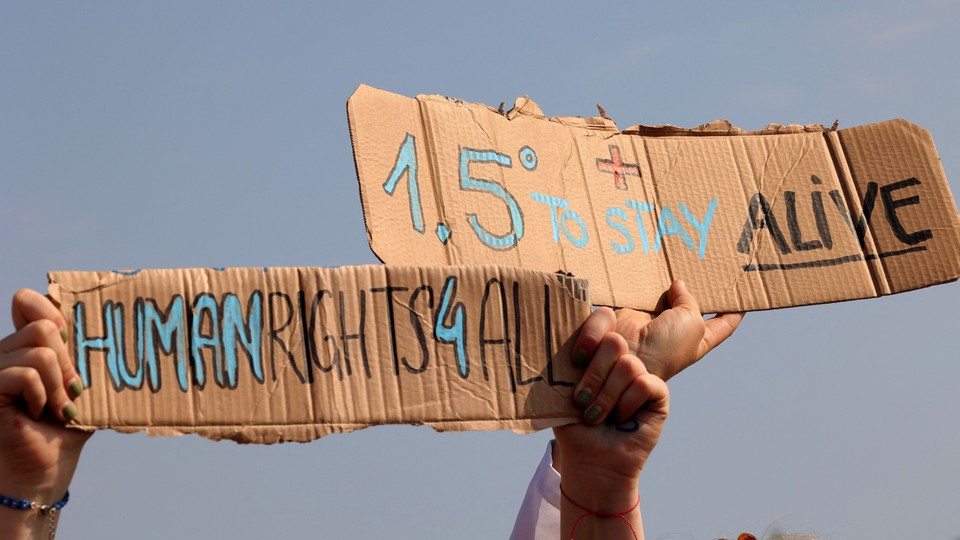
Fayez Nureldine / AFP/Getty
FEBRUARY 1, 2023
SHARE
Sign up for The Weekly Planet, The Atlantic’s newsletter about living through climate change, here.
How hot is too hot for planet Earth? For years, there’s been a consensus in the climate movement: no more than 1.5 degrees Celsius above preindustrial levels. The figure comes from the Paris Agreement, a climate treaty ratified in 2016, and world leaders such as President Joe Biden bring it up all the time: “If we’re going to win this fight, every major emitter nation needs [to] align with the 1.5 degrees,” he said in November. Youth activists at the Sunrise Movement call 1.5 degrees a “critical threshold.” Even the corporate world is stuck on 1.5 degrees. Companies including Apple, Google, and Saudi Aramco—the world’s largest oil company—claim to be transitioning their operations in alignment with the 1.5 goal.
But here’s the thing: 1.5 degrees, or 2.7 degrees Fahrenheit, isn’t based on any scientific calculation. It doesn’t represent a specific planetary threshold or ecological tipping point. It was first proposed during international climate negotiations as a moral statement, a rebuke of the idea that the world could accept some disruption and suffering in order to burn fossil fuels just a bit longer. That’s the takeaway of a new study on the history of the target from two French academics, Béatrice Cointe from the Centre for the Sociology of Innovation and Hélène Guillemot from the Centre Alexandre Koyré, both funded by the French National Centre for Scientific Research. From the perspective of the present, it’s a relief that 1.5 degrees doesn’t represent a scientific threshold, because we are almost certainly going to blow past it. As a rebuke, however, it may live on.