x





Published online 27 January 2023
Distinct life-cycle stages of Toxoplasma gondii use different molecular bridges to infect cells, including proteins that make an effective vaccine in animal trials.
Andrew Scott
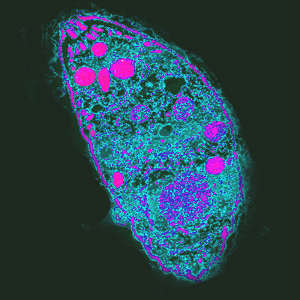
Toxoplasma gondii
AJ Cann / cc-by-sa-2.0
Toxoplasmosis is a serious but relatively neglected disease caused by a single-celled parasite with a complex life cycle. The parasite, Toxoplasma gondii, infects host cells by forming a molecular bridge called the moving junction (MJ). This has been well-studied for the acute phase of infection, but not for the chronic phase, involving a cyst-forming dormant state that can persist throughout life. Researchers at the American University of Beirut in Lebanon, with colleagues in France and Canada, have characterized the proteins involved in the MJ of the chronic phase, and investigated using some MJ proteins in vaccines.
“We have designed a potential vaccine, and demonstrated its selective and potent efficacy,” says molecular parasitologist, Hiba El Hajj of the American University of Beirut team. There is currently no vaccine for humans, although a veterinary form is licensed for use in sheep.
The parasite’s life cycle depends on a key central stage in cats, but includes a phase when it can be transmitted to any warm-blooded mammals, including humans. Around one third of the worldwide human population is estimated to be infected. Most people experience few symptoms, but those with weakened immune systems can become seriously ill, sometimes fatally. The US Centers for Disease Control and Prevention has classified toxoplasmosis among its group of neglected parasitic infections requiring improved control actions for general public health.
The acute phase of infection is mediated by a form of the parasite called tachyzoites, while a different form called bradyzoites mediates the chronic stages of the disease. The researchers’ first key finding was that the protein composition of the MJ allowing the bradyzoites to enter cells differs from that used by tachyzoites. They characterized these differences in molecular detail for the first time, giving useful new insights into understanding all stages of the disease.
They also explored different combinations of MJ proteins as vaccines, with potential for use in both veterinary applications and hopefully eventually in humans. Initial tests in mice revealed that one candidate vaccine, made with two proteins from the acute phase MJ, stimulated effective immunity against both the acute and chronic forms of the disease.
“This is a significant breakthrough,” says cell and physiological biologist, Marwan El Sabban, also at the American University of Beirut, but not involved in the research. He emphasises that a vaccine could prevent chronic toxoplasmosis from establishing cysts in the brain and skeletal muscles.
There are also therapeutic possibilities besides vaccines. El Hajj says that understanding the moving junction complex, both in toxoplasmosis and a variety of other diseases using similar cell entry mechanisms, might lead to new treatment options. The cell entry mechanism of a parasite serves as an ideal target for preventing an infection from spreading.