x



Alternatives for tugs
Niger is a key country for migration from Africa to Europe. But the western military presence is viewed critically there.
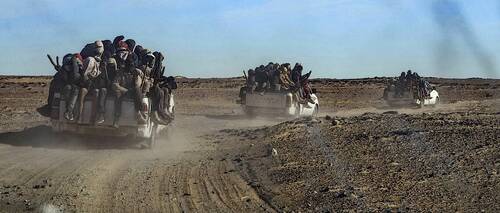
Migrants in the Air Desert, in northern Niger, on their way to Libya, January 2019.
While Europe likes to believe that it is the dream of all Africans, opinions south of the Sahara are more complex. Sometimes there is even open protest against the policies of northern countries, even though they claim a "partnership" with Africa. There are doubts about this, for example, in the West African Sahel state of Niger. In mid-March, an alliance of civil society groups called for a demonstration to protest the presence of foreign troops from western countries. According to the organizers, around a thousand people followed the call. The initiators are convinced that the presence of the foreign military undermines the sovereignty of their country, while on the other hand it does nothing to improve the security situation.
Many people in Europe are probably not even aware of how many western soldiers are stationed in the Sahel state and how important it is for Europe. This is despite the fact that the country only has a good 21 million inhabitants and is the poorest in the world according to the United Nations Development Index. But from a European perspective, Niger is currently a key country in containing migration and fighting Islamist terrorist groups that are gaining influence in the region.
Niger borders Mali in the west, where radical Islamists are present in the north and in the center. In the north lies Libya, a patchwork of zones of influence of various militias. Rebels are fighting the government in eastern Chad. In Nigeria in the south, the Islamist Boko Haram is unsettling large parts of the country. Members of this terrorist group are also gaining influence in Burkina Faso, which also borders Niger.
Despite the concentrated foreign military presence, many areas of Niger have become so insecure in the past months or years that tens of thousands are fleeing from there.
After years in which this Sahel state was considered unimportant, western military forces are now competing for space for further bases. French soldiers have been stationed on the Libyan border since 2014, and an Italian contingent could soon be added. Several western armies, including German soldiers, are training Nigerien soldiers. They are part of the EU mission "EUCAP Sahel Niger", which was established in 2012 and has been massively expanded since 2015. Nonetheless, the progress is only noticeable and slowly noticeable. This was confirmed by the European Court of Auditors of the EUCAP Sahel mission in its audit report from the middle of last year.
The United States is also active in Niger. The extent became known by chance at the beginning of October 2017 through an attack by radical Islamists on a military patrol in southwest Niger. In addition to five Nigerian soldiers, four US soldiers were also killed. They belonged to the US special unit "Green Berets". The attack also triggered a debate in the United States about the presence of US troops in Niger, at the time about 800 people. Most were used to build a second drone base for US and French aircraft in Agadez, a city in the north of the country. According to its own statements, the US Army also supports the Nigerien military in training and fighting extremists in the region.
Despite the concentrated foreign military presence, many areas have become so insecure in recent months or years that tens of thousands of people are fleeing there, for example from the border region with Nigeria. You feel defenseless, despite the foreign troops. Many therefore believe that the Western military is not interested in the security of the population and that Europeans in particular want to hinder migration. However, from the point of view of the region's inhabitants, this does not pose a threat, but was a lucrative industry - until the transport of migrants in the north of the country was criminalized in 2015 under pressure from the European Union. Since then, foreigners have been prohibited from moving north of Agadez. This also applies to citizens of the West African economic community ECOWAS, who are actually allowed to move within the territory of the community for three months without a visa.
Law 036/2015 has been rigorously implemented since 2016. The maximum sentence for those who nevertheless transport foreigners north of Agadez is five years in prison. Since the beginning of 2016, more than 200 people have been arrested and more than 300 pickups have been confiscated.
From a European perspective, the law was a success. Before its implementation, more than 300,000 people traveled through Agadez to Libya and possibly from there to Europe. The entire Agadez region benefited from the travelers in Niger: transport companies who registered their trade and paid taxes to the municipality of Agadez, drivers, petrol station owners, owners of restaurants and hostels, shops where travelers buy provisions, agents for mobile payment transactions and many others more. Since Law 036/2015 came into force, the number of migrants traveling north via Niger has decreased by two thirds. Many former transport companies have given up their jobs. However, a hard core continues, even though transportation is now illegal. They ski on desert slopes that are even more remote than those on which the formerly legal rides took place.
The EU should put enough effort into finding the right solutions rather than being too quick to settle for measures that raise a number of new problems.
Those who continue despite the dangers are tougher and more unscrupulous than the previous “smugglers”. Survivors report that human smugglers abandon their passengers in the desert when a military patrol approaches to avoid arrest. In the meantime, the “smugglers” have in fact become criminals organized like cartels.
The mass exodus of workers from Africa to Europe cannot go on continuously as it happened in 2015. However, the EU should put enough effort into finding the right solutions, rather than being too quick to settle for measures that pose a number of new problems.
A good example is the alleged compensation for lost income after the end of legal migration. To compensate for this, the EU had already promised “actors in migration” in Niger funds and projects in 2016. But the promised means came or come late, and they lag far behind what people had promised. The EU allegedly wanted to help those who had earned their living with migration by starting their careers again. First of all, a list of all so-called “migration actors” was drawn up, around 6,600 beneficiaries were initially recognized, the remaining 5,000 at the end. They were allowed to apply for money for a project - the equivalent of a maximum of € 2,300. Well over 2,000 applications were made, almost 1,000 approved. So far, 371 people have received money for a new start - not even six percent of those affected. The rest are still waiting, with increasing anger.
Breaking concrete promises harms the reputation of Europe and the reputation of democracy. And it brings people up against their government and against Europe. At the same time, the population is quite positive that Europe, especially Germany, is becoming more involved in development cooperation. During her last visit to Niger in early May, Chancellor Angela Merkel made further commitments and on this occasion praised Nigerian President Mahamadou Issoufou for his progress in the fight against illegal migration and smuggling.
But that is only one aspect of the overall picture. Despite the increased development efforts and the increased payments from north to south, it is said in the Agadez region that gang crime has recently increased massively - due to lack of work and income, as the population suspects. This is not a good basis to limit the influence of Islamist groups, which is increasing in Niger and neighboring countries.