x





A pair of studies offer the most detailed look yet at groups of hunter-gatherers living before, during and after the last ice age.
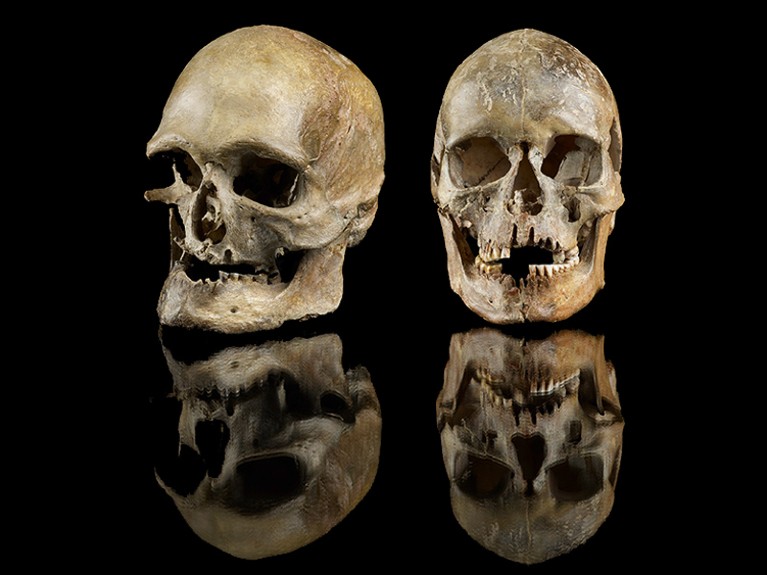
These 14,000-year-old skulls were found in western Germany. Their genetic ancestry suggests that human populations migrated in response to Europe’s changing climate.Credit: Jürgen Vogel/LVR-LandesMuseum Bonn
Like retirees who flock to the Costa del Sol, ancient European hunter-gatherers sought out Spain’s warmer climate during the peak of the last ice age.
A pair of ancient-genome studies shows that humans who had holed up in the Iberian Peninsula repopulated Western Europe after the retreat of glaciers that covered large parts of the continent from about 26,000 to 19,000 years ago1,2.
Ancient African genomes offer glimpse into early human history
The research — based on newly sequenced genomes of more than 100 individuals — offers the most detailed look yet at groups of hunter-gatherers who lived in Europe before, during and after the last ice age.
Ancient genomes from this period are scarce, so “even adding one data point is really important”, says Mateja Hajdinjak, a molecular biologist at the Max Planck Institute for Evolutionary Anthropology in Leipzig, Germany, who was not involved in either study.
Homo sapiens migrating out of Africa reached Europe at least 45,000 years ago — and possibly earlier. But the handful of ancient genomes from this period suggest that these pioneers left no genetic trace in later hunter-gatherers.
Instead, a landmark 2016 study3 identified a genetic signature in 35,000-year-old remains from the Goyet cave system in Belgium, which persisted in hunter-gatherer populations that lived tens of thousands of years later. The Goyet remains were associated with Aurignacian artefacts, a Europe-wide material culture known for its elaborate cave-wall art and ‘Venus’ figurines.
But the 2016 study raised a mystery. The Goyet ancestry was missing in remains from a roughly 20,000-year period leading up to and during the peak of the ice age, before reappearing later in hunter-gatherers in western Europe. “Where were these people hiding for 20,000 years?” asks Cosimo Posth, a palaeogeneticist at the University of Tübingen in Germany.
Ancient genomics is recasting the story of the Americas’ first residents
To find out, Posth and his colleagues sequenced ancient DNA from 116 hunter-gatherers who lived in Europe and western Asia between 35,000 and 5,000 years ago, and analysed previously sequenced genome data from hundreds more.
Among the trove they detail in Nature on 1 March1 are several pre-ice-age individuals from sites in France and Spain. Their remains were found with artefacts attributed to another pan-European material culture known for its figurines, called the Gravettian. When Posth’s team looked at these people’s genomes, the researchers found a direct link to the earlier Goyet population that had seemingly vanished.
The researchers traced this ancestry to 21,000- and 23,000-year-old individuals from sites in northern Spain and southwestern France, respectively. These sites are linked to another culture called the Solutrean.
A separate study reported on 1 March in Nature Ecology and Evolution2 found that a 23,000-year-old man from a site in southern Spain — also linked to Solutrean artefacts — also had Goyet ancestry.
The two studies suggest that the Iberian Peninsula was a refuge for hunter-gatherers as the climate cooled and glaciers ensconced northern Europe. The genetic signature — the same one found in Goyet 35,000 years ago — later pops up across western Europe and even into Poland after Europe’s climate warmed.
Iberia wasn’t Europe’s only ice-age holdout, says Posth. His team discovered a genetic signature in post-ice-age people in northern Italy that eventually reached Sicily. But these people were not related to humans who were in Italy before the peak of the Ice Age, nor to the western hunter-gatherer groups.

Oldest DNA from a Homo sapiens reveals surprisingly recent Neanderthal ancestry
Instead, they descend from people who saw out the coldest periods in southeastern Europe, probably in the Balkans, says Posth. There is currently no ancient DNA from this period to confirm that hunch, he adds, leaving a “big empty spot on the map”.
Colin Wren, an archaeologist at the University of Colorado Colorado Springs, says those findings confirm his own work, suggesting that ice-age Italy was less hospitable to humans than was Iberia4. Italy was once connected to Croatia by a now-submerged plain, so it makes sense that eastern hunter-gatherers moved in, he adds.