x



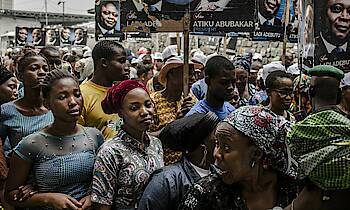
Before the presidential election in Nigeria
The campaign before the presidential election in Nigeria on February 16 has now reached its peak. According to observers, this ballot is crucial for the consolidation of democracy in the most populous country and the largest economy in Africa. What is at stake is simply explained: the incumbent President, Muhammadu Buhari of the APC (All Progressives Congress) is competing against the former Vice President Atiku Abubakar, who is a member of the Democratic People's Party (PDP), the largest opposition party.
Buhari could have an incumbent advantage, although former President Goodluck Jonathan - the man Buhari replaced in 2015 - also had an incentive bonus that he couldn't use. At the time, Buhari's promise to fight corruption, revitalize the economy, and improve security fell on fertile ground among voters disillusioned with Jonathan's poor performance. But although the Nigerians may not be as enthusiastic about Buhari as they were four years ago, his defeat would still be a significant setback: his image as an "honest man" gives him Abubakar, who is treated with suspicion and who is considered susceptible to corruption. a certain advantage.
There are several reasons why these elections are important. First, there are the fifth elections since constitutional law was reintroduced in 1999. For a country with a lamentable history of political instability, which has repeatedly suffered from post-election conflicts, military coups and counterrevolution, this is a promising development that needs to be promoted. And given that what's happening in Nigeria affects all of sub-Saharan Africa, the results are even more significant there.
These would be the second fair and credible elections in the country after 2015. Failing to achieve an acceptable result could lead to violent reactions, the impact of which would be difficult to predict.
Second, this would be the second fair and credible election in the country after 2015. Failure to achieve an acceptable outcome could lead to violent reactions, the impact of which is difficult to predict. In addition, the election takes place amid "growing tensions along ethno-religious and regional lines," said Chris Kwaja, a senior advisor to the United States Institute of Peace (USIP).
What is striking this year is unprecedented voter interest. With past governments unable to meet people's needs, citizens became aware of the need to register and finally elect capable civil servants. Many unemployed and impoverished young people who blame bad governments for their lot now want to influence their future. This has led to a sharp increase in the number of registered voters: According to the arbitration tribunal of the Independent National Election Commission (INEC), there are 84 million this year - compared to 70 million four years ago.
In view of this, the INEC is now facing a major challenge. In a country that is around 924,000 square kilometers three times the size of Germany, it must provide enough staff and materials. Failure to cope with this logistical nightmare could lead to protests before, during or after the elections.
The ubiquitous uncertainty across the country is even more worrying. The biggest threat to the elections appear to be the Islamist Boko Haram terrorists in the northeast. They are determined to hinder the elections and have therefore intensified their attacks against government forces and civilians. Hundreds of people have been killed in the past few months alone, and over 59,000 others have fled to camps set up for people displaced within the country.
The biggest threat to the elections appear to be the Islamist Boko Haram terrorists in the northeast. They are determined to hinder the elections.
And armed bandits are marauding in northwest Nigeria. They steal cattle, kidnap people for ransom and engage in other criminal activities. According to Nnamdi Obasi, a leading consultant with the International Crisis Group, the security situation is deteriorating "from alarming to tragic - and could even get worse".
The struggle between rural Fulani herders and farmers in the central northern zone could also help disrupt the election. The main reason for this conflict is that the usable pasture and agricultural areas are decreasing. However, there are also Christian-Muslim, north-south and ethnic lines of conflict that have long influenced Nigerian politics. The problem of false news could also become a spark that ignites a conflagration of violence. Violence between political parties has also increased - and even within them. And as if that weren't enough: in some parts of the country, security agencies are warning of the existence of arms stores set up by troublemakers to use during or after the elections. And the separatist organization of the Indigenous People of Biafra (IPOB) in the southeast of the country is calling for boycotting the presidential election.
To prevent unrest, INEC must prevent electoral fraud, financial interference, minor participation, multiple votes, and other crimes. Across the country, security measures must be high enough to create an atmosphere that encourages voters to vote. The military and the police also have to demonstrate a high degree of professionalism and impartiality.
Finally, influential members of Nigerian society also play a role in ensuring that elections are conducted peacefully - including clergymen, entrepreneurs, former heads of state and traditional tribal leaders. As in 2015, when they encouraged President Jonathan to congratulate the winner - a historic gesture that has greatly strengthened Nigeria's democratic development - they must now be ready to intervene if necessary.