x



Bukarest: Kunst der Wiederauferstehung
The artists and their works are like the capital of Romania itself: chaotic and warm.
«We have a love-hate relationship with Bucharest. There is enormous potential in the city, wonderful energy. But the incompetence of the authorities paralyzes everything. »Dragos Olea is a member of the Apparatus 22 collective, which is active in Bucharest, Brussels and Turin. There are no cultural infrastructures; on the map of contemporary art, Romania shines through its absence. «An unworthy situation because Bucharest is a unique place.
In the metropolis there is a wonderful coexistence of historical trends and different schools of architecture, »says the artist. The city is as chaotic as it is poetic and is home to struggling cultural workers who are among the loveliest in the world. Their only motivation is the passion, the members of this community try to recreate the art scene that was eradicated by Nicolae Ceausescu during the dictatorship.
Giuliana Nardin's art is only apparently naive.
With its location on the ground floor of the university library, Galateca is one of the few galleries that have a restaurant on the street. Under the direction of Andreea Sandu, the institution opened in 2012 has become the hub for transdisciplinary projects, concerts and other cultural events. «We are a people of survivors. We survived the Byzantine, Tatar and Ottoman invasions. And finally communism, which has destroyed our cultural heritage », says the co-responsible from Galateca. The slender red-haired woman continues: “To build our future, we need to know where we come from. That is why we started a project that explores our 3000 to 4000 year old history. »It bears the name Maïastra like the bird from the Romanian saga, which is reborn from its ashes. Maïastra is also the title of a famous series of sculptures by Nicolae Brancusi (1876-1957). The sculptor and national hero worked for eight years to capture the essence of bird flight in it. His abstract works paved the way for surrealism.
Brancusi is still the most important art reference of the population, which shows little interest in current work. For people, making music today still ends with Debussy (1862-1918), says Diana Rotaru, composer and professor at the conservatory. "It takes a lot of effort to convey the meaning of contemporary dance to people, for example." This is the reason why most Romanian artists, such as Florica Prevenda, are looking for an audience abroad. The artist commutes between Paris, New York and Brussels. However, she cannot make up her mind to leave her city. «It is often said that Romania is a Latin island in the Slavic Ocean.
The artist Florica Prevenda, who lives in Bucharest, grew up in communist Romania.
Bucharest was also called Little Paris. Whether I work here or there doesn't matter in our globalized world. ”This statement also fits her work on Net People - sculptures that are inspired by Facebook addiction. The people involved in art and culture all tell more or less the same story: their parents and grandparents were intellectuals and bourgeois who were persecuted by the communist regime. «In other countries of the former Eastern Bloc people speak relatively freely about this era. Not in Romania. Our parents still have this fear reflex. People want to forget », says Sandu.
In Bucharest, the artistic system is still young and not very articulated. Until 2002 there were no private galleries, the first auctions took place in 2008. There were no patrons, no foundations, maybe some philanthropic projects by large companies. Survival is difficult for artists and gallery owners. "You struggle through," says Sandu. In addition to her gallery, the entrepreneur runs an interesting boutique that presents works by local designers and artisans. Although the people of Bucharest are clearly struggling with problems, the visitor feels a lot of movement. The attitude towards life is reminiscent of East Berlin after the fall of the Berlin Wall in 1989. As in the German capital, abandoned factories and historical buildings overgrown with plants are converted into clubs, restaurants, idea laboratories and cultural centers. With the difference that the prices have not yet risen.
Nomadic workers find an excellent internet connection everywhere and mingle with the young, happy night owls. And this is far from the tourist crowds that come up elsewhere. Curious and pioneers meet ideal conditions in Romania. It takes some detective skill to find the galleries housed in private apartments. The solution is called Facebook. All addresses are entered there, the owners immediately reply to messenger messages. The visitor is warmly received and informed on site. For example in the H’art gallery. After we have arranged a meeting as mentioned above, Dan Popescu is waiting for us at the door of his five-room apartment, where a construction site is pointing out the upcoming exhibition. "The cheapest way is to exhibit an artist in your own apartment," says the former philosophy professor.
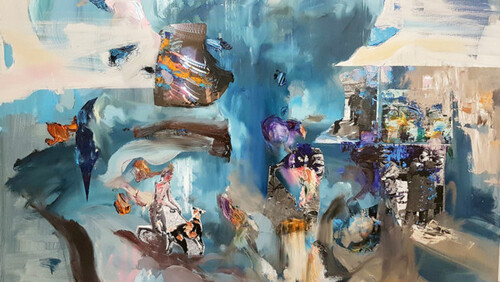
Liviu Miha creates strong, conceptual images with messages that should move the audience.
The conversation leads to the difficult definition of Romanian art. “Above all, it's the freedom to invent shapes. Our artists are inspired by the unbelievable combinations of styles that can be found here. »However, an uninformed public could think that something that is actually meant as a humorous contribution is bad taste, he says. Also in a private apartment, but this time in the basement, Galerie Mobius opens an exhibition by Roman Tolici. "We share the legacy of trauma that our parents and grandparents suffered during the time of communism with the artists of the former Eastern Bloc," says the artist, who comes from Moldova. There is also a complicated relationship with money: before 1989 it was unimportant. But that changed quickly. Still, a career like Jeff Koons would be impossible here, the forty-year-old says ironically.
Before we leave Bucharest, we visit the National Museum of Contemporary Art MNAC. It is housed in a wing of the brutalist former palace of the Ceausescu couple, which is now the seat of parliament. The museum is a curiosity. Until January 27th it shows a selection of its own collection. "Seeing History - 1947-2007", the title, presents works by official artists of the party up to the 1989 revolution as well as acquisitions that were subsequently made by the authorities. More than with their aesthetics, the works act as historical testimony for viewers who are ready to decipher them.