x




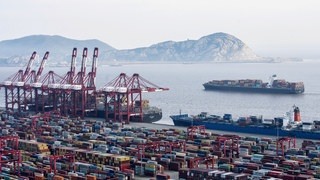
Chinas Wirtschaft Schwächstes Wachstum seit Jahrzehnten
The Chinese economy is growing as slowly as it has in almost 30 years: the trade conflict with the United States is weakening the world's second largest economy. In addition, "Made in China" is less in demand worldwide.
The growth of the Chinese economy has slowed down unexpectedly. In the third quarter of 2019, the world's second largest economy grew by only six percent compared to the same period in the previous year, as the statistics office in Beijing announced. This is the lowest level in around 30 years.
In total, the three quarters saw economic growth of 6.2 percent, which was lower than the government's targets for the year as a whole. This is between six and 6.5 percent. 6.4 percent had been achieved in the first quarter and 6.2 percent in the second. Experts actually expected 6.1 percent growth in the third quarter.
Uncertainty about trade agreements
Observers see the trade war with the US as the reason for the slowdown in the Chinese economy. The uncertainty among investors and the Chinese efforts to tackle growing debt are further causes of the slowdown in economic growth. "There is still a lot of uncertainty about a US-China trade agreement," said economist Ho Woei Chen of the United Overseas Bank in Singapore.
A few days ago, US President Donald Trump announced a partial settlement with China in the trade conflict. The US government agreed to waive the increase in tariffs on Chinese products from 25 to 30 percent, which was actually planned for Tuesday. However, Trump wanted to maintain the pressure to keep the threat that tariffs would apply to all products from China in mid-December.
China is, according to Trump's statement, ready to open up to US banks and financial service providers and to protect intellectual property in the future. China will also order $ 40 to $ 50 billion of agricultural products from the United States.
Asia Pacific Summit
Nevertheless, the danger is not averted: Both sides want to put an agreement on paper until Trump and China's head of state and party leader Xi Jinping meet at the Asia-Pacific summit in mid-November. However, there are still many ambiguities - this applies in particular to the level of China's agricultural imports from the United States. China is also demanding not only to suspend announced new US punitive tariffs, but to lift existing special taxes.
Weak domestic demand
However, the trade conflict with the USA is only gradually becoming apparent in the figures, such as in exports or investments in the manufacturing sector, said Max Zenglein from the Berlin China Institute Merics. The declining growth in China is also responsible for the lower global demand for goods produced in China. Domestic demand for goods also weakened.
"Almost all growth drivers are pointing down," said Liu Shengjun, vice president of China Europe International Business School (CEIBS) in Beijing. "In addition to investments and exports, consumption is also slowing." The government does not use large stimulus measures because it creates new problems such as over-indebtedness and bubbles.