x





The mathematical biologist will take over from Patrick Vallance to provide guidance for the prime minister and cabinet on science and technology policies.
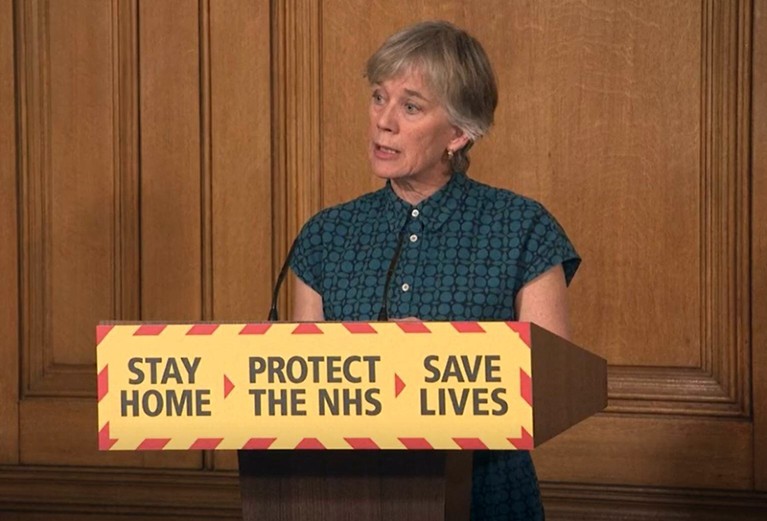
Angela McLean during a Downing Street media briefing on COVID-19 in 2020.Credit: PA Images/Alamy
Angela McLean, a mathematical biologist who helped to build models to study the spread of COVID-19, has been appointed as the UK government’s next chief scientific adviser.
She will take over from Patrick Vallance — who has held the role since 2018 and has appeared in many televised public briefings throughout the pandemic — on 1 April.
As chief scientific adviser, McLean will counsel the prime minister and his cabinet, the government’s most senior decision-making body, on science and technology policies. She will be the first woman to hold the role since it was created in 1964.
During the COVID-19 pandemic, McLean was a member of the Scientific Advisory Group for Emergencies (SAGE) and co-chaired the subgroup that used epidemiology, data analysis and mathematical modelling to guide the government’s response to the pandemic. Since 2019, she has been chief scientific adviser to the Ministry of Defence.
“I am delighted to take on this role at such an important time in our country for science, innovation and technology,” she said in a press release accompanying the announcement of her appointment on 20 February.
The move from Vallance to McLean “follows hot on the heels of other machinery-of-government changes”, says James Wilsdon, a research-policy specialist based at University College London. Two weeks ago, the government created a new department dedicated to science and technology. There is still a question mark over “where the lines of responsibility fall between ministers, senior officials in that department”, Wilsdon adds.
“There are expectations that [McLean’s] role will be quite broad,” says Joanna Chataway, a science-policy researcher at University College London. “It will address economic growth in the priority areas for the government of making science, technology and innovation really relevant to a broad economic and social infrastructure.”
McLean’s appointment also provides a chance to revisit the question of the diversity of forms of expertise in the advisory system, says Chataway. “We think about what COVID left us with, and what those decisions made at the time really meant, and we can see that it would have been good to have much more social-science expertise”, she says. McLean’s experience serving on SAGE “could put her in a really good position” to think about reforming the body.
The ongoing public inquiry into the government’s response to the COVID-19 pandemic offers an opportunity to reflect on what has worked well and what has not in the scientific advisory system, says Wilsdon. McLean will need to “step back from the immediate aftermath of that crisis and look afresh at how well our system is working, what can be done to strengthen it and make it fit for the challenges that lie ahead”.