x




Chemist Basant Giri designs inexpensive assays to test for contaminants and other health hazards in low-income countries.
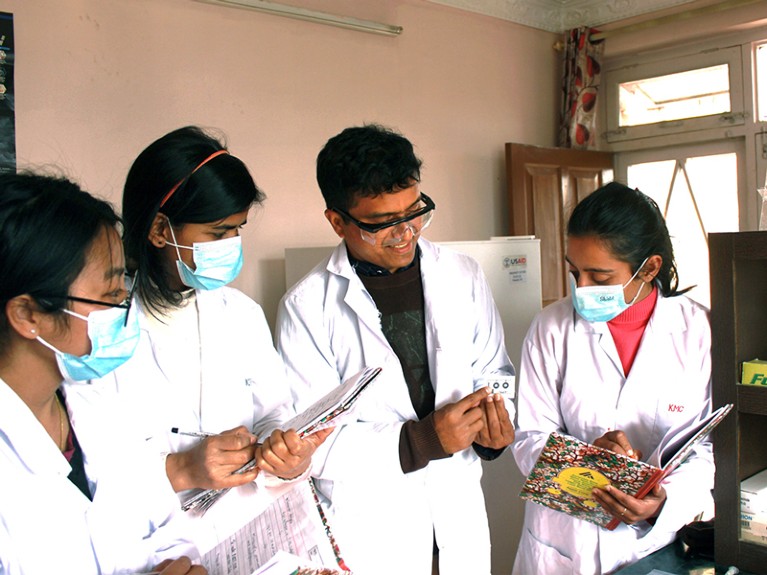
Basant Giri (second from right) shows a paper-based analytical device to students in his lab at the Kathmandu Institute of Applied Sciences in Nepal.Credit: Kranti Acharya/Kathmandu Institute of Applied Sciences
While working on his PhD at the University of Wyoming in Laramie in early 2010, Basant Giri worked with a microfluidic chip, a device half the size of a credit card that can channel the flow of a tiny amount of fluid for early cancer screening. Giri found that these minuscule devices could detect cancer biomarkers using 100-fold lower sample volumes than those required by conventional, bulky laboratory equipment1.
After returning to his home country Nepal in early 2014, Giri’s fascination with the potential of tiny devices stayed with him. Giri is a co-founder of the Kathmandu Institute of Applied Sciences (KIAS), and he and his team have designed paper-based devices that use analytical chemistry to test everyday items such as water, drugs and vegetables for contaminants. The paper device changes colour when it is exposed to specific molecules — similar to a litmus pH test. The tool is cost-effective, simple to customize and portable, so it can be readily used and has huge potential in some low-income countries, where many people still get sick from drinking contaminated water, eating food with high levels of pesticide residue or taking counterfeit medicines.
Giri aims to combine paper-based chemical analysis with smartphones to help millions of people to avoid health hazards. He describes how the development of an inexpensive, convenient and multipurpose device for testing in daily life could have a significant impact on public health.
During my master’s research at Tribhuvan University in Kathmandu, I studied ion-selective electrodes, a device for measuring the activity of ions in a solution. During my PhD, I delved further into the field through my work in microfluidics, which combines analytical chemistry with engineering and clinical instrumentation. This experience solidified my decision to pursue a career in analytical chemistry, because I saw the potential for employment in industries such as pharmaceuticals, biotech and petroleum. I was also excited about how my training could improve life for others, from testing fluoride levels in toothpaste to arsenic levels in drinking water.
In early 2014, I returned to Nepal and joined the Nepal Academy of Science and Technology as a research fellow, but I quickly realized that working in a government body would not allow me to lead research projects of my own expertise and design. I was not alone in this realization — many colleagues who had studied abroad and returned to Nepal had the same desire.
We had two options: either to head abroad and work with foreign institutes, or to stay and start an independent research institute. My colleagues and I decided to pursue the latter, and discussed ways to establish such a research centre. In August 2014, 14 co-founders formally established KIAS.
We started by collecting 15,000 Nepalese rupees (about US$110) from each co-founder to cover the initial legal and office expenses. Then, we secured a few thousand dollars through international grants that helped to set up lab and working space. I brought a full suitcase of used equipment from a professor’s lab at the University of Wyoming. This gave us the necessary equipment to kick-start our work.
My work in Wyoming revolved around advanced techniques to detect biomarkers. But in Nepal, I faced challenges of limited technology and funding. I decided to explore paper-based devices in my research. Because paper is a cost-effective and widely available material, paper-based devices are easier to design than are those made of polymers or glass-based materials. This allowed me to continue to work on analytical devices with similar capabilities, but with fewer resources.
It is a filter, or cellulosic, paper that is loaded with specific chemicals and reagents. It functions similarly to a COVID-19 rapid antigen test. For example, to use it for drug-quality testing, there are 13 lanes pre-loaded with different chemicals. When a drug sample is placed on the paper device, the drug’s active and inactive ingredients or degradation products react with the chemicals in the lanes and change colour. By looking at the overall pattern of colours, it is possible to tell whether the sample is genuine. In another test, a similar colour change can signal that there are pesticide residues on vegetables.
Smartphones are an everyday tool in households even in low-income countries, making them an ideal platform to do signal detection. The paper device’s colour change can be difficult for the human eye to discern accurately, so we have developed a smartphone application that analyses the colour change and indicates whether the vegetable is safe to eat.
Our ultimate goal is to design a portable, compact device, similar to a pencil case, that contains all the necessary chemicals for testing water and food quality. In 20 years, we want this tool to be in every household, allowing people to easily test food quality in their kitchens.
Researchers in Nepal face many hardships, including lack of funding, difficulty in retaining trainees and logistical barriers, such as supply and repair delays. Money is a major challenge, because government funding is minimal and university funding does not extend to research institutes such as KIAS. We must compete for funding through international grant programmes, which can be unpredictable. Recruiting and retaining early-career researchers is also challenging, because many lab-trained students leave the country.
At KIAS, I have trained approximately 30 students so far, and my approach is to give them broad research problems and encourage them to explore solutions independently, while providing guidance and support. I also push students to present papers, write grant proposals and publish research papers. Furthermore, I urge students to seek opportunities abroad. I firmly believe that there are no boundaries when it comes to conducting science.