x




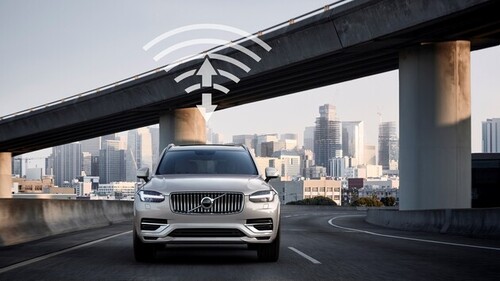
C-V2X: Volvo testet 5G im Auto für die Markteinführung 2021
With the Scalable Product Architecture 2, Volvo wants to offer 5G in its vehicles for the first time. The platform is to celebrate its premiere in 2021 with the new XC90. The first tests for C-V2X are already taking place in China with the local mobile operator China Unicom.
The first generation scalable product architecture (SPA) has been used at Volvo since the introduction of the second generation XC90 in 2014. Vehicles such as the S90 and V90 as well as the smaller models S60, V60 and XC60 are also based on the platform. The predecessor was the P3 platform from the Ford partnership.
The SPA2 with the third generation of the XC90 is to be launched next year. Then Volvo wants to offer 5G connectivity in its vehicles for the first time, in order to handle C-V2X, i.e. Cellular Vehicle to X, using the new mobile communications standard. With the SPA2, autonomous driving according to Level 4 should also be introduced.
C-V2X is used, for example, to allow vehicles to communicate with each other, but also for communication with the infrastructure such as traffic lights, parking lots or traffic cameras. C-V2X also integrates people with their smartphones into the network of the car.
China Unicom and Volvo are testing 5G-V2X
In China, Volvo is currently testing C-V2X based on 5G with the locally based mobile operator China Unicom. In addition to China Mobile and China Telecom, China Unicom is the third largest of the three state-owned mobile operators.
Volvo and China Unicom are testing the potential benefits of 5G's higher speed and lower latency. 5G also enables a significant concentration of participants per cell, so that more vehicles can communicate with each other. The two companies expect improvements in the areas of safety, sustainability, customer comfort and autonomous driving.
The vehicle could be informed of a high volume of traffic or a construction site in good time so that the speed could be reduced or an alternative route taken. This in turn could increase safety and reduce stop-and-go situations, which would reduce consumption and thus the environmental impact. Traffic cameras could help find free parking spaces, while connected traffic lights could allow longer green waves. When it comes to vehicle-to-vehicle communication, Volvo sees better traffic flow and increased safety potential for driving up and down the highway.
China is driving 5G expansion
C-V2X requires a nationwide mobile network coverage and, in addition to 5G, is also possible with LTE (LTE-V2X). Regarding 5G availability in China, 86,000 mobile phone locations in 50 cities in the country were put into operation at the beginning of the new standard at the beginning of November last year. By the end of 2019, 130,000 base stations are said to have been built. Just a few days ago, the 141 km long section of the Guangzhou – Shenzhen – Hong Kong Express Rail Link high-speed train was fully supplied with 5G.