x




Experiments suggest that sleep doesn’t cut you off from the outside world as much as scientists had thought.
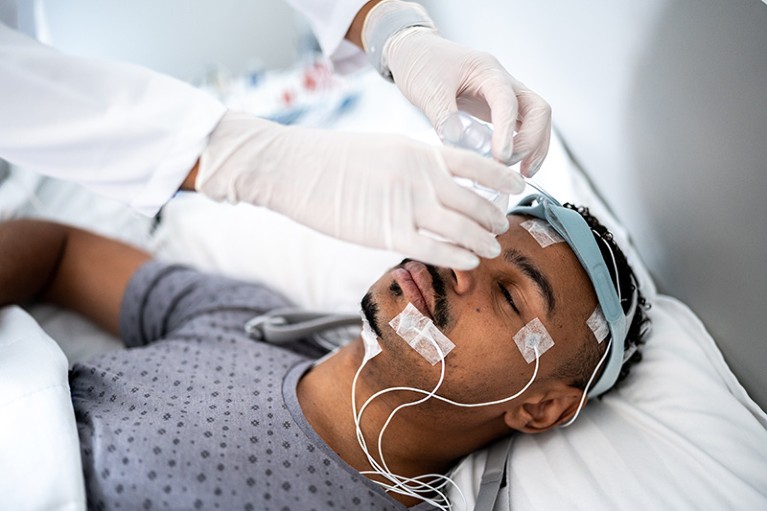
Sleep studies often involve measuring the electrical activity in a person’s brain using electroencephalography.Credit: Getty
Scientists once considered sleep to be like a shade getting drawn over a window between the brain and the outside world: when the shade is closed, the brain stops reacting to outside stimuli.
A study published on 12 October in Nature Neuroscience1 suggests that there might be periods during sleep when that shade is partially open. Depending on what researchers said to them, participants in the study would either smile or frown on cue in certain phases of sleep.
“You’re not supposed to be able to do stuff while you sleep,” says Delphine Oudiette, a cognitive scientist at the Paris Brain Institute in France and a co-author of the study. Historically, the definition of sleep is that consciousness of your environment halts, she adds. “It means you don’t react to the external world.”
A few years ago, however, Oudiette began questioning this definition after she and her team conducted an experiment in which they were able to communicate with people who are aware that they are dreaming while they sleep — otherwise known as lucid dreamers. During these people’s dreams, experimenters were able to ask questions and get responses through eye and facial-muscle movements2.
Karen Konkoly, who was a co-author on that study and a cognitive scientist at Northwestern University in Evanston, Illinois, says that after that paper came out, “it was a big open question in our minds whether communication would be possible with non-lucid dreamers”.

Sleep loss impairs memory of smells, worm research shows
So Oudiette continued with the work. In her latest study, she and her colleagues observed 27 people with narcolepsy — characterized by daytime sleepiness and a high frequency of lucid dreams — and 22 people without the condition. While they were sleeping, participants were repeatedly asked to frown or smile. All of them responded accurately to at least 70% of these prompts.
Overall response rates were higher for all participants during REM (rapid eye movement) sleep, when the deepest sleep occurs but the brain remains quite active, than during other sleep stages. The researchers tracked participants’ brain activity during the experiments using electroencephalography (EEG), which captures signals from electrodes placed along a person’s scalp.
What this shows is that “you have some physiological states that are more favourable to opening the [window shade] to the external world”, Oudiette says.
Using similar experiments, researchers might gain a better understanding of various sleep disorders, including insomnia and sleep walking, she says. And they might begin to identify the parts of the brain that are active during sleep, and how those relate to consciousness.
This study is part of a larger evolution in the field of sleep research, says Mélanie Strauss, a neurologist and cognitive scientist at Erasmus Hospital in Brussels, Belgium. Researchers are moving away from monitoring sleep mainly with EEG and towards “fine grained” approaches that combine EEG with various tasks and stimuli — a strategy that could help to shed light on specific diseases or conditions, she says.