x





Sediment dislodged by ocean-floor mining could disrupt jellyfish metabolism, potentially causing the animals serious harm.
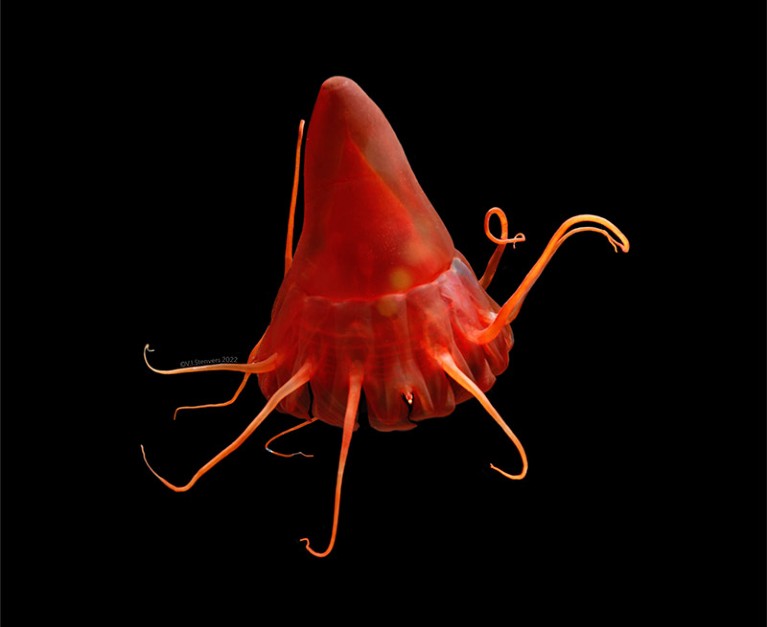
A helmet jellyfish (Periphylla periphylla) collected with a remotely operated vehicle in the North Pacific Ocean.Credit: Vanessa Stenvers
Mining of the ocean floor for minerals could harm deep-sea jellyfish, according to the first study1 of mining impacts on animals living in the water column. The study suggests that sediment stirred from mining sites could activate potentially damaging stress responses in the jellyfish.
Commercial harvesting of the sea floor for minerals such as cobalt and manganese could soon get the green light; proponents say that it is needed to support the manufacturing of electric-vehicle batteries and other electronics. But scientists warn that too little is known about its potential impacts on deep-sea ecosystems.
Until now, most deep-sea research has focused on mining’s effects on the seabed, says Patricia Esquete Garrote, a deep-sea ecologist at the University of Aveiro in Portugal. “The water column is not very well understood. So, any studies that come from there are golden,” she says.
The study, co-led by Vanessa Stenvers, a marine ecologist at the GEOMAR Helmholtz Centre for Ocean Research Kiel in Germany, analysed deep-sea helmet jellyfish (Periphylla periphylla) collected from several Norwegian fjords where the animals regularly congregate. In testing tanks on board their research ship, Stenvers and her team exposed 64 jellyfish to five concentrations of sediment representative of what the animals could experience at a mining site, ranging from zero as a control up to 333 milligrams per litre (mg/l).
At sediment concentrations above 17 mg/l, the jellyfish showed signs of acute stress. Sediment particles stuck to the animals’ bodies, and they produced excessive amounts of mucus — a common stress response for cnidarians, the phylum to which jellyfish belong. On average, more than 30% of the animals’ bodies were covered in mucus after being exposed to the two highest sediment concentrations for 24 hours. Producing mucus uses a lot of energy, which could be harmful for the health of jellyfish if they are exposed to sediment over extended periods, say the researchers.
“Food in the deep sea is very scarce. If there’s no extra energy coming in; this could potentially lead to starvation,” says Stenvers.
She and her colleagues also found that jellyfish doubled their respiration rate at the highest sediment concentrations, suggesting that the animals required more energy than they would otherwise need. Jellyfish that produced excessive mucus also overexpressed genes involved in energy metabolism, wound repair and the immune system.
If other gelatinous organisms in the deep ocean respond similarly, commercial harvesting of the sea floor could reduce biodiversity and threaten crucial functions of the ecosystem — such as carbon sequestration and nutrient cycling.