x





Dogma-defying bacteria package DNA in unusual ways
Some bacteria appear to encase their genomes in proteins called histones — which weren’t thought to exist in bacterial cells.
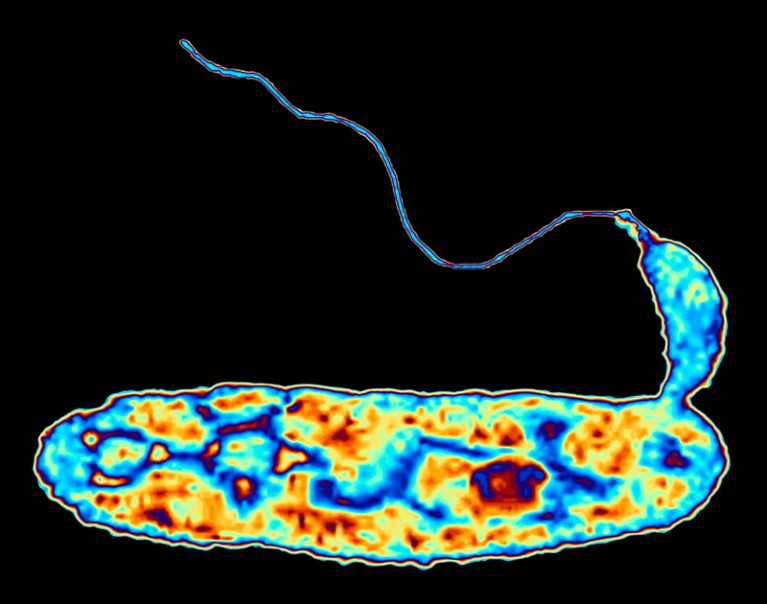
The predatory bacterium Bdellovibrio bacteriovorus infiltrates larger bacteria and digests them from within.Credit: Alfred Pasieka/Science Photo Library
A startling discovery in bacteria suggests that some species have a bizarre way of packaging chromosomes and regulating gene expression — using proteins that, until recently, weren’t thought to exist in bacteria at all.
In a preprint posted on bioRxiv on 26 January, researchers report the characterization of proteins called histones that, in two bacterial species, seem to bind together to coat regions of the bacterial chromosome1. This is completely different from the arrangement of histones seen in other organisms. For example, in organisms called eukaryotes, whose cells have a membrane-bounded nucleus, DNA winds around histones, rather than being encased by them.
Although histones are vital tools for maintaining chromosome structure and controlling gene activity in eukaryotes and microorganisms called archaea, for years it was widely assumed that they did not exist in bacteria.
As more bacterial genome sequences became available, the discovery of sequences characteristic of histones challenged that assumption2. “But nobody had ever characterized them or done functional studies,” says Remus Dame, a biochemist and microbiologist at Leiden University in the Netherlands. “This is definitely something new and interesting.”
Eukaryotic histones are remarkably uniform in their structure and function — a consistency that can be frustrating for researchers who want to study histone evolution, says biochemist Karolin Luger at the University of Colorado Boulder. “If you want to get at the evolutionary origin, you can’t go to a ‘primitive’ eukaryote,” she says. “It already has everything.”
The lack of diversity also raises questions for synthetic biologists in search of new ways to control gene expression, says Tobias Warnecke, a molecular evolutionary biologist at Imperial College London. “The fundamental composition of the chromatin and how gene expression works is very similar across eukaryotes and then you start wondering, ‘is that a frozen accident?’” he says. “Is there something special about histones that makes them unique, or can we build systems in a different way?”
Recent explorations of archaeal histones have yielded more diverse systems, and Warnecke and Antoine Hocher, a systems biologist also at Imperial College, decided to see what surprises bacterial histone-like proteins might hold. Together with Luger and other collaborators, they studied the proteins from two species that can be readily grown in the laboratory: the pathogen Leptospira interrogans and a predatory bacterium called Bdellovibrio bacteriovorus. This infiltrates larger bacteria and digests them from within, chopping up its prey’s DNA and proteins for use as building blocks to replicate itself.
When the researchers isolated the histone protein from B. bacteriovorus and analysed its structure, both on its own and while it was interacting with DNA, they were surprised to find that it did not behave like any known histones from archaea or eukaryotes. The bacterial histones came together in pairs that surrounded the DNA strand. Long chains of these could act as a shield around the DNA, a marked difference from their function in eukaryotes, in which histones group together to form a spool around which the DNA winds. “I was blown away,” says Luger.
It’s a striking finding, but it still isn’t clear whether that structure reflects how histones and DNA interact in the bacterial cells, or whether it’s an artefact of working with the isolated proteins in the laboratory, says Dame.
For now, researchers can only speculate as to what the histones might be doing, and how their unusual mode of action might help the bacteria survive. For B. bacteriovorus, the histones could be protecting the DNA from picking up stray pieces of the fragmented genomes of its prey, says Warnecke.
The bacterium is also known for having tightly packed DNA during its free-swimming phase, before it infects its prey, notes Géraldine Laloux, a microbiologist at the Catholic University of Louvain in Belgium. “We have been wondering what drives this very strong compaction and how it de-compacts,” says Laloux. “This unique way of binding the DNA could bring new insights into this.”
As part of their study, the researchers surveyed thousands of bacterial genomes. They found histone-like proteins in about 2% of the genomes, which suggests that there will be many other systems to study. “People got excited and said ‘oh, bacteria weren’t supposed to have histones’,” says Warnecke. “But if you work on microbial evolution, you know that if you look hard enough, you’ll find some.”