x





Mathematical biologist, philosopher and historian of science who challenged the vision of science as a masculine activity.
Credit: Rick Friedman/Corbis via Getty
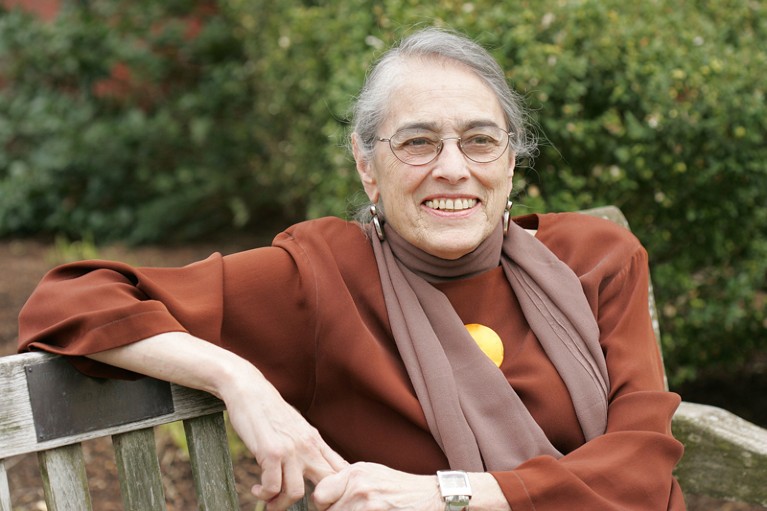
Evelyn Fox Keller achieved prominence for her studies on gender and science, the role of language in shaping how we see and study the world and her analysis of key concepts in modern biology, such as the gene. Keller tackled the fundamental question of how scientific knowledge is created and challenged entrenched gendered assumptions about science. Her work on how modern science constructed objectivity in a way that devalued traits conventionally considered feminine was groundbreaking. It opened up possibilities for developing a better way of doing science.
Keller also contributed to the history and philosophy of modern biology, through conceptual analyses of genetics and developmental biology. She proposed abandoning the idea that genes are master molecules that provide the blueprints for and direct the development of an organism. She called, instead, for a recognition of the genome’s complexity. She championed approaches that paid attention to the complex, dynamic and profound ways in which genes, organisms and the environment interact at different levels. Keller also showed how language, including people’s choice of metaphors, influences the directions of scientific research.
Born in New York City into a Russian immigrant Jewish family, Keller was the youngest of three siblings, who all became academics. After obtaining a physics degree at Brandeis University in Waltham, Massachusetts, in 1957, she attended Harvard University, in Cambridge, Massachusetts, to pursue theoretical physics. Discouraged by rampant sexism and lack of support in the department, she began following the exciting developments in molecular biology that her brother was studying, and decided to pursue mathematical biology. She earned her PhD in 1963, then moved to New York and took a series of part-time teaching and research positions. In 1972, the State University of New York at Purchase offered her a post that enabled her to pursue interdisciplinary scholarship.
Juggling marriage, motherhood and a job proved difficult without the support of other academic women. This experience raised her feminist consciousness and encouraged her to see science as a human institution shaped by the gendered roles common in broader society. In turn, her feminism shaped her vision of science.
Why were there so few female scientists? Why was science considered a masculine enterprise? Reflecting on these issues, Keller embarked on two projects: her studies on gender and science, and her biography of US geneticist Barbara McClintock. In A Feeling for the Organism (1983), one of the earliest contributions to the history of women in science, Keller explored how McClintock’s ability to view the genome as a whole enabled her to uncover phenomena, such as the transposition of genetic elements in maize (corn), that had not even been imagined before.
In Reflections on Gender and Science (1985) Keller challenged the historical definition of science as masculine, and the exclusion of what had been categorized as feminine (emotions and subjectivity). She proposed a different approach, called dynamic objectivity, which would allow for the acceptance of a researcher’s subjectivity.
How centuries of sexism excluded women from science — and how to redress the balance
Keller’s work on gender and science encountered some criticism, but it became influential. Her biography of McClintock received much attention when its subject received the Nobel Prize in Physiology or Medicine months after the book’s publication. Keller contributed to the growing body of studies that showed why scientific ideas and practices needed to be studied in their sociocultural context. Many scholars have built on her insights about language and science. Others have revealed how scientific objectivity has been understood in different ways throughout history. Her academic recognition led to professorships at the University of California, Berkeley, in 1988, and at the Massachusetts Institute of Technology in Cambridge, where she worked from 1992 until her retirement.
In the latter part of her career, Keller examined major concepts in modern biology. Her books Refiguring Life (1995), The Century of the Gene (2000) and Making Sense of Life (2002), showed how progress in science requires not only empirical studies but also the constant revision of concepts that constrain how we understand nature. Notably, she called for a rejection of the conception of genes as units of heredity that determine traits. In The Mirage of a Space between Nature and Nurture (2010), she argued that the nature-versus-nurture debate rested on problematic ambiguities and concepts that obscure the complex ways in which organisms interact with their environments.
Keller cherished her intellectual independence, as was evident in her lack of disciplinary identification and in her working style. After critically examining one area, she quickly moved on to explore other issues. Although recognizing that her approach had some drawbacks, she also thought that it had enabled her to go directly to the core of a problem.
Keller’s confidence that women could tackle the frontiers of science and the humanities was inspirational for younger generations. She drew our attention to language, metaphors, gender and subjectivity, and showed that these were relevant to science. Although Keller was sometimes mistakenly seen as a critic of science, she succeeded in her goal: to articulate fairer and better ways of living and doing science.