x





A small fraction of Earth’s surface bears almost all of the environmental stresses resulting from industrial salmon and chicken farming.
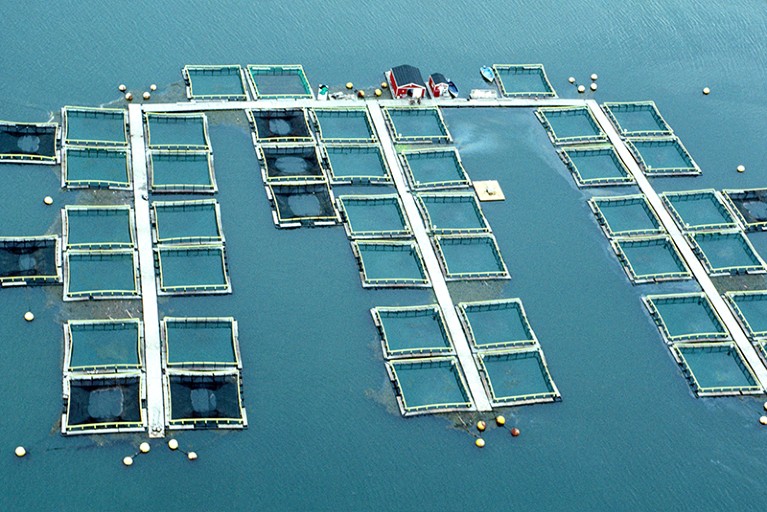
Plenty of fish in the sea: a salmon farm in Canada.Credit: Michele and Tom Grimm/Alamy
Industrial chicken and salmon farms are found around the world, but nearly all of the environmental burden of these operations is concentrated on geographical hotspots, according to a study1.
The work, published on 13 February in Current Biology, is the first to map the environmental pressures of farmed chicken and salmon on a global scale. It suggests that less than 5% of Earth’s surface bears 95% of the cumulative environmental burden of chicken and salmon production — a finding that could be used to inform agricultural policy.
“Are we better off to have really high impacts concentrated in a very small area or low impacts widely distributed?” asks Peter Tyedmers, an ecological economist at Dalhousie University in Halifax, Canada, who was not involved in the study. He doesn’t think a clear answer emerges from the study, but says the work sets up the question.
To calculate the environmental footprint of farmed chicken and salmonids, which include salmon, marine trout and Arctic char, the researchers examined four types of ecological threat — greenhouse-gas emissions, water use, habitat disturbance and nutrient pollution from fertilizers and animal waste. They estimated the effects of both chicken and salmon farming in each category, then mapped the combined footprint of these four threats.
Both chicken and salmon farming exert some level of environmental pressure around the globe, but 95% of those pressures are concentrated on less than 5% of Earth’s surface, the researchers found. Hotspots include regions of the Midwestern United States, Brazil, Europe, India and China, and coastal areas of South America, West Africa and southeast Asia.

What humanity should eat to stay healthy and save the planet
Roughly 85% of the area facing threats from salmon production also faces threats from chicken production. This overlap is probably the result of the same ingredients, such as soya and fishmeal, being used to produce feed for both animals. “A lot of people, when they’re eating chicken, might think about the terrestrial footprint, but they don’t realize that chicken [farming] actually has a big footprint in the ocean,” says study author Caitlin Kuempel, a conservation scientist at Griffith University in Nathan, Australia.
According to some of the metrics that Kuempel and her colleagues considered, global chicken production is more environmentally efficient than salmon production. Overall, chicken farms cause 10 times more habitat disturbance and 20 times more nutrient pollution than do salmon farms, but they yield 55 times more product, the researchers found (see ‘By land or by sea’). That’s partly because chickens take only 6–8 weeks to reach the size at which they are slaughtered, whereas salmon take 1–2 years.
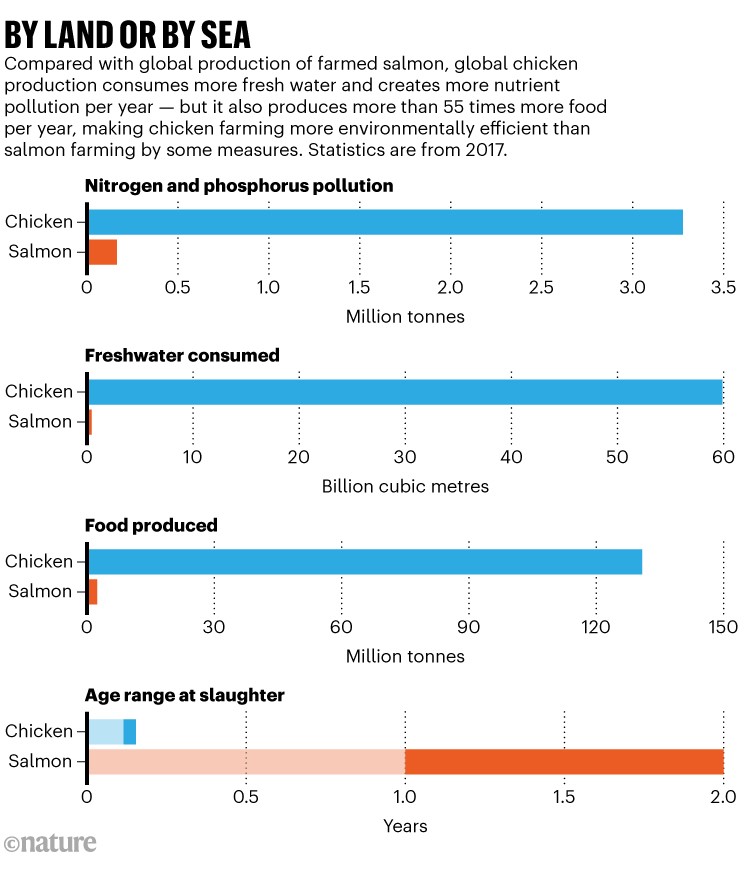
Source: Ref 1.
However, Tyedmers cautions that the comparison of aquatic and terrestrial footprints is challenging. Unlike farms, which displace native animals and plants from their habitats on land, fisheries typically leave many organisms in the water.
Moreover, both salmon and chicken are better for the planet than many other meat products, Tyedmers adds. “Trying to reduce it to a fight of high-performing proteins is a dangerous exercise when the alternative is people might go back to eating beef.”
In an e-mail, Kuempel concedes that more work is needed to better compare environmental footprints on sea and land. But she notes that the analysis accounted for the fact that marine wildlife disturbed by farming tend to recover, whereas habitats and species affected by farming on land generally don’t.
Kuempel also says that the study was meant to compare the footprint of a land-based food with that of an ocean-based food, rather than to pit the two proteins against each other. “The goal of the study was not to advise people to eat one or the other,” Kuempel says. But she agrees with Tyedmers that salmon and chicken are among the most sustainable meat products on the food market.