x





The record-setting Mars helicopter Ingenuity broke during a final, fatal flight.
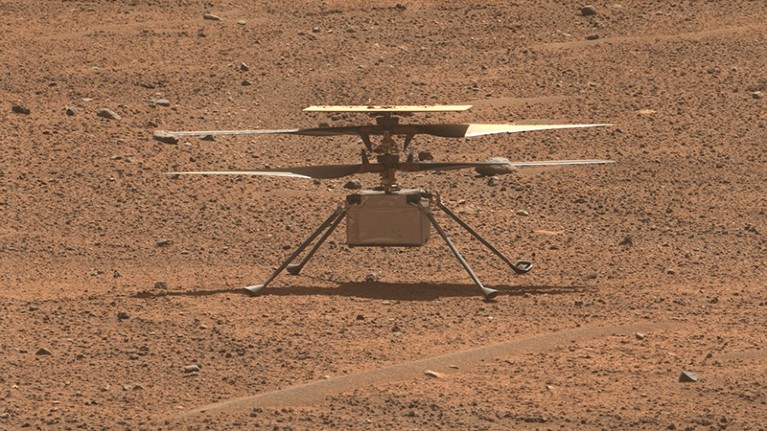
The Mars helicopter Ingenuity propels itself with two blades that are 1.2 metres in length.Credit: NASA/JPL-Caltech/ASU/MSSS
NASA’s Ingenuity helicopter, the first aircraft to fly on another world, has died. It perished on 18 January during its 72nd flight in Jezero Crater on Mars. Ingenuity was nearly three years old (if you count its time on the red planet).
The helicopter, a box-shaped drone with a pair of 1.2-metre-long carbon-fibre blades, was a trailblazer for interplanetary spacecraft. NASA’s Jet Propulsion Laboratory (JPL) in Pasadena, California, built it as a test to see whether powered flight was possible in the thin atmospheres of other worlds. It accompanied NASA’s Perseverance rover to Mars, where both landed in February 2021 and began studying Jezero.
“Ingenuity absolutely shattered our paradigm of exploration by introducing this new dimension of aerial mobility,” says Lori Glaze, head of NASA’s planetary sciences division in Washington DC.
Ingenuity was supposed to make only five flights and last about a month, but ultimately it traversed 17 kilometres of the red planet and flew for a total of nearly 129 minutes between 2021 and 2024. During its final journey, something fatal happened — perhaps the rotor blades striking the ground, NASA announced on 25 January. An image that the helicopter took of the ground after the flight ended shows the shadow of one of the blades, with at least one-quarter of it missing. The helicopter can still communicate with Earth, at least for now, but it will not fly again.
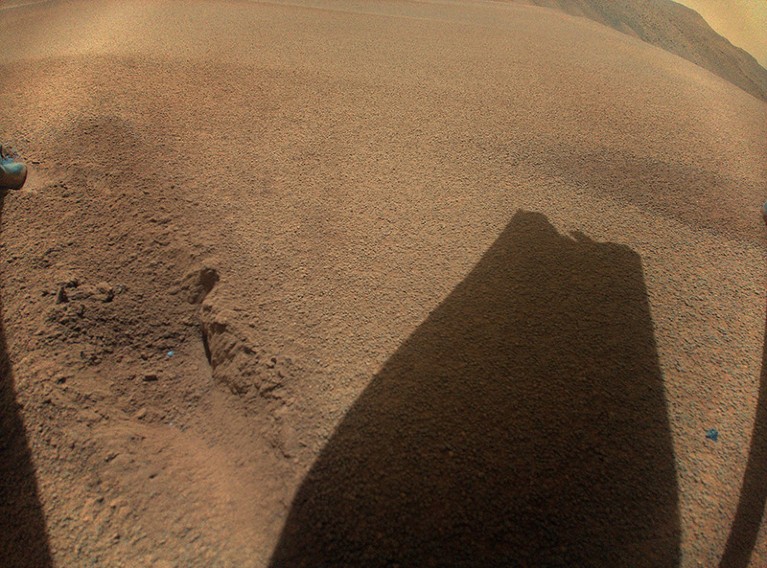
After Ingenuity’s last flight, it took this picture looking down at the Mars soil. The shadow of its damaged blade is visible.Credit: NASA/JPL-Caltech
Future planetary missions might use the aerial lessons learnt from Ingenuity. “This type of mobility can take us to places we never dreamed we’d be able to explore,” says Laurie Leshin, director of JPL. NASA is already building an eight-rotor helicopter to explore Saturn’s moon Titan, a mission that will launch as early as 2028. And engineers at JPL have been working on advanced helicopter designs for some future Mars mission that could carry large payloads, and could explore places such as cliffs and canyons that other spacecraft cannot reach.
Ingenuity enabled science while on Mars, in part by allowing researchers to study how its blades kicked up dust clouds into the red planet’s thin atmosphere. It also served as something of a sidekick to Perseverance, often flying ahead of the rover’s planned path to scout the landscape for potential obstacles. Sometimes, however, the rover drove much more quickly than the helicopter could fly, and Perseverance had to wait for Ingenuity to catch up.
NASA’s Jet Propulsion Laboratory, which built Ingenuity, pays tribute to the helicopter’s journey in this video.
Ingenuity died on top of an ancient river delta in Jezero, several hundred metres northwest of the rover’s current location. The goal for both spacecraft was to explore billions of years of history in the crater, in particular whether it was ever home to Martian life. Perseverance has travelled more than 24 kilometres while collecting cores of rock and dirt from geological settings in the crater. It has gathered 23 cores so far; 10 are sitting on the surface in a storage depot, awaiting a future mission to pick them up. The rest are still on board the rover.