x





Computational model uses sea-surface temperatures to predict when whales and turtles are likely to get stuck in fishing gear.
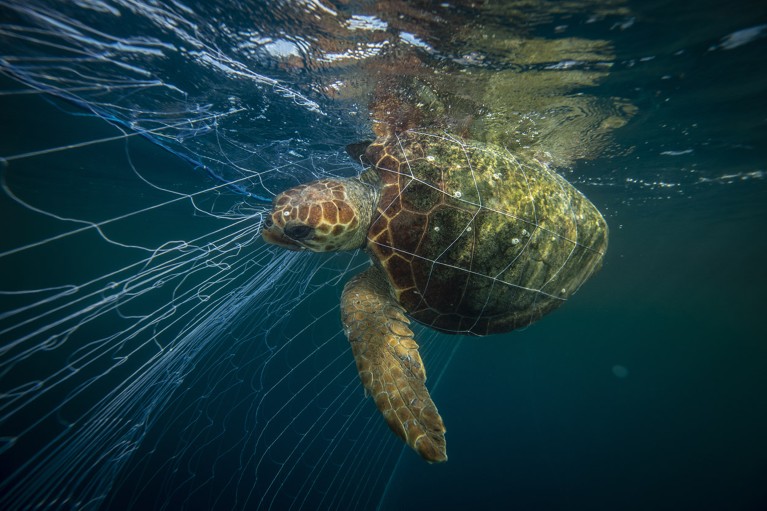
Loggerhead sea turtles can be killed if they are caught in fishing nets. Credit: Sebnem Coskun/Anadolu Agency via Getty
Researchers have developed a way to forecast when whales and turtles are likely to get entangled in fishing gear — up to a year in advance. The technique, published in Nature Communications1 on 5 December, could protect the animals and benefit fisheries.
Researchers have previously developed ways to predict how heatwaves will affect the distribution of wild fish and productivity of fish farms. But few forecasting tools have focused on protecting marine animals from hazardous human activities such as fishing.
“There’s a lot of power in a forecast approach,” says marine ecologist Stephanie Brodie at the Commonwealth Scientific and Industrial Research Organisation in Brisbane, Australia. The technique Brodie and her colleagues have developed can help both conservationists and those trying to make fisheries sustainable, she says. It is also more accessible to researchers than previous methods.
Ecological forecasting models can predict where marine animals are likely to be using sea-surface temperatures. Previous forecasting tools often require researchers to infer sea temperatures in a specific region at a high resolution from lower resolution global data — which is a complex process that requires powerful computers, says Brodie.
Instead, Brodie and her team have shown that they can use widely available, low-resolution, global forecasts of sea-surface temperature to accurately predict when whales are likely to swim near the shore off the coast of California, where a local fishery lays down crabbing pots on the seabed from around November to June. Ropes extending upwards from these pots pose a risk to the animals.
“That rope gear is what whales can get entangled in,” says Brodie. This can cause rubbing injuries on their fins, mouth or tail, preventing them from diving, feeding and sometimes killing them, she says.
To avoid this, the local crab fishery currently uses the past month of sea-surface temperatures in this region to make monthly decisions on whether crabbing can go ahead on the basis of whether a current of cold, nutrient-rich water — which attracts whales — has been compressed towards the shore.
This phenomenon is quantified using a metric called the Habitat Compression Index (HCI). When this value falls below a certain threshold, whales are likely to move inshore, and fishers suspend crabbing. But this leaves little time for the fishers to adapt to the economic impacts of fishing closures, says Brodie.
The team found that using global temperature forecasts to calculate the HCI for each month — over a 33-month heatwave in 2015 — allowed them to accurately forecast when the whale’s habitat was compressed towards the shore up to 11.5 months in advance.
The researchers studied another local fishery that deploys floating fishing nets, and uses the past 6 months of unusual sea-surface temperatures to decide whether loggerhead turtles are at high risk of getting caught in the nets in the same region. Turtles tend to track warmer waters, so if the waters where people fish are warmer the fishery may close, says Brodie. “When turtles get caught in those nets it could strangle them, or stop them being able to move and feed,” says Brodie.
The team found that they could use forecasts for global sea surface temperatures to accurately predict when closures were necessary to protect turtles during the 2015 heatwave, also up to 11.5 months in advance.
“These results raise optimism for reliable ecological forecasts in regions for which high-resolution local ocean models may not be available,” says marine ecologist Kathy Mills at the Gulf of Maine Research Institute in Portland. “As ocean resource users, managers and communities make decisions, they need relevant, timely, and reliable information,” especially amid climate change and increasingly frequent marine heatwaves, she adds.