
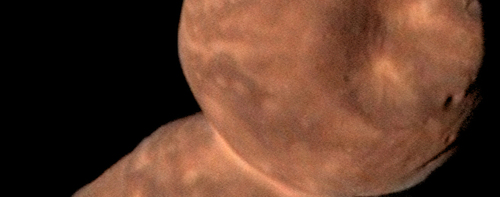

Photos have long been nothing special. Mobile phone out, press the button, off to Instagram. Only a few stand out and have lasting value. This is certainly one of them: the inclusion of an object in the Kuiper belt , which for a time was called "Ultima Thule" and has been referred to as "Arrokoth" since November, which is the extinct language of the indigenous population in the east of today's US state Virginia's "sky" means.
It is the most distant object that has so far been explored up close by a research probe, and it is also the most original. Since its formation in the early phase of the solar system a good four billion years ago, it has changed very little, say the researchers of the Nasa probe “New Horizons”, which Arrokoth has visited.
If the assessment is correct, the mission data allow a unique look into the past and help to understand how the first planetary building blocks developed in the dust disk that surrounded the young sun.
Unique pictures from 3500 kilometers away
The shot of Arrokoth was made on New Year's Day in 2019 . Since its launch in January 2006, New Horizons has been traveling to the outskirts of the solar system. In July 2015, the probe delivered sharp images of Pluto for the first time and received a mission extension to search for additional objects in the Kuiper belt - including Arrokoth, which is 44 times further away from the sun than Earth .
From a distance of “only” 3,500 kilometers, the probe took the first pictures and sent tons of measurement data to Earth. The research teams are now presenting the evaluation of the material in three articles in the " Science " magazine .
The shape is striking. Because of the two knobs - 13 and 16 kilometers in diameter, respectively, Arrokoth was already referred to as a "peanut" and a "snowman" . Planetary researchers prefer to say "contact binary": two bodies that touch. Such objects are found more frequently in the Kuiper belt, as are comets such as “67P / Churyumov-Gerasimenko”, on which a European probe landed in 2014. This raises the question of how such double bodies are created, Comets are known to lose material due to degassing near the sun. If the loss is uneven, a compact comet nucleus can be fitted gradually. But it must have been different in the distant Kuiper belt, where the sun's radiation is only a thousandth as large as here on Earth.
According to another model, “clouds” of particles from millimeter to decimeter in size initially form in denser regions of the dust disk, which come closer together thanks to gravity and ultimately form larger bodies. Instead of violent impacts at several kilometers per second, the particles hit the surface gently at a few meters per second and build it up further. This is exactly how it should have been at Arrokoth, writes the team led by William McKinnon from Washington University in St. Louis.
Accordingly, the “knobs” united today grew initially individually in the early phase of the solar system, but were already circling. This system lost energy - whether due to tidal effects or friction within the dust disk is still unclear - until the two bodies touched. The researchers estimate that the collision speed was at most four meters per second .
Nothing suggests a strong impact
They are based on modeling and terrain data. Both parts of Arrokoth show a similar composition, there are no structures at the contact point that indicate a strong impact. The two halves would hardly have survived that. Because they are probably porous and contain a lot of methanol ice as well as silicate material , as another team led by Will Grundy from the Lowell Observatory in Flagstaff (Arizona) reports .
It is not surprising that one knows frozen comet methanol, Grundy writes the Tagesspiegel. "However, it is strange that we have not found any water ice ." With the prevailing temperatures between minus 210 and minus 260 degrees Celsius, it is stable and no mechanism is known how it could disappear. "Our hypothesis is that Arrokoth was created under special chemical conditions that exist at the outermost edge of the solar nebula: cold enough to freeze carbon monoxide and methane on dust particles, where methanol was formed from them." So far, no comets have been seen, that are as rich in methanol as Arrokoth. This could mean that none of the comets observed came from this outermost region, but all formed somewhat closer to the sun or in a different era of the solar nebula than the chemical conditions were different.
A puzzling red color
The red coloring also puzzles the scientists. It is already known from several other objects in the Kuiper belt and is probably caused by organic molecules, tholines. "You can find them almost everywhere in the universe," Grundy says. Where there is high-energy radiation, such as UV light, these bonds of simple organic molecules can break and thus lead to the formation of complex molecules.
"The big question is when and where Arrokoth's Tholines were made, " he writes. Did they exist before our solar system came into being, did they form in the protoplanetary nebula or only after Arrokoth was concentrated, for example due to sun exposure? "I suspect it was one of the first two processes," Grundy says. "Otherwise I would expect systematic color differences between the elevated equatorial regions and the flat polar regions, but they are not visible in the pictures."
There is still a lot to discover in the Kuiper Belt
Instead, they show a monotonous surface with only a few asteroid impacts at a resolution of around 33 meters per pixel. Arrokoth still looks like it was four billion years ago. This is crucial to better understand the early development of the solar system , says Hauke Hußmann, a planetary researcher from the German Aerospace Center in Berlin who was not involved in the mission.
The measurement data from "New Horizons" provided the first concrete indications that the "contact binaries", of which there are many in this region of the Kuiper belt, could really have been created by gentle accumulation of material and largely without collisions.
There is still a lot to discover. According to Nasa, around 2,000 objects have so far been recorded in the Kuiper belt . Astronomers estimate that there are hundreds of thousands that are at least 100 kilometers long. But you shouldn't be fooled by these numbers. This belt is an extremely thin cloud . The matter gathered there is estimated to be only a tenth of the mass of our earth.