x





Researchers demonstrate for the first time that using more qubits can lower error rate of quantum calculations.
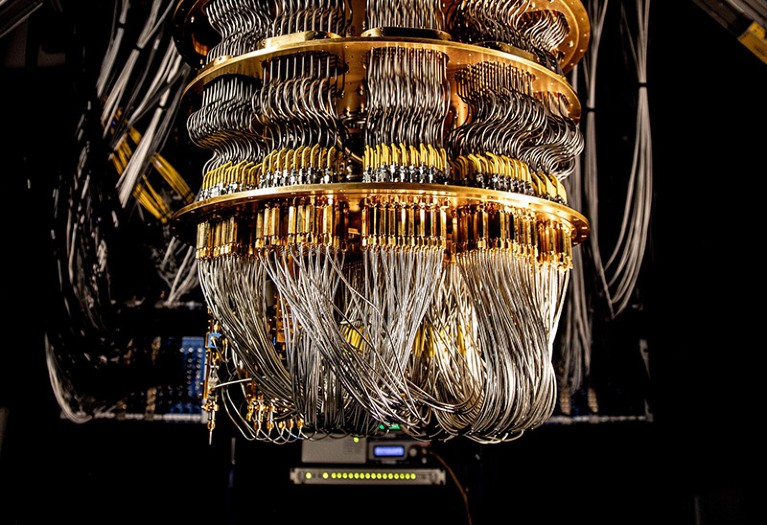
Google has set a quantum-computing road map for itself with six major milestones.Credit: Google Quantum AI
Physicists at Google have reached what they describe as their second milestone along the path to a useful quantum computer. At a laboratory in Santa Barbara, California, they have demonstrated that they can lower the error rate of calculations by making their quantum code bigger.
The feat, reported in Nature on 22 February1, follows up on a celebrated 2019 experiment in which a Google quantum computer achieved ‘quantum advantage’ — by performing a calculation that would have taken thousands of years on an ordinary computer.
Underdog technologies gain ground in quantum-computing race
Error correction is an inescapable requirement if quantum computers are to fulfil their promise of solving problems that are beyond the reach of classical machines — such as factoring large whole numbers into primes, or understanding the detailed behaviour of chemical catalysts.
“The Google achievement is impressive, since it is very hard to get better performance with large code size,” says Barbara Terhal, a theoretical physicist who specializes in quantum error correction at the Delft University of Technology in the Netherlands. The improvement is still small, the Google researchers admit, and the error rate needs to drop much more. “It came down by a little; we need it to come down a lot,” said Hartmut Neven — who oversees the quantum-computing division at Google’s headquarters Mountain View, California — during a press briefing.
All computers are subject to errors. An ordinary computer chip stores information in bits (which can represent 0 or 1) and copies some of the information into redundant ‘error correction’ bits. When an error occurs — as a result of stray electrons crossing an imperfectly insulating barrier, say, or a cosmic-ray particle disturbing the circuit — the chip can automatically spot the problem and fix it.
“In quantum information we can’t do that,” said Julian Kelly, Google’s director of quantum hardware, at the press briefing. Quantum computers are based on quantum states called qubits, which can exist in a mixture of ‘0’ and ‘1’ states. A qubit cannot be read out without its full quantum state being irretrievably lost, which means that its information cannot be simply copied onto redundant qubits.
But theoreticians have developed elaborate ‘quantum error correction’ schemes to address this problem. These typically rely on encoding a qubit of information — called a logical qubit — in a collection of physical qubits rather than a single one. The machine can then use some of the physical qubits to check on the health of the logical qubit and correct any errors. The more physical qubits there are, the better they can suppress an error. “The advantage of using multiple qubits for quantum error correction is that it scales,” says Terhal.
First quantum computer to pack 100 qubits enters crowded race
But adding more physical qubits also increases the chances that two of them will be affected by an error simultaneously. To address this issue, the Google researchers performed two versions of a quantum error-correction procedure. One, using 17 qubits, was able to recover from one error at a time. A larger version used 49 qubits and could recover from two simultaneous errors, and with slightly better performance than the smaller version could achieve. “The improvement currently is very small, and it is no guarantee yet that using even larger codes will give even better performance,” says Terhal.
Joe Fitzsimons, a physicist at Horizon Quantum in Singapore, says that various laboratories have made big steps towards effective error correction, and that Google’s latest result has many of the required features. But qubits also need to store information for sufficient time for the computer to carry out calculations, and Google’s team has yet to achieve that feat. “For a convincing demonstration of scalable error correction, we would want to see improvement in lifetimes”, as the system scales up, says Fitzsimons.
Google has set a quantum-computing road map for itself with six key milestones. Quantum advantage was the first, and the latest result was the second. Milestone six is a machine made of one million physical qubits, encoding 1,000 logical qubits. “At that stage, we can confidently promise commercial value,” says Neven.
Superconducting qubits are only one of several approaches to building a quantum computer, and Google still thinks it has the best chance of succeeding, says Neven. “We would pivot in a heartbeat if it becomes very clear that another approach will get us to a useful quantum computer quicker.”