x




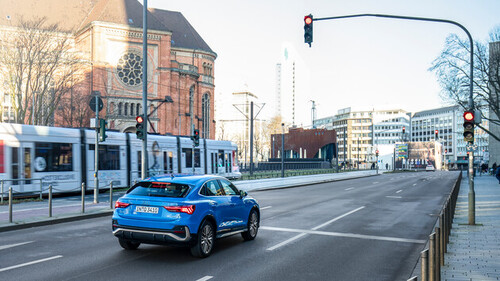
Grüne Welle: Audi vernetzt sich mit Ampeln in Düsseldorf
Audi will be offering the traffic light information service in Düsseldorf at the end of January. After Ingolstadt, it is the second city in Europe in which the vehicle-to-infrastructure service can be used. Traffic light information shows the driver the optimal pace for a green wave and also delivers the aggregated measured values back to the city.
The traffic light information service in Ingolstadt has been available since July of last year and has been available in the USA since 2016. At the end of this month, the implementation for Düsseldorf will initially be at around 150 traffic lights. By early summer, a large number of the intersections in Düsseldorf will be networked, so that 450 of the 600 signal systems will then provide information for the Vehicle-to-Infrastructure service (V2I).
GLOSA and time-to-green
The service is divided into two functions: “Green Light Optimized Speed Advisory” (GLOSA) and “Time-to-Green”. GLOSA is responsible for ensuring that the driver can choose the optimal speed for a green wave. If the applicable speed limit is displayed in the instrument cluster, this indicates that the next traffic light is green. At a red traffic light around 250 meters in front of the signal system, GLOSA can suggest reducing the speed in order to arrive at the traffic light on time. The aim is to reduce uneconomical and stop-and-go traffic.
If these measures do not take effect and the stop at a red traffic light can no longer be prevented, with "Time-to-Green" a countdown in the display counts the seconds until the next green phase. The function is activated before the stop so that the driver can roll out the car and save fuel.
With traffic light information, Audi wants to increase efficiency, comfort and safety in traffic. As part of a pilot project, Audi was able to use the service to reduce fuel consumption by 15 percent. “With Audi traffic light information, we want to improve driver comfort, increase traffic safety and promote a forward-looking, economical driving style,” says Andre Hainzlmaier, Head of Apps, Connected Services and Smart City Development at Audi.
The system learns and returns data
The partner for the project is Traffic Technology Services (TTS). Together they developed an analysis algorithm that calculates the forecasts from three sources. The data comes from the respective control program of the signal system, the real-time data from the traffic computer - a combination of occupancy cameras, detector loops in the street, bus or tram registrations and pedestrian push buttons - as well as historical data. The forecast algorithm is supposed to improve continuously and learn how traffic changes in the morning during rush hour or at noon when kindergartens and schools close. The Audi fleet sends anonymized data of the traffic light crossings to an Audi backend, where it is checked whether the real traffic light crossings match the forecast data. Only then should the traffic lights be released for display in the car, explains Hainzlmaier.
With traffic light information, data flows in both directions, so cities should also benefit from it. The data show when cars make an unusual number of stops at an intersection or when the average waiting time is comparatively long. “We aggregate the measured values in reports that we will make available to the cities. Traffic lights can then be switched more efficiently and traffic flows better. "
These models support traffic light information
Audi had shown the V2I traffic light service for the first time at CES 2016. In North America, service is available at 10,000 intersections, including over 2,000 in Manhattan, New York City. 1,600 other intersections are located around the U.S. capital Washington D.C. networked.
Traffic light information works in all e-tron, A4, A6, A7, A8, Q3, Q7 and Q8 that have been produced as "Model Year 2020" since mid-July 2019. "Audi connect Navigation & Infotainment" and "camera-based traffic sign recognition" are required.