x





Researchers find massive merger’s signature aftershocks hidden in 2019 data from LIGO and Virgo detectors.
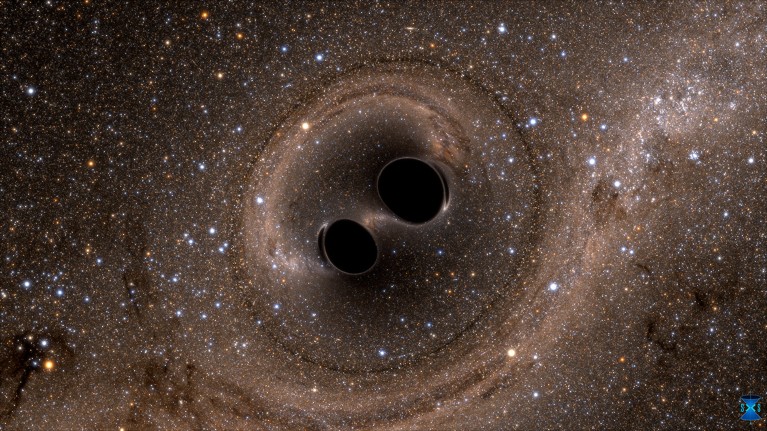
Merging black holes create gravitational waves that can be detected on Earth (computer simulation). Credit: The SXS (Simulating eXtreme Spacetimes) Project
The largest black-hole merger ever detected seemed to produce a black hole 150 times the mass of the Sun, in defiance of some accepted theories. Researchers now say they’ve found, for the first time, evidence of the long-sought vibrations produced by the resulting black hole as it settled into a spherical shape.
The findings provide a new, stringent test for Albert Einstein’s general theory of relativity — the theory of gravity that makes detailed predictions about both black holes and gravitational waves — says Steven Giddings, a theoretical physicist at the University of California, Santa Barbara. “We are really exploring a new frontier here.”
Physicist Badri Krishnan, one of the study’s authors, says that he worked on this type of analysis as a theoretical possibility earlier in his career. “At the time, I never thought I would ever see such a measurement in my lifetime,” says Krishnan, who is now at Radboud University in the Netherlands. The results1 were published last week in Physical Review Letters.
In the years since the dawn of gravitational-wave astronomy in 2015, the detection of merging black holes has become a routine occurrence. The twin detectors of the Laser Interferometer Gravitational-Wave Observatory (LIGO), in Washington State and Louisiana, are now spotting such mergers more than once a week, on average.
Data from LIGO and from the smaller Virgo observatory near Pisa, Italy, typically show the signature of gravitational waves from two massive objects spiralling into each other until they merge. The frequency of these orbits, and how that frequency increases in time up until the instant of the merger, reveals the masses of the two objects and of the single black hole that results from their merger. Generally speaking, the more massive the objects, the longer their orbits at the time of merging, and the lower the frequency of their gravitational waves.
But among the dozens of such events detected so far, GW190521 — named after its date of discovery, 21 May 2019 — stood out. Its merging frequency was so low that the system entered LIGO and Virgo’s range of sensitivity only during its last two orbits.
Krishnan and his colleagues, who are not affiliated with the LIGO–Virgo collaboration, wanted to see whether gravitational waves from that event might carry information not just from the time preceding the merger, but also from the moments immediately after it. At the instant when two black holes merge, the resulting black hole has a lopsided shape. But black holes are stable only when they are spherical (or spheroidal, if they are rapidly spinning). Within milliseconds, they settle into a lowest-energy, symmetrical shape.
In the same way that a bell rings with specific frequencies determined by its shape, the stabilizing black hole ‘rings down’, and radiates gravitational waves with frequencies determined by its mass and its spin, says Krishnan. Measuring the ringdown frequencies provides an alternative to measuring the spiralling frequencies when it comes to estimating the properties of the black hole.
Krishnan and his colleagues reanalysed data from the GW190521 event to look for evidence of the ringdown. They found two separate ringdown frequencies, which together put the resulting black hole at around 250 solar masses — much heavier than the original analysis by the LIGO–Virgo team suggested2,3.