x



How Africa's growing cities are turning politics upside down
The new power of cities
How Africa's growing cities are turning politics upside down and deciding on the future of the continent.
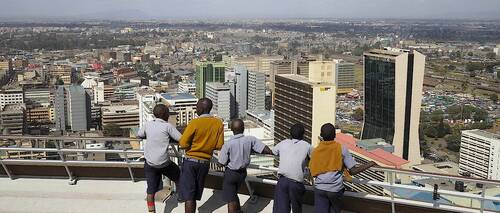
The roofs of Nairobi.
Read this article also in English and Russian.
The urban population of Africa will double in the next 25 years. The majority of all Africans will live in cities by 2040 at the latest. There are many reasons for this: hope for jobs, climate change and escape from war. The list could easily be extended. Urbanization is one of the greatest transformations that Africa is facing in the 21st century. So far, however, people have moved to "unjust" cities. The majority live in informal settlements and work in precarious conditions, mostly in the informal sector, without an employment contract and social security. For example, in Nairobi, Kenya, more than 60 percent of the population live in informal settlements, but they make up less than ten percent of the city's surface. A national and international elite, on the other hand, live in isolated districts with private security services.
Urbanization takes place on the African continent in the absence of a structural transformation of the economy. The typical city dweller in Lagos, Nigeria or Nairobi in Kenya is not a textile worker, but rather a seller of imported second-hand shirts or a domestic worker with an average wage of less than three euros a day; or a UBER driver who has to give 25 percent of her income to a Silicon Valley company. Union representation in these sectors is particularly difficult. Incomes fluctuate from day to day and are usually far below the state minimum wages. An illness often leads to indebtedness.
So far, there have been hardly any parties or politicians who have represented the interests of employed city residents. So far, the rural population working in agriculture has been the majority.
Urbanization without jobs for more and more city dwellers presents the continent with ever greater challenges. The sequence of industrialization and urbanization known from Europe and parts of Asia is not recognizable in Africa and is hardly possible anymore in the age of automation and increasing trade conflicts. In Europe and parts of Asia, the increase in agricultural productivity and the state expansion of educational and health services often ran parallel to a strategically controlling industrial and commercial policy that protected its own markets. This led to the industrialization of cities and the creation of jobs in export-oriented, urban factories. The availability of these jobs accelerated urbanization, increased demand for urban services and sometimes brought about socio-political and economic pluralization; especially when workers' parties and unions won new freedoms and better wages.
It is often forgotten that this sequence was politically prepared in Europe by authoritarian land reforms, and thus the compulsion to do paid work for the rural population driven into the cities. In Africa - in addition to the unequal distribution of land due to the colonial era - it is now increasingly the effects of climate change that are driving people increasingly into cities. But there are hardly any prospects for a good income there.
Although economic productivity and job demand are decoupling worldwide, many African governments and the international community continue to hope for the outdated "development sequence" with industrial jobs that will soon become too expensive in China or Vietnam due to wage increases or automation. Special economic zones and tax exemptions are intended to attract international investments to build up industries in many African countries. The hopes that these will come are increasingly futile when simple tasks in manufacturing industries will be taken over by digital systems in the future. However, no alternatives are in sight. A growing and still small IT and start-up sector in Kenya, for example, employs only a small, highly educated elite and has limited growth potential.
A scenario threatens in which the African labor markets of the future will be even stronger than today urban, precarious and informal labor markets. The design of urbanization is therefore also about the fundamental question of which growth path the continent can take if the old industrialization path in times of Industry 4.0. and climate crisis is no longer available. In many African countries, discussions about the economic effects of climate change do not focus on the question
A scenario threatens in which the African labor markets of the future will be even stronger than today urban, precarious and informal labor markets. The design of urbanization is therefore also about the fundamental question of which growth path the continent can take if the old industrialization path in times of Industry 4.0. and climate crisis is no longer available. In many African countries, discussions about the economic effects of climate change do not focus on the question of how existing jobs in CO2-intensive industries can be converted into climate-neutral jobs because these jobs often do not exist. It's more about the question of how climate-neutral jobs can be created.
Not the strike in the factory, but the impending eviction of a slum to make way for a street or the increase in fees for privatized drinking water are driving political mobilization.
In addition, cities around the world are already responsible for over 70 percent of all CO2 emissions, at a time before more than a billion people will soon be living in African cities. Much of the necessary urban infrastructure in Africa has not yet been built. How, by whom, under what conditions and for whom this infrastructure is to be built is unclear. There is design potential here. International and national politics must therefore concentrate much more on African cities.
So far, urbanization in Africa has been a catalyst for various inequalities. The political struggle against inequality in Africa will thus automatically become an increasingly urban one. As a result, the multi-party systems introduced on the continent at the beginning of the 1990s are already changing. At the time, multi-party elections were introduced in parallel to the reduction of public services and political scope for action through structural adjustment programs prescribed by the IMF and the World Bank. This structural adjustment and existing international financial, trade and tax regimes have made industrialization difficult to this day. Unprocessed raw materials and minimally taxed profits continue to be exported from the continent, while processed products are imported.
Without industrialization and the urbanization that is often associated with it, there have so far been hardly any parties or politicians who represent the interests of dependent urban residents. So far, the rural population working in agriculture has been the majority. Most of the formal urban jobs were in the public sector. So far it has been all the easier for political elites to mobilize for their goals through supposed regional or ethnic differences. This mobilization model is now under pressure. Opposition parties on the continent are already more successful in the city than in the country, while government parties can still rely on support in rural areas. This will change when the majority of all voters soon live in cities.
The absence of industrialization leads to the increased importance of the city for political identity. It is not the strike in the factory, but the impending eviction of a slum to make way for a street or the increase in fees for privatized drinking water that are driving political mobilization in African cities. Protest movements from Senegal to Kenya are increasingly successfully organizing new urban alliances. In these alliances, city dwellers demand solutions to problems that affect them collectively and not just individually.
With a hip-hop outfit and controversial but popular speeches, the new governor of Nairobi, Mike Sonko, specifically addresses the majority of younger and poorer voters and thereby wins elections.
Politicians are also changing their tactics. In Kenya, for example, some politicians are trying to address the majority of informal living and working urbanites with new methods. They mobilize beyond ethnic categories along which Kenyan election campaigns have so far been mobilized. It is advertised by a speech that differentiates between the "coughsters" on the street and the elites in the wealthy areas. With a hip-hop outfit and often controversial speeches and campaigns, Nairobi governor Mike Sonko, for example, specifically addresses the majority of younger and poorer voters and thereby wins elections. He himself does not belong to any of the largest ethnic groups or to any of the influential political families to date. Trucks with drinking water, job creation measures in slums or the prevention of evictions ensure the support of Sonko. How these benefits are financed is sometimes controversial. He is currently under investigation for suspected corruption.
Sonko is not the only urban populist on the continent. However, the opaque financing of this urban populism and the ad hoc nature of decision-making processes do not offer a long-term solution to the structural problems in African cities. What is missing is a link between social urban development policy and a broader discussion about socially just and ecological sustainable growth paths, which creates perspectives for precarious urban residents. In order for the "unjust" to become the "just" city, democratization of economic decision-making processes from the local to the national level and international support are required, especially when the old "development path" is no longer an option due to the climate crisis and automation.
The growing cities are already the venue for new sociopolitical struggles for public goods. More and more city dwellers are voting for new politicians and distrusting the old. New protest movements overcome social divisions. Unions are trying to attract new members among the informally employed city dwellers. All of this shows that civic engagement in Africa will in future be defined more than ever through the center of life in the city. This is about decisions about housing, transportation, a fairer distribution of land and property in the cities - and the taxation of wealth of those who withdraw into the privatized oases. New alliances are possible along with the demands for a right to the city.