x





The inclusion of women and people of colour in NASA’s astronaut cadet programme was unprecedented — and met sometimes fierce resistance.
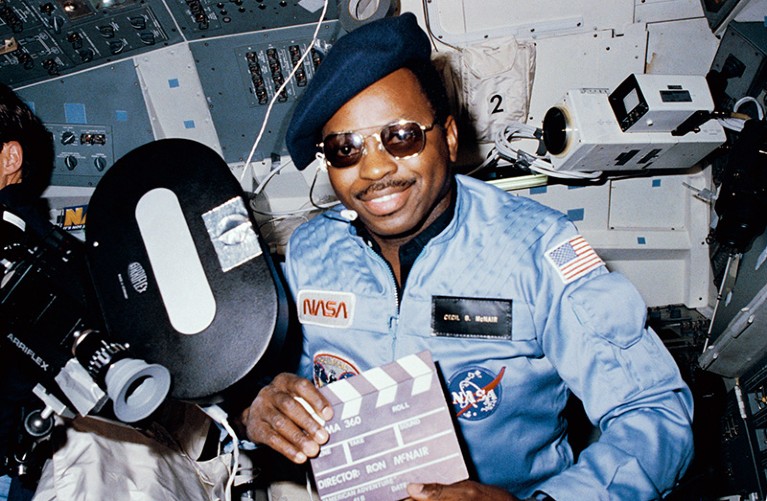
Ronald McNair, part of the class of 1978, died in the space shuttle Challenger in 1986.Credit: NASA
The New Guys: The Historic Class of Astronauts That Broke Barriers and Changed the Face of Space Travel Meredith Bagby William Morrow (2023)
Growing up in racially segregated South Carolina in the 1950s, Ronald McNair saw door after door slammed in his face. The public pool was for white people only, so he could not learn to swim. When he was nine years old, a librarian called the police on him for trying to borrow calculus books.
McNair fought the racism and went on to study physics at the North Carolina Agricultural and Technical State University in Greensboro — a historically Black institution — and at the Massachusetts Institute of Technology in Cambridge. In 1978, NASA chose him as a finalist to be an astronaut, in the first such group to contain women, people of colour and scientists. His pioneering class included Sally Ride, who would become the first US woman in space; Ellison Onizuka, the first Asian American in space; and Guion Bluford, the first African American in space.
Fifty years after astronauts left the Moon, they are going back. Why?
With The New Guys, Meredith Bagby, a film producer and former journalist, has produced a broad and easily readable narrative about this group of US astronauts. She does not break new ground in outlining their experiences and the team’s role in space history. But she does illuminate the historic nature of their selection — and, significantly, how they helped to shape NASA’s space shuttle programme, from its first flight in 1981 until its end in 2011.
NASA’s first astronaut class, chosen in 1959, was the iconic Mercury Seven that included John Glenn, Alan Shepard and Gus Grissom. The next six groups were in the same vein: all white, male military pilots lionized for having “the right stuff”. Then came the class of 1978. Of the 35 new astronauts, 14 were civilians, 6 were women and 4 were men of colour.
It was a time of huge change for NASA. The Apollo Moon programme had wound down, and NASA had set its sights on developing a reusable space plane that would launch like a rocket and land like an aeroplane. Astronauts on this vehicle would deploy military and scientific satellites into space. It was time for a new type of astronaut for a new type of spaceship.
Bagby views the shuttle era through the experiences of its astronauts, with a focus on women moving into new roles. They include Ride, a gay woman who remained in the closet while at NASA because the agency would not hire her otherwise; geologist Kathryn Sullivan; physicians Rhea Seddon and Anna Fisher; biochemist Shannon Lucid; and engineer Judith Resnik.
In the late 1970s, the view in much of NASA’s ranks was that the agency had lowered its standards to admit a more diverse class, and the class acquired the soubriquet “Those Fucking New Guys”. John Glenn and Chuck Yeager, the quintessential “right stuff” pilots, were among those who fought against hiring women as astronauts. Opposition from Yeager had probably helped to keep Ed Dwight, a Black test pilot, from joining a previous class.
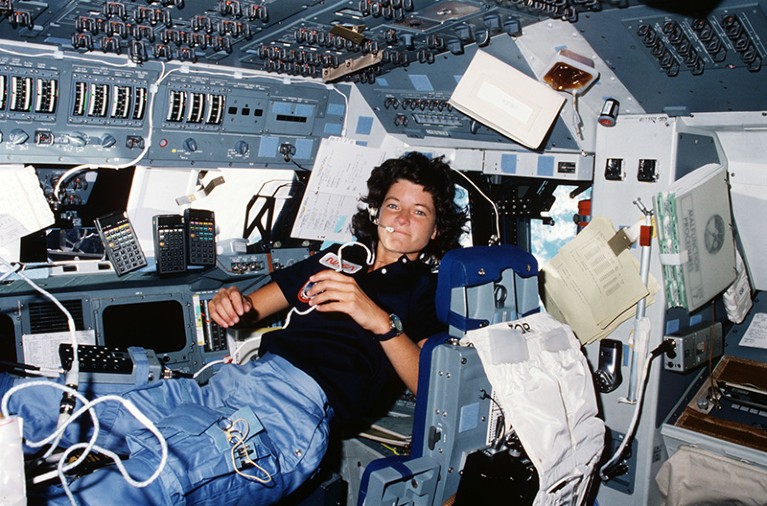
Sally Ride, the first US woman in space, works on the flight deck of the space shuttle Challenger in 1983.Credit: NASA
Bagby’s narrative shines as she explores the early years of the space shuttle as NASA focused on deploying large satellites. In 1990, for instance, Sullivan helped to launch the Hubble Space Telescope, an observatory too large to get into orbit on any other vehicle.
It is easy to forget that shuttle astronauts performed the first on-orbit satellite repair back in 1984, on the Solar Maximum Mission observatory, and deployed important scientific spacecraft such as the Galileo mission to Jupiter and the Ulysses mission to study the Sun. But the pressure to fly as often as possible to meet the needs of customers quickly caught up with NASA. From 1983 onwards, cost-cutting meant fewer engineers, fewer inspections and less time and attention to spend on thorny mechanical issues.
On separate flights in January 1985 and April 1985, Onizuka and fellow class member Frederick Gregory came close to death without knowing it, when the O-rings that helped to seal the shuttle’s solid rocket boosters nearly failed. Facing a long list of planned launches, NASA managers overrode concerns aired by contractors. In January 1986, four members of the group — McNair, Onizuka, Resnik and Richard Scobee — were on board with three other astronauts when the space shuttle Challenger’s O-rings failed just after lift-off, causing an explosion that killed them all.
The $93-billion plan to put astronauts back on the Moon
Ride served on the panel that investigated those deaths, and helped to bring the O-ring cover-up to public light. The disaster led to the end of the shuttle’s role in deploying satellites and in partnering with the military.
And yet Ride found herself on an investigation panel again in 2003 — this time concerning the fatal accident of the shuttle Columbia, which disintegrated just before landing because a piece of foam that had detached from the fuel tank during launch had damaged the craft’s thermal-protection tiles. As with Challenger, NASA culture was to blame. Mission control did not even inform the Columbia crew about the foam strike until a week into the nearly 16-day mission, when it said: “This item is not even worth mentioning other than wanting to make sure that you are not surprised by it in a question from a reporter.”
NASA retired the shuttle fleet in 2011, after astronauts finished construction on the International Space Station — an abrupt ending to the programme and to the story of the 1978 astronaut class.
Much of the information in The New Guys can be found elsewhere. David Shayler and Colin Burgess’s 2020 book NASA’s First Space Shuttle Astronaut Selection contains more technical detail on the class of 1978. Sociologist Diane Vaughan’s The Challenger Launch Decision (1996) is the definitive account of the circumstances of that disaster. The many popular histories of the shuttle programme include journalist Pat Duggins’s 2007 book Final Countdown. But The New Guys succeeds as a comprehensive and engaging overview of this period in space-exploration history.