
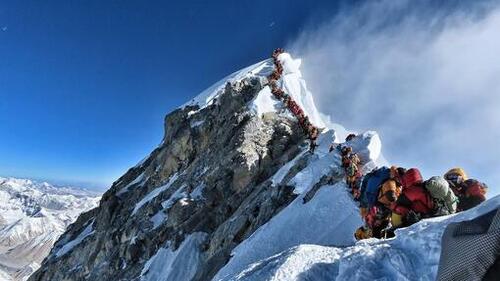

You can hear them long before the excavators can be seen in the lush green landscape. It rattles, it crashes, then a thud. The earth is shaking. Rocks are broken up, rock is excavated and the slope is poured down. Cracking, impact, shock. Again and again, from sunrise to dawn. It is not a normal construction site, but road construction almost 3000 meters above sea level. Here in Solukhumbo, the region below Mount Everest , the last corners of the Himalayas are opened up - and Nepal is changed forever.
A man of about forty stands in front of his house just a few meters from the excavator. The rock is drilled out and removed directly below his property, next to a paddock on which two dozen mules stand. The man speaks very little English, but the fact that he is moved by the construction site can already be seen in his facial expressions and gestures. His parents already lived in the house in the branched village of Bupsa on and off the old path, he says.
Soon the donkeys are superfluous
For centuries, the only trade and supply route from the valley led to the Sherpa villages further up through Bupsa. Soon the worn stone steps up to the highest mountains in the world will probably only be used by a few trekking tourists. The man looks skeptically at the excavator, then points to his donkey. So far, they have carried kerosene, food, beverages and hygiene articles. They will soon be superfluous.

Difficult terrain. A donkey caravan on the way down to the valley. PHOTO: FELIX HACKENBRUCH
Just like below, because gravel roads have long run through the slopes like veins. Where jeeps and trucks whirl up dust, donkey caravans and human vehicles are no longer required. The sweet smell of donkey, the strict calls of donkey drivers - they disappear with every meter of road construction.
China dredges in 20 valleys
Not only in Solukhumbo are the excavators moving in Nepal. Bit by bit, the remote Himalayan villages are opened up, first with roads, then with radio masts. The mountainous country is growing together. The infrastructure projects are often financed from China. The government in Beijing sees Nepal as a strategic transit country for its “New Silk Road” project. The fastest way to the important markets in India is directly through the roof of the world. The ambitious infrastructure projects that Beijing wants to implement include a tunnel and a railway line between Kathmandu and Tibet, which the People's Republic annexed in 1950 and claims for itself. Numerous streets are also being created. North-south connections are particularly interesting for China. Excavation is currently taking place in around 20 valleys.

Namche Bazar can only be reached on foot. It is a long day's walk to the next airport, a short walk to the next street ... PHOTO: FELIX HACKENBRUCH
"With their massive investments, the Chinese are primarily pursuing their own interests and definitely not the strategy of economic improvement in neighboring Nepal," says Peter Hinze. The journalist has been traveling to Nepal for more than 30 years and has written numerous books and reports about the country. He has already seen the impact of Chinese construction activities in many places. "It is still only a narrow slope, but it will not be long before the first cars will roll there." Hinze fears for the cultural heritage of Nepal. On the ground, criticism of China's expansion plans is limited. Because even without good will, the new streets bring progress for many locals. "Medical care benefits as well as trade and school and training opportunities," says Hinze.
There are two daily marches to the next mark
The changeoffers opportunities, also finds Passang Gelje. "Hopefully the people here can sell their goods to Kathmandu or the rest of Nepal through the streets." The 35-year-old from the Sherpa people has spent his whole life in Solukhumbo, comes from a small village below Bubsa. “It is not easy to live here,” says Gelje. Most of the villagers work in agriculture. Many only have their simple wooden huts, some cattle and a few meters of arable land. "So far, farmers can only sell their goods at the markets in Lukla or Namche Bazar." One and a half to two day's walk away. Gelje hopes that the street will open up new sales markets. After all, vegetables and fruits of all kinds grow on the terraced slopes: millet, rice, corn, but also mandarins, apples, potatoes, cabbage and even kiwis.
His father still lives in the village, but many of the other houses are empty, he says, pointing to huts on the opposite slope. "Anyone who does not work in tourism has major competitive disadvantages," says Gelje. He does not believe that the road will bring more tourists to the region , despite the government's announcement that visits to the country will double to two million in 2020. "The government talks a lot, but does little," says Gelje. He didn't wait for new roads. He left his hometown ten years ago and now runs a small snack in the tourist town of Namche Bazar.

Excavators open up the Himalayas. PHOTO: FELIX HACKENBRUCH
More than 30,000 hikers from all over the world come here every year. If you want to go to the base camp of Mount Everest, you have to go through the kettle-shaped Namche Bazar. The tourist money has led to some prosperity among many Sherpa families. But the trekking season from September to December is short and already many foreigners fly over the lower villages of the Solukhumbo and land on the spectacular runway in the higher-lying Lukla . The way up is shortened from three weeks to ten days.
And so, below, those who benefit from tourism are afraid of the street. "Who should still stay here when the jeeps and trucks drive past the house," asks Pramina Khaling. It is a rainy December day when she stands at the kitchen window of the Gorkhali Lodge in Jubing. The day before, yellow excavators appeared in front of their property, excavated stone slabs, tore trees and bushes from the ground and leveled everything flat. Where there was just a centuries-old path, there is now a clay mud track. For 25-year-old Khaling and her family, the beginning of an uncertain future. Her parents have achieved some prosperity with the small accommodation. When the earthquake destroyed the inn, they immediately rebuilt it. Without government help, they proudly emphasize.
Nepal's cities are growing rapidly
Like Passang Gelje and Pramina Khaling, many young people leave their homes and flock to the cities. In the capital Kathmandu, the population has tripled in the past 30 years. In Pokhara, the second largest city in Nepal, it grew fourfold. Can new roads counteract rural exodus?
"The road brings its good and its bad." Transport will be easier, medical care will also determine, Pramina Khaling believes. Your mother limps. "Tourists won't stop here in the village," she suspects. Your family has already considered how to change the business. Maybe a restaurant or a gas station. Through the kitchen window she looks thoughtfully at the excavator. A couple of donkeys with wet fur and kerosene bottles on their backs trot through the mud. "If times change, we also have to change."