x





Experiments with lasers reveal a way to melt lunar dust into solid paving slabs.
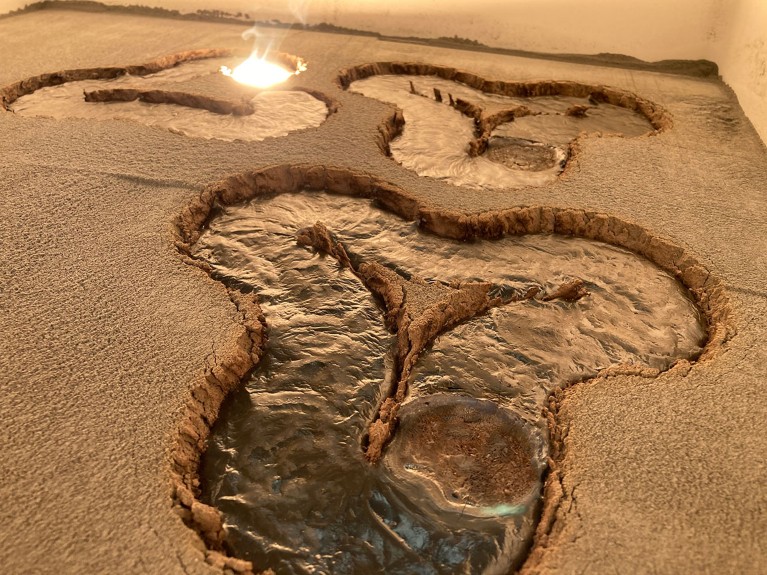
Researchers tried melting the simulated Moon dust into slabs of different shapes that could be fitted together to make a paved surface. Credit: PAVER Consortium
A beam of concentrated sunlight could be used to build paved roads on the Moon by melting lunar dust, according to proof-of-concept experiments involving lasers and a substance resembling Moon dust.
Such roads could be useful infrastructure for future lunar missions, say engineer Juan-Carlos Ginés-Palomares and his colleagues, because they could provide areas for spacecraft to land or move around without churning up fine dust that can damage on-board scientific instruments and other equipment.
The Moon will be an important jumping-off point should humans ever want to explore further reaches of the Solar System. But its low gravity means dust doesn’t settle. Paving the lunar surface by melting the regolith — loose rock and dust — could help to address this problem.
The team’s idea, outlined on 12 October in Scientific Reports1, would be to deploy a solar concentrator that uses a lens to melt the dust, rather than heaters that might require solar cells for power. “A solar concentrator uses the sunlight directly. It does not need to convert the solar energy into electricity,” says Ginés-Palomares, who is based at the Technical University of Berlin.
Such devices would need huge, expensive lenses — the team says a disk measuring around 2 metres across would be needed to melt lunar soil. So to test the concept, the researchers instead used a laser that gives out the same power.
By firing the laser onto simulated moon regolith, they could make Moon-dust ‘tiles’ that were around 25 centimetres in diameter. They experimented with different geometries to make tiles that can interlock to form paved areas. These initial results are promising, but more research is needed before the moon gets its first roads, says Ginés-Palomares. “The performance of the tiles under a rocket thrust should be tested,” he says, as well as whether the process of making them works under low gravity.