x





Assessing the reproductive potential of the Cape honey bee to check population health status.
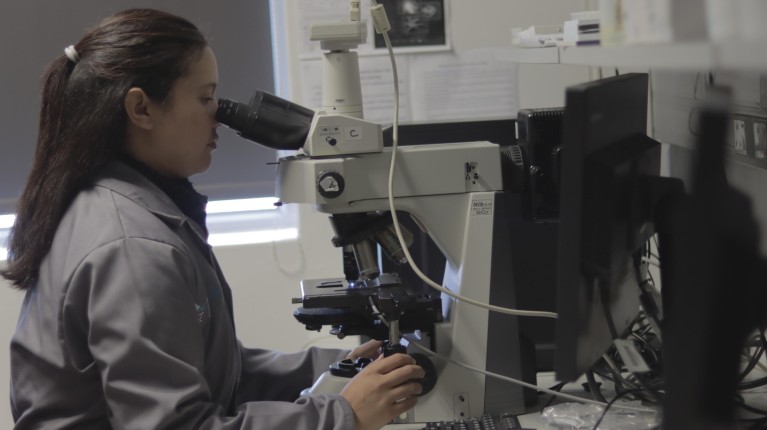
Janice Murray in the lab.Credit: Morgan Morris
A new way to measure how fast honey bee sperm moves will help researchers track their reproductive health.
The new technique, by South Africa’s University of the Western Cape (UWC) Comparative Spermatology Group, combines the use of computer-aided sperm/semen analysis (CASA) with fluorescent microscopy. While automated CASA systems have been successful in measuring sperm motility in human and other species, it’s never worked with honey bee sperm, explains Janice Murray, the doctoral student who finessed the new approach during her master’s research at UWC.
Credit: Morgan Morris
Sperm motility determines its capacity to move through the female reproductive tract to reach and fertilise an egg. Poor sperm motility has increasingly been linked to colony failure, or colony collapse disorder (CCD), among global bee populations. CASA uses the sperm head as a reference point to measure sperm swimming speed and kinematic behaviour (the sperm’s motion). Murray outlined this work on the Cape honey bee (Apis mellifera capensis), in a recent paper co-authored with her supervisors, Gerhard van der Horst and Retha Kotzé of the Department of Medical Bioscience at UWC, and Mike Allsopp of the South African Agricultural Research Council (ARC).
Murray points out that honey bee sperm is different in structure from, for example, human sperm with its prominent head and small tail. “With honey bee sperm, you can barely distinguish between the head and the tail because the sperm is so narrow and small.” The team combined a CASA system with fluorescent microscopy, where chemical stains and dyes are used to highlight structures of interest and viewed under specialised microscopes.
Murray targeted her stains at the sperm head, which under a powerful fluorescent microscope, can easily be told apart from the sperm tail. Using this approach, the team looked at indicators of sperm functionality.
“Such data may be useful to determine the effect of stressors, including environmental factors such as pests or pesticides, on honey bee sperm fertilisation capability,” explains Kotzé. “By analysing these parameters, honey bee sperm can serve as a potential bioindicator that provides information on lethal and sublethal effects of stressors on a colony’s performance and health.”
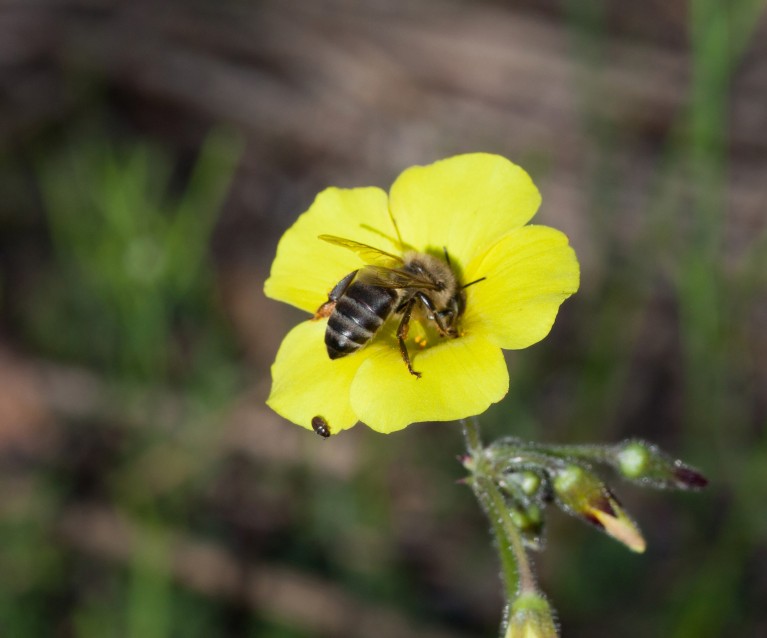
The Cape honey bee.Credit: Julie Anne Workman - CC BY-SA 3.0
The technique also holds promising benefits for research on other insects to gain a better understanding of their sperm function, she adds.
For the second part of her master’s work, which is still to be published, Murray used the technique to look at how sperm quality is affected by miticides, the chemical substances used to control infection by the voracious parasitic mite known as Varroa destructor, which was first detected in South Africa in 1997.