x





Political divisions are intensifying, threatening democracies around the world. What strategies bring people closer together again?
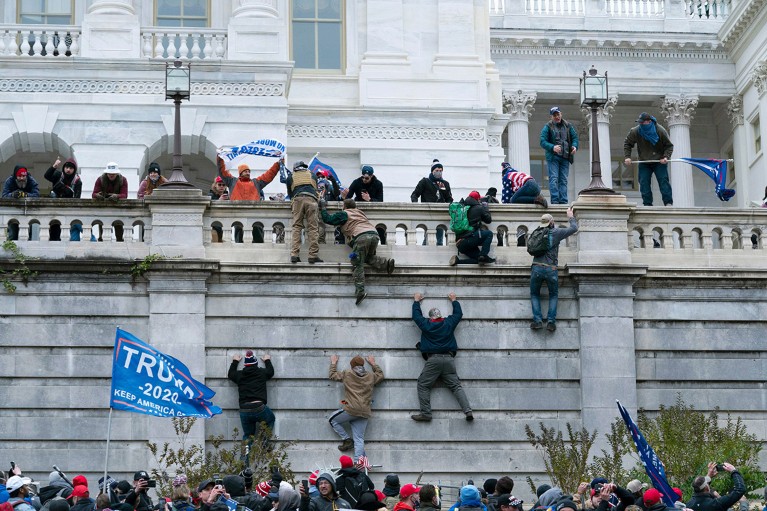
Supporters of former US president Donald Trump climb the west wall of the US Capitol building in January 2021.Credit: Jose Luis Magana/AP/Shutterstock
On 20 October 2020, in the middle of a bitterly contested US election season, there was an unexpected détente in Utah. Two opposing candidates for governor, Spencer Cox (a Republican) and Chris Peterson (a Democrat), shunned the verbal attacks that dominate most political campaigns. Instead, they released a joint political advertisement in which they made a commitment to remain civil, accept the outcome of the election and eschew the divisive hatred that infests politics today.
“I’m not sure this has ever been done before,” Cox tweeted along with the video ad.
The message went viral. And, according to researchers who later studied its effects, viewing it helped to shore up support for democracy among potential voters (see go.nature.com/3kjgpct).
The video was one of around two dozen interventions tested last year in an initiative called the Strengthening Democracy Challenge, run by social psychologists at Stanford University in California. The team is part of a community of researchers who are trying to find ways to stem the flow of hatred into politics.
Animosity is running high right now. In a survey conducted last year by the Pew Research Center, a think tank in Washington DC, 72% of Republicans said that Democrats are “more immoral” than members of their own party, and 63% of Democrats said the same about Republicans — increases of 17% and 16% in just a three-year period. Similar trends have been seen in other countries1. In Switzerland, for example, the degree to which people like their own party more than another has increased by about 60% since the 1980s. The pattern in the United States, however, is especially strong (see ‘Strength of feeling’).
Hostility between political parties has been associated with a lack of respect for democracy and a rise in support for partisan violence2, such as the attack on the US Capitol in 2021. Some researchers think that these trends could eventually culminate in the collapse of democracy in the United States and elsewhere. “That’s the lurking dark pit that we’re all trying to avoid,” says social psychologist Kurt Gray at the University of North Carolina at Chapel Hill.
Gray and other social scientists, mostly based in the United States, report that they have made some progress in easing tensions. They have developed ways of engineering conversations so they move away from conflict and towards productive discourse. Some of the most effective methods are time consuming and require a lot of buy-in from participants, so researchers are developing easier interventions — such as watching Cox and Peterson’s joint ad — that measurably reduce antidemocratic attitudes, at least in the short term.
At the same time, researchers are beginning to harness technology in ways that might one day bring these interventions to millions of people. And practitioners working at hundreds of bridging organizations — groups that forge links and aid collaboration between people — are turning research into genuine connections between members of opposing groups.
But there are major challenges ahead. Most of these interventions have been used only in small-scale trials, and some researchers doubt that they could be scaled up enough to have a measurable impact. Meanwhile, some studies3 suggest that politically motivated violence — often thought of as one of the most damaging outcomes of animosity between opposing groups — might be a separate beast altogether, driven by different factors.
“I think the field as a whole is doing really great work and doing the right kind of work,” says political scientist Lisa Argyle at Brigham Young University in Provo, Utah. But changing the tone of an entire nation is not a simple ask. “Right now, we wish we had better answers,” she says.
Hostility between people who support different political parties — or partisan animosity — has increased markedly in the past few decades. In 1978, when people in the United States were asked to rate their warmth towards political parties on a 100-point scale, they rated their own party 27.4 points higher than the other party, on average. By 2020, the gap had widened to 56.3 points. Several other countries, including Switzerland, France and Denmark, showed similar trends1, but none to the same degree as the United States — where most research on how to reduce animosity is also taking place.
As trust has diminished, serious threats to democracy have emerged. In the 2022 US midterm elections, more than one-third of Republican nominees running for a state position denied the legitimacy of the 2020 election, according to an analysis by news analysis website FiveThirtyEight (although many of these candidates were not elected).
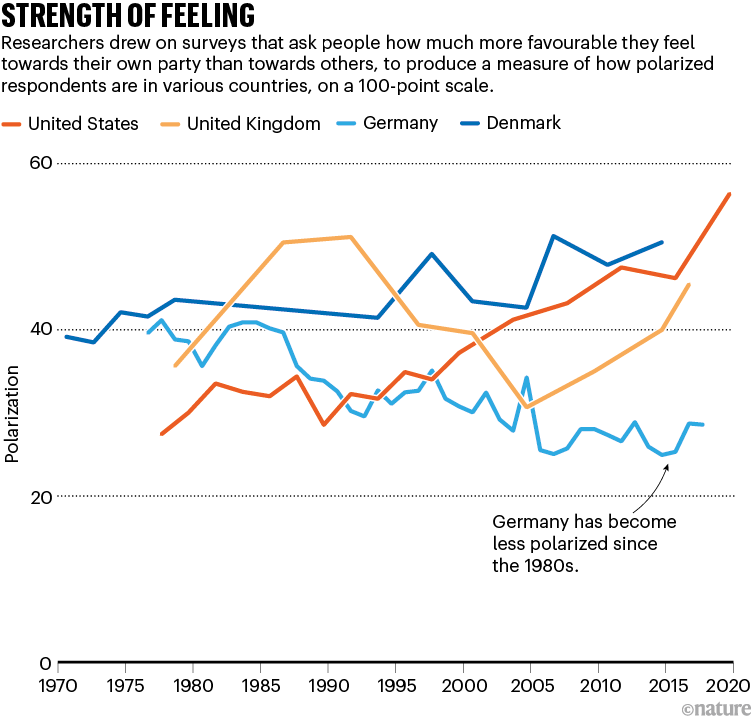
Source: Ref.1
In the United States, some people seem comfortable with the idea of using violence to hash out political differences. In a study published last year4, political scientist Sean Westwood at Dartmouth College in Hanover, New Hampshire, and his colleagues found that between 1% and 7% of participants favoured such tactics.
“I’m deeply troubled,” says Westwood. An especially insidious consequence of partisan animosity, in his view, is the way political beliefs are seeping into aspects of life they shouldn’t impact, including hiring practices and even physicians’ advice.
Some researchers blame the proliferation of partisan news sources for the country’s woes. Meanwhile, structural aspects of US politics, such as the two-party system, mean that “us-versus-them is baked into our political process”, says Gray.
These factors breed disagreement, but disagreement alone is not the problem, says Gray. In fact, it is a crucial component of a pluralistic democracy. Problems arise when citizens block out the things that they agree on and begin to focus only on their differences. “Conflict flattens people,” says facilitator John Sarrouf at the bridging organization Essential Partners in Cambridge, Massachusetts.
The study of partisan animosity has its roots in the century-old field of in-group and out-group dynamics. In 1954, US psychologist Gordon Allport outlined a set of conditions that foster acceptance between members of disparate groups, such as having equal status, a common goal and support from authority figures5. Many current efforts to reduce partisan animosity still incorporate some or all of these qualities.
In 1988, political scientist James Fishkin, now at Stanford University, stumbled upon one of these methods. At the time, his goal was to find out what voters really thought about the political issues of the day. He devised a system called deliberative polling. Participants from diverse political backgrounds were given briefing materials describing various issues, then left to discuss their views with the help of trained moderators. After the discussion, participants worked together to draft questions for panels of experts. They alternated between discussions and posing questions to the experts over the course of several days.
It turns out that deliberative polling is a very effective way to bring participants together on polarizing issues6. “We get massive changes!” Fishkin says. For example, before a 2021 deliberation exercise involving almost 1,000 people, 35% of Republican participants endorsed the need to reach net zero carbon emissions; after taking part, that figure rose to 55%. Democrats, meanwhile, became more supportive of using nuclear power to reduce greenhouse-gas emissions. Deliberative polling has helped to reduce prejudice against marginalized Roma people in Bulgaria and build trust between Protestant and Catholic people in Northern Ireland7. “We have maybe blundered on to a design, but it works,” Fishkin says.
In the past decade, researchers have deepened their understanding of what contributes to animosity and have learnt lessons about how to apply their knowledge to today’s online culture.
One factor that worsens divides is that people tend to overestimate how different they are from supporters of the opposite political party, imagining their opponents as “simplistic caricatures”, says decision scientist Julia Minson at Harvard University in Cambridge, Massachusetts. Republicans think that around 36% of Democrats are atheist or agnostic (the true figure is about 9%) and Democrats think that around 44% of Republicans earn more than US$250,000 (2% actually do)8. In one study9, helping people with liberal views to correct false beliefs increased their feeling of warmth towards people with a conservative outlook by about 7 points on a 100-point scale.

Supporters of Brazil’s former president Jair Bolsonaro break a window of the Supreme Court in Brasilia in January, a week after the inauguration of new president Luiz Inácio Lula da Silva.Credit: On Molina/AFP via Getty
Hoping to foster constructive engagement, Minson and her colleagues used a natural-language-processing algorithm to identify qualities of conversations that make people feel heard10. Participants with opposing views held text-based online conversations about contentious issues, then rated how receptive their partners were to their viewpoints. The algorithm correctly predicted which participants would be viewed as receptive by their interlocutors, and which would not.
Study participants who seemed most considerate of others’ views hedged their claims, emphasized points of agreement and acknowledged other perspectives, among other behaviours. What’s more, Minson has found that she can train people to show these qualities in conversations.
The right framing for a conversation can go a long way. When Sarrouf prepares to facilitate a discussion with a community in conflict, he carefully considers how to initiate the dialogue. For example, “if I ask you, ‘are you for or against gun control?’, you’ve got a polarized conversation right away,” he says. Instead, he asks participants to tell a story that can help others to understand how they’ve reached their beliefs.
Interventions designed for individuals or small groups are inherently difficult to deploy at the scale of a country. Some researchers are designing new interventions — and updating old ones — to have a broader reach.
Fishkin and his collaborators at Stanford’s Deliberative Democracy Lab want to bring deliberative polling to the whole United States. The first problem is that “we have to figure out a way where deliberations can run without a human moderator”, says Alice Siu, a researcher at the lab. It would be too hard to find enough qualified people to run such a huge number of sessions, even if the money to hire them was available. With the help of Stanford computer scientist Ashish Goel, Fishkin, Siu and their collaborators built a custom online deliberation platform, complete with an automated moderator. In 2021, they used the system in a session based around climate change, and it seems as adept at depolarizing participants as in-person sessions are, says Fishkin.

Inside the US Supreme Court’s war on science
Next, they want to scale up. The major hurdle is finding people to take part, Fishkin says. Word of mouth might help, and Fishkin hopes that social-media platforms will help participation to grow. “I think it’s going to spread the benefits of deliberation around the world.”
But not everyone wants to spend hours discussing politics online, Westwood says. What’s more, the positive effects of deliberative polling might wane and need to be reinvigorated once in a while. Fishkin has evidence6 that the effect on participants’ voting habits lasts a year, but would people be willing to take part in multi-day deliberations on an annual basis? “That’s a huge ask,” says Westwood. Minson suggests testing the system on an intermediate scale before devoting resources to a country-wide trial. “Can we depolarize one city?” she asks.
Social psychologist Robb Willer at Stanford University and his colleagues are studying much less intensive methods for reducing partisan animosity. Their Strengthening Democracy Challenge crowdsourced and tested online interventions — often surveys or videos that already existed — to see whether they reduce anti-democratic attitudes, support for partisan violence or extreme levels of partisan animosity in a group of more than 30,000 online participants.
One of the most successful interventions was an ad for Heineken beer. In the four-minute video, pairs of people with opposing viewpoints work together to achieve a goal (assembling a bar and a set of stools) then sit down to have a drink together while they discuss their views. Watching the ad produced a reduction in partisan animosity of about 10 points out of 100. In a similarly effective intervention, participants read about how the media exaggerate political differences to increase engagement.
Social-media platforms could help to promote these videos, Willer thinks. But even so, getting enough people to watch the videos to make a difference could be tough, Westwood says. Willer suggests a more nuanced approach. What if social-media platforms could use principles identified by research to find naturally occurring content that decreases animosity, such as the Heineken ad, then give it more visibility relative to more polarizing content? A couple of platforms, he says, have expressed interest in working with him on such projects.
Researchers could randomly select people to view material thought to reduce animosity, and then assess how well it worked.
Argyle is intrigued by this idea, but has questions. For example, “Can we actually identify the kinds of posts that increase partisan animosity and decrease it in a really consistent, reliable way?”
One major reason for dialling down partisan animosity between individuals is to help counteract bigger problems that threaten democracy. But some research questions whether the two issues are linked. In one study3, Westwood and his colleagues tested whether a positive experience with a member of the opposite political party could change broader feelings of party loyalty, support for collaboration between parties or support for democratic norms.
They told participants that members of the opposite political party were going to choose to give them some, all or none of $10. In reality, a computer chose whether to give them most or none of the money.
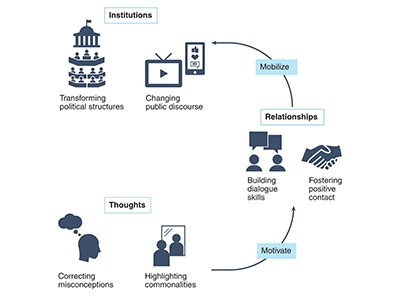
Interventions to reduce partisan animosity
Believing they had a positive experience with the opposite-party member increased the warmth participants felt towards that person, but did little to change their opinion of the wider democratic system, the researchers found.
Willer’s lab is currently testing the hypothesis that people who support political violence think in an intrinsically different way from those who don’t, and respond to interventions differently.
In terms of research priorities, Minson sees animosity as quite separate from political violence. “I really think we should focus on Grandma and Grandpa at the dinner table and leave the guy with the Viking horns to the prosecutors,” she says.
Some researchers think that visible examples of good behaviour might help to maintain democracy.
Westwood would like to see more politicians promote democratic norms. The joint political ad produced by Cox and Peterson is a prime example of how party elites can model responsible behavioural norms. “And it is as simple as pledging to be positive,” he says.
Support from the top has proved crucial in other countries, as well. Peacebuilder Seth Karamage helps to dispel tensions between members of different ethnic and religious groups in Nigeria. When Karamage, who is affiliated with the Karuna Center for Peacebuilding in Greenfield, Massachusetts, starts working in a new region, the first thing he does is to find key politicians whose agendas are well served by reducing violence in the region. Gaining their support increases his access to community leaders.
For the past four years, Karamage has built bridges between people of different religions. A group of farmers, who are Christians, recently told Karamage that last Christmas was the first time they’d celebrated the holiday without enduring an attack from nearby cattle herders, who are mostly Muslims. The impacts of peacebuilding work are “very hard to quantify”, Karamage says, but anecdotes such as this give him confidence that the approach is working.