x





Chandrayaan 3 will attempt to join the exclusive club of countries that have explored the lunar surface.
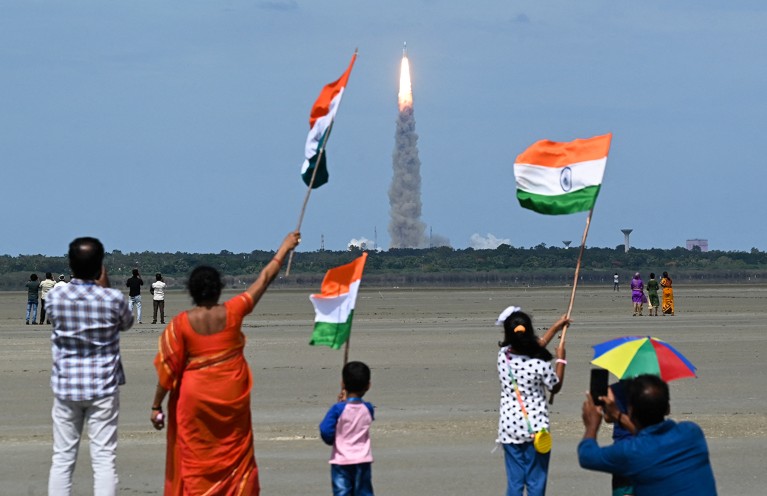
A rocket carrying Chandrayaan-3 lifts off from the spaceport in Sriharikota. Credit: R. Satish Babu/AFP via Getty
India launched Chandrayaan-3, its third lunar mission, on 14 July. The goal is to become the fourth country to achieve a controlled landing on the Moon, after the United States, the Soviet Union and China.
A Launch Vehicle Mark III rocket lifted off from a spaceport on Sriharikota, an island off India’s east coast, carrying the 3.9-tonne Chandrayaan-3 to an elliptical parking orbit around Earth. Next, a two-tonne propulsion module will inject the craft into a circular orbit about 100 kilometres above the Moon’s surface, carrying a lander–rover complex. The Indian Space Research Organisation (ISRO) plans to soft-land the 1.75-tonne Vikram craft at a spot near the Moon’s south pole on 23 August. The lander carries the six-wheeled robotic rover Pragyan, which will explore the area around the landing site for one lunar day, the equivalent of 14 Earth days.
Chandrayaan-3 follows a partially successful 2019 ISRO mission, which sent an orbiter with eight functioning instruments successfully into orbit. But the lander carrying the rover for that mission crashed into the Moon’s surface in the final moments of descent.
Learning from that failure, ISRO incorporated several design changes into the lander–rover portion of Chandrayaan-3. These include new instruments to handle failures and new algorithms to deal with unanticipated deviations in propulsion or trajectory. Chandrayaan-3 has a heavier lander, too, equipped with sturdier legs to handle additional velocity of almost 1 metre per second; bigger solar panels; more fuel; new sensors to measure the velocity of the spacecraft relative to the Moon; and improved software to guide the landing.
The lander is equipped with four instruments. One will measure changes in the density of ions and electrons near the surface of the Moon over time. Another will record the temperature near the surface. A seismograph will check for moonquakes around the landing site, and a reflector array will help researchers to understand the dynamics of the Earth–Moon system. The rover carries two instruments: a spectroscope for analysing the chemical and mineral composition of the Moon’s surface and a spectrometer to study samples of soil and rocks and investigate their compositions.
“We are excited by the potential of new Chandrayaan-3 instruments,” says Bernard Foing, chief executive of EuroMoonMars, an initiative for research on the Moon and Mars run by the International Lunar Exploration Working Group. Foing was the lead scientist for SMART-1, the European Space Agency’s first mission to the Moon.
ISRO chair Sreedhara Somnath told Nature that Chandrayaan-3’s instruments for studying seismicity, plasma and elemental composition are more sensitive than similar ones on previous successful missions.
“Chandrayaan-3 will help us to better understand the formation and history of the Moon by getting down on the surface and making some unprecedented measurements of the Moon’s chemical make-up,” says planetary scientist Paul Hayne at the University of Colorado Boulder. The rover’s instruments can help researchers to assess the diversity of elements at the landing site, he adds.
Hayne says data from some of the instruments could settle unresolved questions. “On the lander, geophysical instruments will take the Moon’s temperature and measure seismic waves, which will allow scientists to better understand the Moon’s crustal thickness and whether or not it remains geologically active,” he says.