x





In just two weeks, the Indian mission has made some surprising discoveries about the composition of the Moon
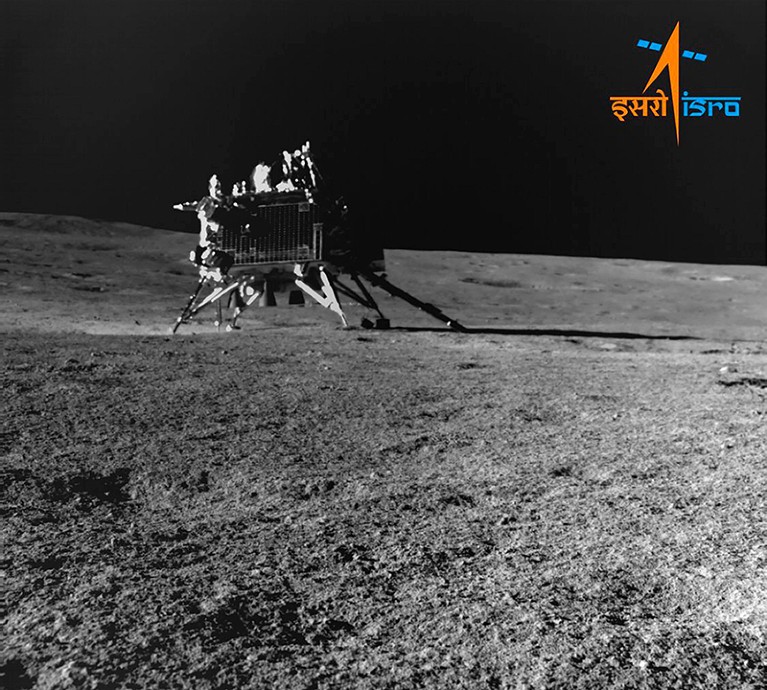
The Vikram lander on the Moon, as photographed by the Pragyan rover.Credit: Indian Space Research Organisation via AP/Alamy
The Indian Space Research Organisation’s (ISRO) Moon lander Vikram and robotic rover Pragyan have now been told to go to sleep. ISRO hopes to awaken them at lunar dawn on 22 September.
But in their two-week sojourn around the Moon’s south pole, they provided insights that have planetary scientists abuzz. Here are some of the first remarkable findings.
A probe onboard Vikram made the first measurements of the density and temperature of Moon’s ionosphere. ISRO reports a “relatively sparse” mix of ions and electrons in the 100-kilometre-thick layer of electrically charged plasma that surrounds the Moon’s surface near the south pole.
Initial measurements of the plasma indicate a density of about 5 million to 30 million electrons per cubic metre. And the density seems to vary as the lunar day progresses, an ISRO scientist analysing the Chandrayaan-3 mission's data told Nature. The peak density of a similar layer in Earth’s upper atmosphere is one million electrons per cubic centimetre.
The density of the ionosphere would affect lunar communication and navigation systems if humans were to inhabit the Moon — the higher the electron density, the longer radio signals take to travel through the ionosphere. The sparse plasma means that potential delays would be “minimal”, the scientist says, and would not pose a problem for transmission.
Understanding lunar soil, including its temperature and conductivity, will be important when considering settlement on the Moon. The soil “is an important in situ resource for construction”, says Anil Bhardwaj, director of ISRO’s Physical Research Laboratory in Ahmedabad.
The lander is fitted with a temperature probe containing 10 sensors and able to reach 10 centimetres below the surface of the Moon. Its preliminary data show that during the day, the temperature 8 cm down is around 60 ºC lower than at the surface.
India’s first Sun mission will investigate the origins of space weather
Planetary scientist Paul Hayne at the University of Colorado Boulder, says that a steep decline in temperature is expected during the lunar daytime, because the heat does not conduct downward from the warm sunlit surface. “This is similar to the effect one experiences when visiting a beach on a hot day — dig down just a few centimetres and the sand is much cooler,” he says.
Measurements so far have found that the temperature at the surface is significantly warmer than recorded by NASA’s 2009 Lunar Reconnaissance Orbiter, adds Hayne.
The temperatures “are far too warm for water ice to be stable”, says Hayne, explaining that water converts from solid to gas at a very low temperature in the vacuum of space — at about −160 ºC. Chandrayaan-3’s data indicate temperatures warmer than −10 ºC at all depths sampled. Further down "we expect temperatures to flatten out at close to the average surface temperature of about −80 ºC”, says Hayne.
Among many vibrations recorded by the lander’s seismograph, one in particular caught the attention of scientists. The instrument “seems to have recorded a very small seismic event that decayed to background in about 4 seconds”, says planetary geochemist Marc Norman at the Australian National University in Canberra. ISRO scientists suspect it was a small moonquake or the impact of a tiny meteorite.
Such perturbations are expected on the Moon. “Small impacts and local tectonic adjustments related to tidal forces are common on the Moon, but we really need a global seismic network on the Moon and longer-term observations to understand the significance of any particular event,” says Norman.
Testing by the rover unambiguously confirms the presence of sulfur in the lunar surface near the south pole, ISRO reports. It also found aluminium, silicon, calcium and iron, among other elements.
“Sulfur, being volatile, is not generally expected,” explains Bhardwaj. Confirmation of its presence is really important, say scientists. Sulfur is a key element of molten rock, and researchers think that the primitive Moon was covered with a thick layer of hot molten rock, which crystallized to form the Moon’s surface. Measurements of sulfur concentrations can provide insight into that process, says the ISRO scientist. However, it’s also possible that the sulfur came from asteroids that bombard the Moon’s surface. The ISRO scientist says they hope to add their findings to those of the US Apollo missions to better understand the Moon’s geochemistry.