x





The laboratory-grown food uses rice as a scaffold for cultured meat.
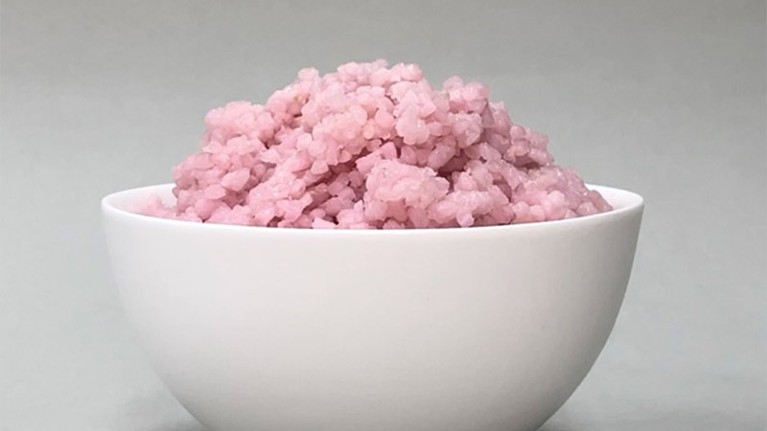
The hybrid beef–rice is pink because the cell-culture medium contains phenol red, an acidity monitor.Credit: Yonsei University
Rice has been used as a scaffold to grow beef muscle and fat cells, resulting in an edible, “nutty” rice–beef combo that can be prepared in the same way as normal rice.
The study, published today in Matter1, uses manufacturing methods similar to those for other cultured meat products, in which animal cells are grown on a scaffold in a laboratory, bathed in a growth medium. Using rice as the scaffold has the benefit of adding nutrition to the rice, with the beef–rice having a slightly higher fat and protein content than standard rice.
The team of South Korean researchers behind the project hopes that the beef–rice will find use as a supplement for food-insecure communities or to feed troops, and will reduce the environmental impact of rearing cattle for beef. “Finding alternative protein sources or making conventional livestock production more efficient is critical,” says Jon Oatley, an animal biotechnologist at Washington State University in Pullman. “It’s probably one of the most important things facing the future of the human race.”
That need has spurred a variety of cultured meat projects in recent years, ranging from fully fledged salmon fillets to products similar to minced beef. As of last year, only the United States and Singapore had approved the sale of lab-grown meat.
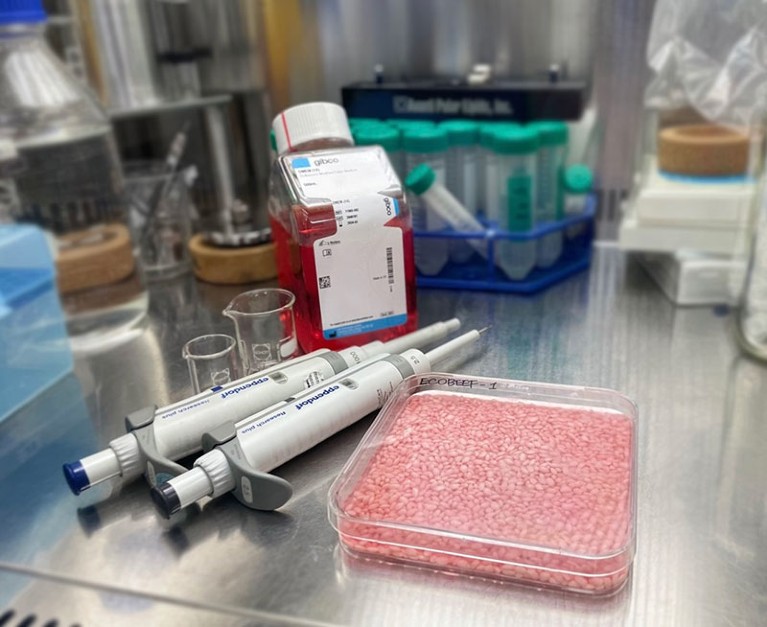
The rice grains, seeded with bovine cells, sitting in the growth medium.Credit: Yonsei University
Co-author Sohyeon Park, a chemical engineer now at Massachusetts General Hospital in Boston, says that the team tried to grow beef cells directly in the porous crevices of a grain of rice, but the cells didn’t take well to the grain. Instead, the researchers found that coating the rice in fish gelatin and the widely used food additive microbial transglutaminase improved cell attachment and growth. After glazing uncooked rice grains with the gelatin–additive mix, the team seeded the grains with bovine muscle and fat cells. Then, the cells sat in the growth medium for around a week.
After the culturing period, Park washed and steamed the beef-infused rice as she would conventional rice. “It was definitely different from regular rice,” she says. “It was more nutty and harder.”

Lab-grown meat: the science of turning cells into steaks and nuggets
The nutritional content is also different, but only marginally so. A 100-gram serving of the hybrid rice contains 0.01 grams more fat and 0.31 grams more protein, a 7% and 9% change respectively. According to the study, it’s essentially the same as eating 100 grams of rice with one gram of beef brisket — less than half a teaspoon. That’s because the beef-cell content is low, and the cells probably form just a film over the rice, says John Yuen, a tissue engineer and molecular biologist at Tufts University in Medford, Massachusetts. He says the nutritional content could be boosted by increasing the number of bovine cells on the rice grains.
It’s something the team is looking into, says Park. In particular, she hopes to improve the fat content of the rice, which could be tricky, because fat cells don’t grow as well as muscle cells. In addition to boosting the bovine content of the hybrid rice, researchers would need to keep the price low if the product were commercialized, so that food-insecure communities could benefit from it. The team estimates that 1 kilogram of the rice as it’s made now would cost US$2.23, comparable with normal rice ($2.20 per kilogram) and much less than beef ($14.88 per kilogram). And the study estimates that hybrid rice will have a lower emissions footprint than farmed beef.
If production can be scaled up and kept affordable, Oatley says, the hybrid rice could be a cheaper, more efficient source of nutrition than large pieces of lab-grown meat, such as patties or steaks.