x





A trove of more than 300 million gene groups from ocean bacteria, fungi and viruses has been made freely available online.
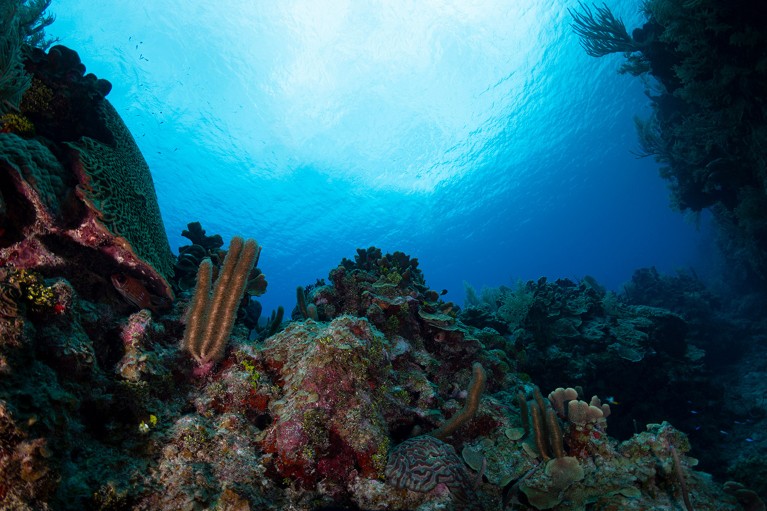
The database includes genomic data from deep beneath the surface of the ocean. Credit: Global Pics/Getty
The most comprehensive analysis to date of genes from marine microbes — including bacteria, viruses and fungi — could serve as a foundation for researchers to discover antibiotics, track the effects of climate change and protect endangered species.
In 2021, researchers constructed a catalogue containing around 300 million groups of genes from microbes living across the land and sea1.
Now, Carlos Duarte, a marine ecologist at the King Abdullah University of Science and Technology in Thuwal, Saudi Arabia, and his colleagues have compiled a database containing about 315 million groups of genes from microbes living in the Arctic, Indian, Southern, Atlantic and Pacific oceans and the Mediterranean sea2.
The database “represents a large increase in the number of genes represented, as well as a larger breadth of geographic and depth coverage”, says Luis Pedro Coelho, a computational biologist at the Queensland University of Technology in Brisbane, Australia.
“In our catalogue, we include genomic data from the deep sea and sea floor,” says Duarte, who led expeditions to recover some of the deeper samples. “Previous catalogues were really focused on the upper ocean, with most of their data from the top 200 metres.”
The researchers analysed the genetic data with a supercomputer, using algorithms to predict the complete sequences of billions of genes for which only partial sections were known. They compared these filled-in sequences with microbial genes with known functions, enabling them to determine the likely roles of the incomplete genes.
The team found that fungi represent more than half of the gene groups identified in the ‘twilight zone’, a region between 200 and 1,000 metres beneath the ocean surface. This suggests that fungi play a greater part in processing organic matter in the ocean than previously thought, says Duarte. The analysis also revealed that some marine viruses contain many more novel genetic sequences than previously recognized.
A more in-depth understanding of marine microbes could have wide-ranging benefits. “Genes and proteins derived from marine microbes have endless potential applications,” says Duarte. “We can probe for new antibiotics, we can find new enzymes for food production,” he says. “If they know what they’re searching for, researchers can use our platform to find the needle in the haystack that can address a specific problem.”
The database can also act as a baseline measurement for marine microbial diversity, so that scientists can track the effects of activities such as burning fossil fuels or deep-sea mining, he adds.
Although the catalogue has many potential applications, it currently provides insights into only groups of bacteria that are broader than the species level, says Andreas Teske, a marine microbiologist at the University of North Carolina at Chapel Hill. Increasing the resolution of the database would make it more useful, he says.