x





Ichthyologist Lucia Rapp Py-Daniel preserves and catalogues the fish of Amazonian waters as their numbers fall because of industrial development.
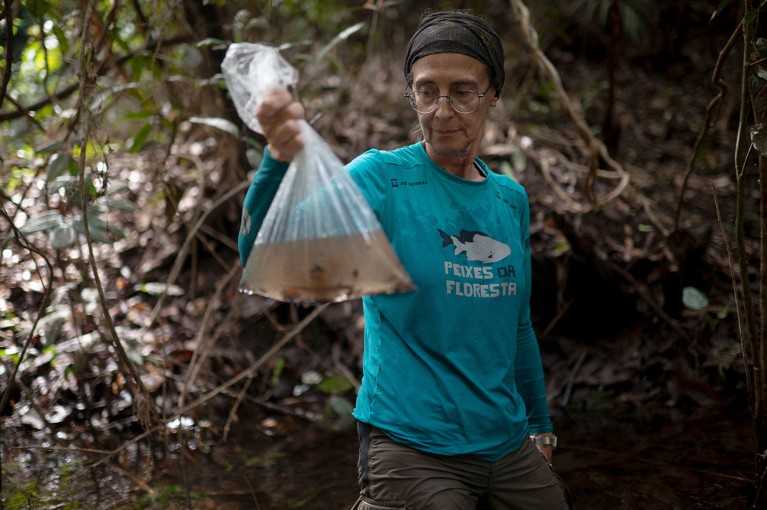
Lucia Rapp Py-Daniel is an ichthyologist at the National Institute for Amazonian Research in Manaus, Brazil. Credit: Mauro Pimentel/AFP via Getty
When I first came to the Amazon from central Brazil in 1978, I was planning to stay just a year, but I was mesmerized by the size of the rainforest’s rivers and its biodiversity. I ended up staying longer and earned my master’s degree in aquatic biology in 1984 from the National Institute for Amazonian Research (INPA), in Manaus, Brazil. I then went to get my PhD in ecology and evolutionary biology at the University of Arizona in Tucson, and returned to Manaus in 1998 to work as an ichthyologist at INPA.
I was part of the team that started INPA’s fish collection in 1978. At the time, most scientific information on Amazonian fish, including specimens, had been collected by researchers and stored at other institutions around the world. Brazilians couldn’t easily access any of it. Now, INPA has preserved and catalogued more than 600,000 fish, all of which are available to our graduate students and scientific community.

This picture, from last June, was taken at a Manicoré River creek in northwest Brazil during a Greenpeace expedition. I’m holding a bag of small fish, collected using sieves.
Since 2006, the riverside communities on the Manicoré have been advocating for a reserve to protect their land from non-sustainable practices. They asked Greenpeace to help map the area’s biodiversity to bolster their application. Greenpeace in turn invited INPA researchers for its mapping expedition. We spent 20 days collecting and registering the wide range of creatures in the Manicoré’s basins.
Besides fires, the Amazon has been hit hard by deforestation and industrial activities. We registered a decline in populations of several fish species after the construction of the hydroelectric complex of Belo Monte — the second- largest in the world — in the Xingu River. These species can thrive only in the oxygenated environment of running rivers and waterfalls, which have been largely destroyed.