This Blog Post is now in the queue for publishing as requested.
Depending on transfer load expect completion in around 15 minutes or 60 minutes if it has just been published by the owner.
This Blog Post has been removed from the queue for publishing as requested.
Mars's glowing auroras snapped by Hope spacecraft
Posted by
Otto Knotzer on July 03, 2021 - 10:25am
Images from the orbiter are the most detailed yet of the planet's discrete auroras, ultraviolet emissions that follow the patterns of a decaying magnetic field.
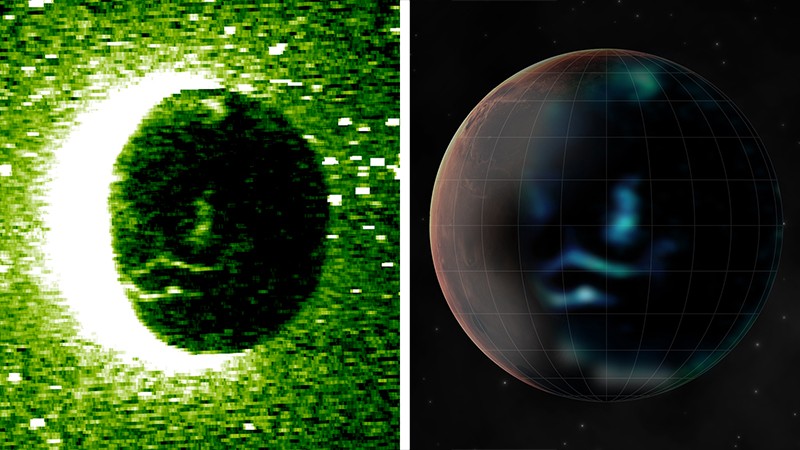
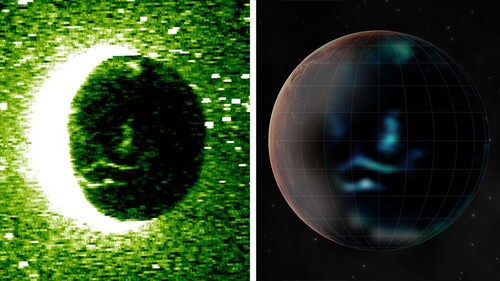
Images taken by Hope's onboard spectrometer (left hand panel) and an artist's impression (right) show discrete auroras on Mars's night side.Credit: Emirates Mars Mission
The United Arab Emirates’ Hope spacecraft has taken the most detailed pictures yet of the ‘discrete auroras’ of Mars. The ultraviolet emissions — seen by the orbiter’s onboard spectrometer — arise when solar wind runs into magnetic fields that emanate from Mars’s crust. Charged particles then collide with oxygen in the upper atmosphere, causing it to glow.
Hope, formally known as the Emirates Mars Mission (EMM), arrived at Mars in February and started its official science run on 23 May. The primary science goals of the 1.35-tonne, US$200-million mission focus on the planet’s atmosphere, not on its magnetism, so the aurora images came as a bonus. “Seeing it has been just a gift,” says Hessa Al Matroushi, the EMM’s science lead at the Mohammed Bin Rashid Space Centre in Dubai.
Mars researchers had previously detected ‘diffuse’ auroras during solar storms, as well as ‘proton’ auroras emanating from high altitudes when solar-wind protons rip electrons off atoms to form hydrogen1. The discrete auroras seem to follow the patterns of Mars’s crustal magnetism, which suggests that the planet once had a global magnetic field similar to Earth’s. Those patterns are thought to have frozen in place billions of years ago, when lava solidified in the presence of such a field.
The emissions seen by Hope were first detected by the European Space Agency’s Mars Express satellite in 2004, and have been previously imaged by NASA’s MAVEN probe. But the EMM took “spectacular images”, says Nick Schneider, a planetary scientist at the University of Colorado Boulder who is part of the MAVEN team. “From my work on the topic, I immediately recognized the way the aurorae draw an outline around the last vestiges of Mars’ decaying magnetic field. These images really capture the fact that Mars has lost its global field, the suspected cause of the disappearance of its earlier thick atmosphere.”
Al Matroushi says that her team plans to publish a study based on the observations.