x





Brain cells are crucial for triggering fights — but also become active when mice merely observe fights.
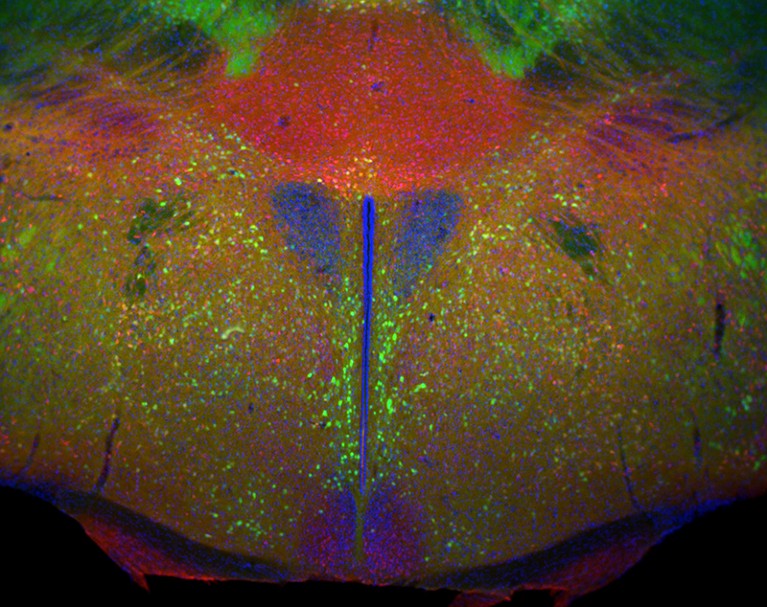
The hypothalamus of a mouse (red marks a signalling protein). This brain region contains cells called mirror neurons that are involved in aggressive behaviour.Credit: NIH/Avalon
A group of brain cells in mice becomes active both when the animals fight and when they watch other mice fight, a study1 shows. The work hints that such ‘mirror neurons’, which fire when an animal either observes or takes part in a particular activity, could shape complex social behaviours, such as aggression.
The mirror neurons described in the study are the first to be found in the hypothalamus, an evolutionarily ancient brain region — suggesting that mirror neurons’ original purpose might have been to enhance defence and, ultimately, reproductive success, the authors speculate. The study was published in Cell on 15 February.
“We’ve now shown that mirror neurons functionally participate in the behaviours they’re mirroring,” says Nirao Shah, a neuroscientist at Stanford University in California who co-authored the study. “That changes what we think about mirror neurons.”
First identified in monkeys in the 1990s, mirror neurons generally fire when an animal takes a certain action, but they also fire when it sees another animal perform the same action. Previous work has linked mirror neurons’ activity to simple behaviours, such as reaching for an object, but not to complex social behaviours, such as fighting.
But exactly how mirror-neuron activity contributes to cognitive functions has been controversial, says Pier Francesco Ferrari, a neuroethologist at the Institute of Cognitive Science Marc Jeannerod in Lyon, France. Some researchers have argued that the fact that mirror neurons fire both when an animal observes a behaviour and when it performs that behaviour itself shows that these neurons are involved in a higher-order awareness of others’ actions — and perhaps even contribute to empathy. But others say that there is little evidence to support this theory.
Mirror neurons have mostly been found in the prefrontal cortex, an area of the brain responsible for regulating social behaviours. But experiments by Taehong Yang, a neuroscientist at Stanford University who co-authored the latest study, and his colleagues made them wonder whether there might be mirror neurons in the ventromedial hypothalamus (VMH), a region that some researchers have called the brain’s attack centre. In 2017, Yang and his colleagues found2 that in certain social situations, activating the VMH neurons in mice did not trigger aggression. This made the researchers think that the VMH might include mirror neurons, which are sensitive to other individuals’ actions.
Yang and his colleagues recorded VMH neurons when male mice watched others fight. They found that some VMH neurons fired both when an animal itself acted aggressively and when it watched others do so. Using a genetic-marker system, the researchers also showed that these neurons don’t just act as bystanders to the fight but are essential for triggering fighting.
Ferrari says that the study doesn’t answer why animals have mirror neurons. But he says that the experiments are well done and that the results hint that mirror neurons might be essential to a social behaviour such as aggression. For example, the mirror neurons — or an entire system of neurons of which VMH neurons are part — of a mouse watching a fight might encode which animal wins that fight.
Scientists knew previously that neurons in the hypothalamus control behaviour, but this is the first evidence that neurons in this region “are actually able to sense or respond to another animal’s social experience”, says Dayu Lin, a social neuroscientist at NYU Langone Health in New York City. It is especially striking that these neurons respond to visual cues in an animal species that relies so heavily on smell, she adds.