x




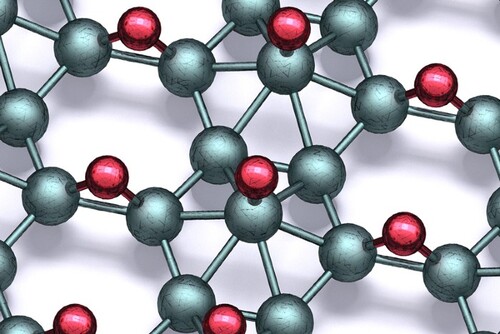

Borophane (artist’s illustration) is a strong, lightweight material made up of atoms of boron (grey) and hydrogen (red). Credit: Mark Hersam/Northwestern University
The addition of hydrogen turns a highly reactive sheet of boron atoms into a stable material.
Materials scientists have created borophane, the first stable two-dimensional form of boron.
Before borophane came borophene — a boron analogue of the 2D wonder material graphene, which is composed entirely of carbon atoms. Graphene’s atoms are arranged in a hexagonal lattice, whereas the atoms in borophene are arranged in various mixtures of hexagons and triangles that can be fine-tuned depending on the material’s desired application. But borophene has a limitation that graphene doesn’t: it quickly oxidizes if removed from a vacuum chamber.
Mark Hersam at Northwestern University in Evanston, Illinois, and his collaborators deposited atomic hydrogen onto borophene’s surface, creating stable borophane. The team also showed that the process could be reversed. Heating borophane — which could be done after it has been coated with an inert compound to permanently seal it off from the air — drives off the hydrogen, yielding a coated form of borophene that is stable outside a vacuum.
Both borophene and borophane are strong and flexible and good electrical conductors, making them potentially useful in display-screen technology.