x





The charge relates to how GNS Science communicated volcanic risk to contractors in the years before the Whakaari White Island eruption in 2019.
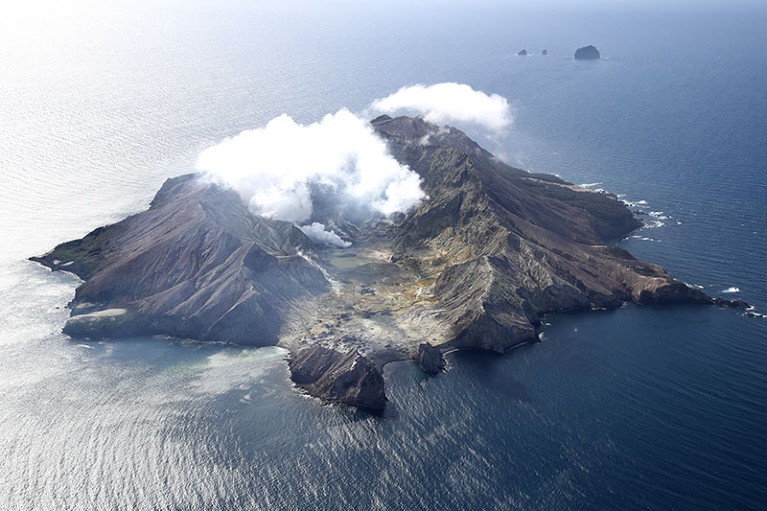
Whakaari White Island erupted in December 2019, killing 22 people and injuring 25 others.Credit: Phil Walter/Getty
New Zealand’s Earth-science research agency, GNS Science, has pleaded guilty to a charge relating to workplace safety, laid against it after a fatal volcanic eruption on Whakaari White Island prompted closer examination of way the agency communicated risk. The December 2019 eruption killed 22 people and injured 25 others, most of them tourists visiting the popular spot. The workplace safety charge was unrelated to these deaths.
GNS Science, which is based in Lower Hutt, New Zealand, monitors New Zealand’s 11 active volcanoes and the volcanic field beneath the nation’s most populous city, Auckland. It issues alert bulletins through a service called GeoNet, which disseminates them to registered media and emergency-response agencies, as well as to the public.
In November 2020, New Zealand’s workplace health and safety regulator, WorkSafe New Zealand, charged GNS Science with two offences. A judge dismissed the first charge, which alleged that GNS Science had failed to adequately communicate volcanic risk to the public, in October 2022.
The second charge related to helicopter pilots that GNS Science had hired to fly its employees to Whakaari White Island for fieldwork. The charge alleged that GNS Science had failed in its duty of care by not including the pilots in its risk-assessment processes and not adequately communicating the volcanic risk to the pilots. In so doing, the charge alleged, the agency had put the pilots at risk of death or serious injury. That charge carried a maximum penalty of NZ$1.5 million (US$915,000).
GNS Science has now pleaded guilty to a lesser charge, acknowledging in a statement that it "failed to sufficiently consult, co-operate and co-ordinate with the helicopter operators", but not that there was a risk of death or serious injury.
Simon Connell, a lawyer and specialist in accident law at the University of Otago in Dunedin, New Zealand, says the plea highlights that research agencies should share their risk assessments with people they have hired to carry out relevant work. “That sort of information-sharing should be happening anyway, but this case is a reminder that [it] is required by health and safety law,” he says.
In the 11 months leading up to the fatal Whakaari White Island eruption, helicopter pilots transported GNS Science staff to the island 23 times and remained on the island while the scientists carried out their work. The period included an April 2016 eruption that was similar in size to the fatal 2019 eruption, but this occurred at night, when no-one was on the island. The period did not cover the fatal eruption itself.
The penalty, which could incur a fine of up to NZ$500,000, will be decided at a sentencing hearing in August.
Risk assessments for fieldwork are commonplace in research institutes, says Raymond Cas, a volcanologist at Monash University in Clayton, Australia. Any volunteers that assist in fieldwork are also covered by the risk assessments, says Cas, and require university approval to participate in the work. “I think we can do field research in a reasonably safe and considered way,” he says, but “there are obviously some situations where it is not safe.”
People who work with volcanoes all the time “basically inherently know what the risks are”, says Kenneth Rubin, a volcanologist at the University of Hawaii in Honolulu. “But for people who don’t, it is very important to convey to them exactly what is going on,” he says.
Connell says that science agencies might have more information about the safety conditions of a site, or of travel to a site, than a contractor. “There needs to be a structured process in place to make sure that that information is shared,” he says.