x




Not the end of the regime
Philipp Jahn in Khartoum on the overthrow of Omar Al-Bashir and the intentions of the new military government.
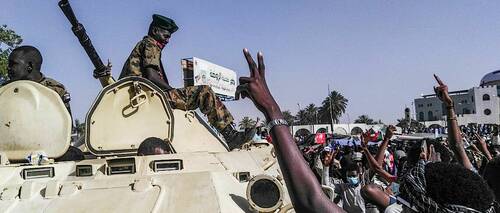
Protesters in Khartoum on April 9.
Philipp Jahn heads the FES country office in Khartoum, Sudan. Previously, he worked for GIZ in Afghanistan, Ethiopia, Azerbaijan and Germany. He worked for three years as a consultant for anti-corruption and integrity for the Federal Ministry for Economic Cooperation and Development (BMZ).
After months of mass anti-government protests, the armed forces arrested President Omar Al-Bashir on Thursday. What is the current situation in Sudan?
On Thursday afternoon, the Sudanese Defense Minister announced on television that Al-Bashir had been arrested and the military had taken over government affairs for two years. The morning of the same day, the military had occupied state television and other strategic locations in the capital. Sudanese airspace was blocked for 24 hours and a night curfew was imposed. In the eight hours between taking power and speaking to the Defense Minister on TV, the residents of Khartoum rushed to the streets to party. Cars with Sudanese flags honked through the streets. The center of the celebrations was the demonstrators' camp in front of the military headquarters. After the announcement of two years of military rule, the mood changed.
Opposition groups condemned the coup and protested the new military government despite the curfew. What are they asking for?
All observers agree that the disempowerment of Omar Al-Bashir does not mean the end of the regime. The latter only sacrificed the president when it found no way to stall the protests. It will also have played a role that more and more military ranks have overflowed to the demonstrators. Military and intelligence shootings had increased in the past four days. The regime had to act out of self-preservation before it lost control. However, the face of the military regime, Defense Minister Ibn Ouf, is perceived by the demonstrators as a classic regime representative. He is an officer and was appointed Vice President by Al-Bashir in February. The demonstrators are now really calling for political changes and the formation of a transitional civil government staffed by technocrats.
How does the army react to the demonstrators?
The situation is very confusing. Another military press conference was held on Friday. My impression was that the military is promoting understanding among the demonstrators. The situation within the regime seems extremely fragile. Further armed conflicts within the regime cannot be ruled out. The role of the militias and the secret service is completely unclear. Their leaders seem integrated into the new military government, but there have been conflicting reports about their role. The demonstrators also seem to be partially divided. Many of the demonstrators had hoped for military intervention, but the young generation on the street is dissatisfied with the result. The political leaders of the demonstrators and the military regime must now find a political solution that is supported by the demonstrators on the street and the military ranks.
Omar Al-Bashir is being sought by the International Criminal Court in The Hague for an arrest warrant for genocide. The Sudanese military has already announced that it will not extradite him. How will it go on with him?
The military government wants to put him on trial in Sudan. The military also explicitly left it open that a later civilian government could extradite him to the International Criminal Court. I understand the international community's right to punishment, but beyond the crimes in Darfur there is a claim to punishment by the Sudanese population. Over 60 people have died in the past four months of protests alone, at least seven this week.