x




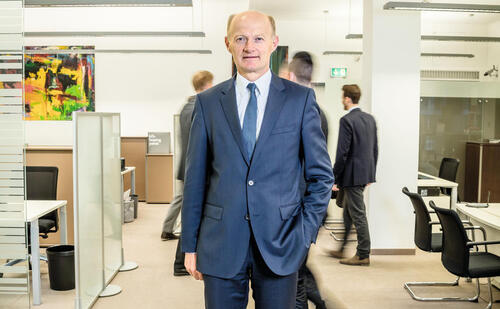
Oberbank boss Gasselsberger: "I'm surprised that there is no outcry"
Oberbank boss Gasselsberger: "I'm surprised that there is no outcry"
Franz Gasselsberger, head of the Oberbank, is frustrated by the ECB's monetary policy, but does not want to bunker cash. Despite losses, he wants to hold onto industrial holdings like Voest.
trend: Mr. Gasselsberger, the economy is deteriorating. Do you already feel this when it comes to credit demand?
Franz Gasselsberger: Basically, it can be said that the year 2019 went a little worse in economic terms than the forecasts would have us believe. Conversely, 2020 could turn out to be a little better than predicted. Until recently, we were still discussing recession. In my view, this has been canceled, but we can already see the economic downturn. However, I hear from some companies in critical industries, keyword automotive suppliers, that the first quarter of 2020 could develop somewhat better than expected. In any case, we still have good credit demand, and in some sectors, such as the real estate, construction or tourism sector, we even have very good one. We even see an increase in investment loans across all sectors, even though major projects have declined by 35 percent.
Are the risk costs increasing?
Gasselsberger: Not yet, although I believe that we are entering a phase of normalization. We expect higher risk costs in 2020.
Will Oberbank record results again in 2019?
Gasselsberger: We had a very good result after nine months, but I don't want to make a definite decision on the annual result because experience has shown that volatilities always occur at the end of the year and the consolidated financial statements are also influenced by the result from investments. But in terms of operations, we will continue to grow in 2019.
Their result is affected by the poor performance of the Voest holding. Basel IV will also require more equity to be deposited. A problem?
Gasselsberger: For us, Basel IV is no problem at all with regard to industrial holdings. Because the Oberbank is very well positioned with more than 17 percent core capital. Our three industrial holdings - Voest, Lenzing and Energie AG - have given us so much pleasure in recent years that we will definitely stick to them in the long term.
We are far from over-branched.
The Oberbank is working on a "Strategy 2025". What are the cornerstones?
Gasselsberger: We are still working very intensively on it, but the three main topics are clear: digitization, expansion and sustainability. 75 percent of our customer contacts are now digital. In payments, it is almost 100 percent. Increasing efficiency and cost potential through digitization are even higher than I thought. Loans of up to EUR 15,000 will be available online from mid 2020. But we are and will remain an advisory bank. At the end of the day, banks will only differ from each other in their employees. The human factor will become even more important.
Will you continue to expand with branches against the industry trend?
Gasselsberger: We have made a lot of progress this year: Saxony is closed, Baden-Württemberg has been pushed. We opened a total of seven new branches. Next year, six to seven new branches will be added, including one each in Hungary and Slovakia. But we are by no means over-branched. With 180 branches in Austria and Germany, we really cannot be called a classic local supplier. We have always pursued our expansion with a sense of proportion.
What do we have to imagine under the chapter sustainability?
Gasselsberger: It's a topic that has to be taken very seriously, and not just since Greta Thunberg. The climate debate has hit the banks with great force and speed. At EU level, a $ 3 trillion fund for green investments was decided overnight. Although I'm curious about the tensions, for example if some countries also include nuclear power. The Austrian Ministry of Sustainability is also working on concluding a green finance pact with the banks. In it we should commit ourselves, for example, to only make more sustainable investments and financing.
What do we have to imagine under the chapter sustainability?
Gasselsberger: It's a topic that has to be taken very seriously, and not just since Greta Thunberg. The climate debate has hit the banks with great force and speed. At EU level, a $ 3 trillion fund for green investments was decided overnight. Although I'm curious about the tensions, for example if some countries also include nuclear power. The Austrian Ministry of Sustainability is also working on concluding a green finance pact with the banks. In it we should commit ourselves, for example, to only make more sustainable investments and financing.
Are the banks sufficiently prepared for this development?
Gasselsberger: We already believe that there are enough green investments and that they are no less profitable than others. The capital market is a strong driver for green finance, and ratings for sustainability are being established. But when it comes to the fact that more equity capital is required for non-green financing, that makes me think. I wonder how the criteria for sustainability are clearly defined. It is better for politicians to issue clear bans and not to misuse the banks to fight the customer. Europe as a banking location has to be careful not to fall behind too much as a model student compared to the USA.
The banks are all too discouraged.
Apart from that, can the Oberbank still invest its money profitably in the zero interest rate environment?
Gasselsberger: We have a hard time. Low-risk investments have become de facto impossible because bonds are practically eliminated. In 2019, of course, like other investors, we also benefited from the good development of the stock markets.
In Germany, banks are already advised to hoard cash instead of paying negative interest to the ECB ...
Gasselsberger: We did the math for insurance and room costs: it doesn't pay off. The ECB's monetary policy is absolutely frustrating because it has achieved nothing. There has been a failure to use the boom phase to normalize, unlike the Americans, and to push the heavily indebted national budgets into reforms. I am surprised that in Austria the outcry is no greater. The loss of real value of money is quietly acknowledged, while in Germany there is loud talk of theft.
Would you charge negative interest to your private customers if it were allowed?
Gasselsberger: The question does not arise, and that's why I don't speculate about it.
Will you have to increase bank fees in Austria instead?
Gasselsberger: The competition in Austria is too strong for a bank to rush here. We are all too discouraged.
What framework conditions do you hope for from a new government?
Gasselsberger: I don't want a good-weather government, but one that is ready for serious reforms: finally a tax reform, a spending brake, a revitalization of the capital market and a pension reform. The latter is central to me because it could create a lot of leeway in the budget. The pension subsidy already amounts to 22 billion euros a year. But apparently the ÖVP does not want to annoy its main clientele. The reform would just be a question of the right marketing.
UniCredit needs money. That may also explain the appetite for the 3-bank group.
How do you concretely envisage a revival of the capital market?
Gasselsberger: I don't just mean more financial education, but concrete measures: The capital gains tax should be based on the retention period for securities. In addition, the second and third pillars of the pension system should be incentivized by the state. If the Austrians save taxes, then they run.
The last government had a financial supervisory reform ready, which was also criticized. Are you advocating their implementation?
Gasselsberger: It has to be said that the FMA has developed very positively. She is increasingly looking for talks with the banks, senseless punishments have decreased. Regulatory reform should increase efficiency, reduce costs and increase transparency. The finished package would meet these requirements. Therefore, we would be in favor of doing it the same way. The operational supervision should lie entirely with the FMA, also because it has a much cheaper cost structure than the OeNB.
The 3-bank group including Oberbank is in dispute with its largest shareholder, UniCredit. How much time and money does it cost?
Gasselsberger: UniCredit actually broke a flood of lawsuits. The lawyers are certainly busy on both sides. Of course, we as the board of directors also keep a close eye on it. But that cannot distract us from our day-to-day business.
What is your forecast? How will it end?