x





Patrick Vallance, Chris Witty and others reflect on advising the UK government during the ongoing investigation into the country’s pandemic response.
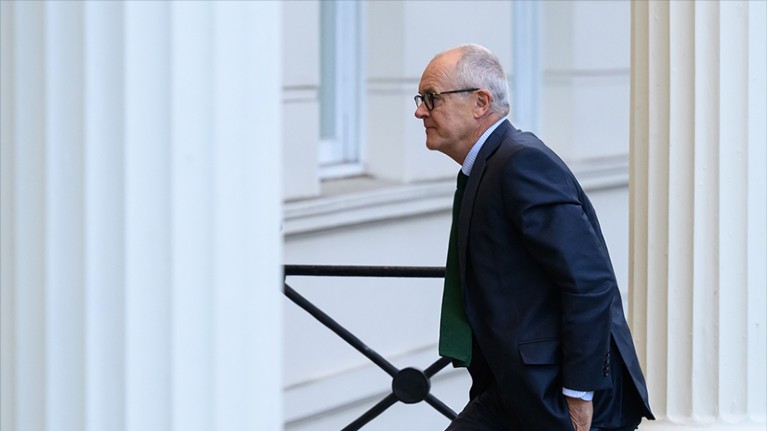
Former UK chief scientific adviser Patrick Vallance spoke at the COVID-19 inquiry on 20 November.Credit: Leon Neal/Getty
Politicians and civil servants didn’t have the scientific knowledge necessary to understand research-based advice during the COVID-19 pandemic, a public inquiry into the UK government’s response to the crisis has heard.
The inquiry was set up to investigate how prepared the United Kingdom was for the COVID-19 pandemic, how decisions were made during the pandemic and the impact that the crisis had on the health-care system. The investigation started in 2022, and is expected to continue hearing evidence until mid-2026.
This week, the inquiry heard from key science advisers, including the government’s current chief scientific adviser, Angela Mclean; Patrick Vallance, who was chief scientific adviser from 2018 until 2023; Chris Whitty, the chief medical officer (CMO) for England and chief medical adviser to the government; and Jonathan Van-Tam, a deputy CMO.
How to convince a politician: a science adviser’s lessons from the pandemic
In his testimony, Vallance said that during the pandemic, then-prime minister Boris Johnson struggled to understand data shown in graphs. This problem was not unique to the UK government, Vallance said. He recalled a conversation in which a group of other European science advisers discussed how to explain exponential curves to ministers. “The entire phone call broke into laughter,” Vallance said.
“Most politicians are honest about not knowing enough science and rely on experts. The onus is thus on scientists to offer the right advice based on science and evidence,” says Shahid Jameel, a virologist at the University of Oxford, UK, who advised the Indian government during COVID-19. “In a fast-moving situation such as a pandemic, the evidence itself changes in time. That is where it gets difficult. Science is a process, which most people, including politicians — and some scientists — do not understand.”
Vallance has said previously that the civil service needs to recruit more science graduates, and he led a drive to do that during his time as the chief scientific adviser.
“I increasingly think some scientists need to be appointed as ministers, taking part in decisions and being held accountable for them, rather than just as external advisers,” says Geoff Mulgan, who researches public policy at University College London and previously worked as head of policy in the prime minister’s office and director of the UK government’s strategy unit during the 2010s.
The inquiry has also highlighted tension around the publication of minutes from scientific-advice meetings. The UK Scientific Advisory Group for Emergencies (SAGE) began to publish its minutes partway through the pandemic. Vallance said in his evidence that this move led to reluctance among civil servants and politicians to participate or speak in SAGE meetings, because their remarks would be published. “That is a very bad outcome,” Vallance said, although he added: “I don’t think the answer is to reach for more redaction or more secrecy.”
Preparing the world for the next pandemic
“My view is that transparency works best in science,” says Kit Yates, a mathematician at the University of Bath, UK, who was part of Independent Sage, a group of UK scientists who set up a separate advisory group. “If you are going to ask people to undergo severe restrictions on liberties and livelihoods based on scientific advice, scientists owe it to the public to explain the science and the modelling behind those decisions.”
“Increased transparency also leads to increased accountability. Being able to scrutinize the minutes of scientific committees such as SAGE means that outsiders can verify the assertions and check the results for themselves,” Yates adds. “This reproducibility and replicability through transparency lies at the heart of science and it should be no different in the case of emergencies.”