Scientists are mapping correlations between race, poverty and heat in cities, and suggesting solutions to reduce the dangers.
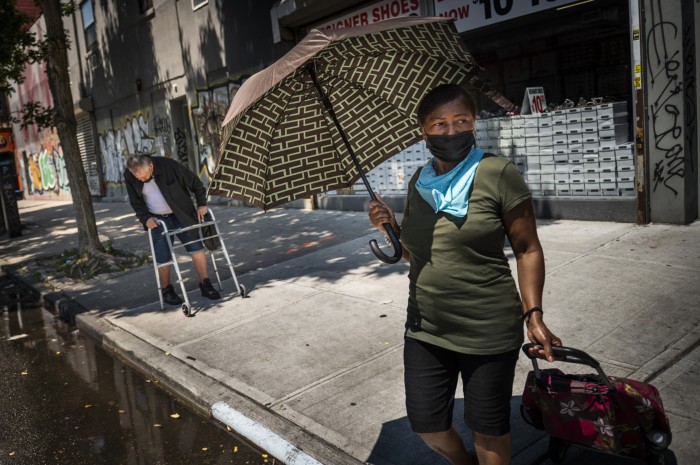
New York City residents endured near-record high temperatures in late June during a heatwave that caused power outages. Credit: Mark Kauzlarich/Bloomberg/Getty
Luis Rodriguez holed up in his kids’ bedroom last month as a brutal heatwave baked his Los Angeles neighbourhood and the rest of the southwestern United States. The space was their only room with an air-conditioning unit, and the safest place in the house when temperatures outside soared above 40 °C.
All day, Rodriguez tapped on his computer, working remotely as a volunteer manager for TreePeople, a non-profit environmental organization in Beverly Hills, California, that plants and cares for trees across Los Angeles. His two young sons crammed into the bedroom with him to avoid the dangerous heat. Only as evening fell would they emerge, after temperatures in the house had climbed so high that it was cooler outside. The boys played in the shade of the fig tree Rodriguez planted in front of his house — as much for its large, shade-producing leaves as for its delicate fruit.
From Los Angeles to Lagos, extreme heat is a growing problem. As temperatures soar and heatwaves become more common because of global warming, people living in cities are particularly at risk. Asphalt, concrete and other surfaces that absorb and emit heat make many urban environments much hotter than suburban or rural areas.
To help reduce the risk of heat stroke and other heat-related illnesses, urban planners, meteorologists, climate experts and other scientists are working to identify the most vulnerable neighbourhoods. Underlying such efforts is a growing awareness of how extreme heat takes a disproportionate toll on people of colour and those in lower-income communities. Racist urban policies, particularly in the United States, have left communities of colour at higher risk of heat-related illness or death than their white neighbours.
In the past few years, a growing body of research has revealed the environmental injustices that have left some residents baking in vast expanses of asphalt while other urban neighbourhoods benefit from green parks, spacious lawns and sprawling trees. “It’s really shocking,” says Angel Hsu, a climate scientist at the University of North Carolina in Chapel Hill. “We have to ask ourselves why — to try to figure out why these patterns are so consistent and so pervasive.”
Similar inequalities threaten urban residents in many other countries, but some of the best-documented examples are in the United States, where researchers are increasingly exploring the links between discriminatory policies and heat risks. Many cities are now working to incorporate heat equity into their urban planning, such as by planting trees and painting roofs white in neighbourhoods that have typically received fewer resources. But such climate-adaptation plans have a long way to go to counter decades of deliberate neglect of the most vulnerable residents.
Fatal conditions
Worldwide, more than 166,000 people died in heatwaves between 1998 and 2017, according to the World Health Organization. That makes heat among the deadliest of all weather-related disasters, including cold spells, floods, lightning and hurricanes. Yet its impact is routinely underestimated, because death certificates commonly list a cause of death, such as heart failure, without noting that the person had been exposed to high temperatures.
In a study1 of deaths and emergency hospital admissions in Houston, Texas, between 2004 and 2013, scientists found that people older than 65 were probably dying as a result of hot days at higher rates than had been officially recorded. “Extreme heat is one of the underappreciated natural hazards,” says Olga Wilhelmi, a geographer at the National Center for Atmospheric Research in Boulder, Colorado, and an author of the study.
Extreme heat can trigger fatal heat exhaustion or heat stroke, which occur when a person’s body cannot cool itself enough. Heat stress can also kill by exacerbating underlying conditions, such as cardiovascular or respiratory disease. Most vulnerable are children, older people and those with chronic health conditions or who work outdoors. But even healthy younger adults can die if the heat is bad enough. Many people die during stretches of hot weather, especially when temperatures don’t drop much at night2,3.
Some of the most lethal heatwaves have occurred in temperate cities that were suddenly exposed to extreme heat. At least 14,000 people died in a heatwave that blasted France in 2003, and more than 700 perished in Chicago, Illinois, in 1995. The full toll of a record-breaking heatwave in the northwestern United States and southwestern Canada last month is not yet clear, but hundreds of people are thought to have died from the heat.
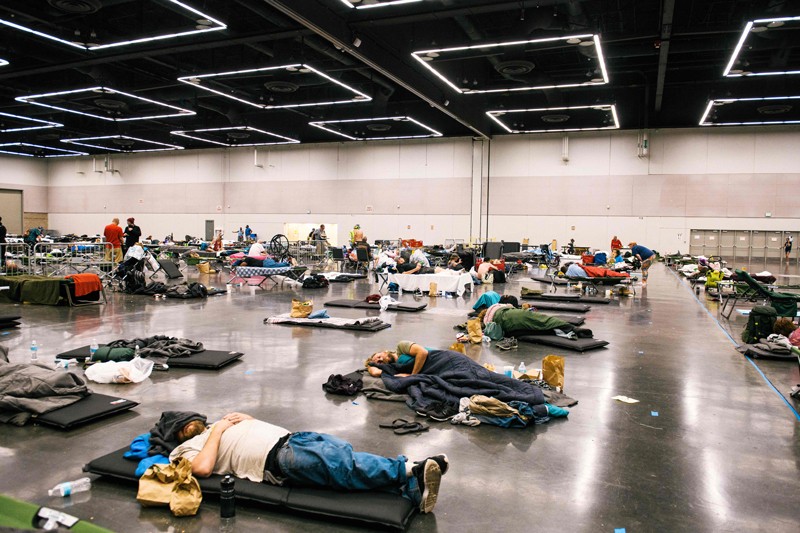
Residents of Portland, Oregon, seek relief in a cooling centre on 28 June, the third straight day of record high temperatures for the city.Credit: Kathryn Elsesser/AFP/Getty
Although heatwaves affect people in rural areas, cities often bear the brunt of the impact. That’s because of the urban heat-island effect, in which the materials that make up streets and buildings cause the air to heat up more than in leafier areas. On average, central urban areas are several degrees celsius warmer during the day than the surrounding countryside — but they can be much hotter than that.
In many cities around the world, the most vulnerable residents face the greatest risk. In Qatar, many migrant workers in the construction industry die from cardiovascular failure brought on by heat stroke4; a study of more than 1,300 workers from Nepal who died between 2009 and 2017 found that heat-protection measures could have saved the lives of up to 200 of them had effective programmes been in place4. In Bangkok, a survey5 of 505 residents conducted during the hot season in 2016 found that people on low incomes were more likely to report experiencing heat stress than were those on high incomes.
Climate models project that the problem will only get worse. Not only are average summer temperatures rising, but heatwaves are becoming more frequent and more intense, and are lasting longer. An international research team reported in May that approximately 37% of heat-related deaths across 43 countries can be linked to human-induced climate change6.
Inequality in hotspots
For Hsu, the challenge became clear when she was working in Singapore, where parts of the urban core can be up to 7 °C hotter than nearby regions. She now runs a data-analytics group that works on climate-change solutions — and has taken a hard look at the racism that helps to determine who in the United States is most exposed to extreme heat, and why.
Hsu likes to point out that her hometown of Greenville, South Carolina, is not green for everyone. The parts of town that experience the most heat stress are populated mostly by Black people, Hsu has found. In one of the broadest studies yet to look at differential heat exposure in the United States, she and her colleagues combined satellite measurements of urban heat with census data that included detailed demographic information about who was living in which parts of 175 cities7.
Hsu says she expected to find disproportionate exposure, but was shocked by the sheer magnitude of the difference. In 97% of the cities, communities of colour were exposed to temperatures a full degree celsius higher, on average, than communities composed mostly of non-Hispanic white people. “We see systemic, pervasive and widespread evidence of environmental racism with respect to urban heat island exposure,” she says. “I didn’t think it was going to be basically universal.”
Exposure to heat also correlated with income; people living below the poverty line, irrespective of race or ethnicity, were exposed to higher temperatures than were those above the poverty line.
Yet race remains the factor that shapes so much of US urban heat exposure. And the history traces back more than a century and a half. After the United States abolished slavery in 1865, housing policies across the nation were designed to systemically exclude people of colour, particularly Black people, from living in certain neighbourhoods.
One major driver for today’s differential heat exposure was a federal loan-approval programme created by Congress in 1933, which was meant to help people to pay their mortgages during the Great Depression. The corporation overseeing the loans drew up detailed neighbourhood maps in 239 US cities, ranking them from A (perceived as the safest place for banks to invest) to D (perceived as the riskiest). Neighbourhoods with a high percentage of minority racial or ethnic groups or immigrants were almost inevitably graded as D — often with racist annotations from the corporation representative — and marked as red on city maps.
This ‘redlining’ practice led to deliberate decisions that affect nearly all aspects of many US cities, including access to schools, parks and other community facilities. And over the past several years, the environmental non-profit organization Groundwork USA, a network of local groups across the country, has worked with various research teams to compare those redlining maps against modern environmental risks such as extreme heat and flooding (see ‘Inequality and extreme heat’). “You can see how little investment has been done in the areas that were redlined,” says Jasmin Barco, a community organizer at Groundwork Denver in Colorado. “It’s just crazy.”