x





Human depletion of underground reservoirs has shifted the global distribution of water so much that the North Pole has drifted by more than 4 centimetres per year.
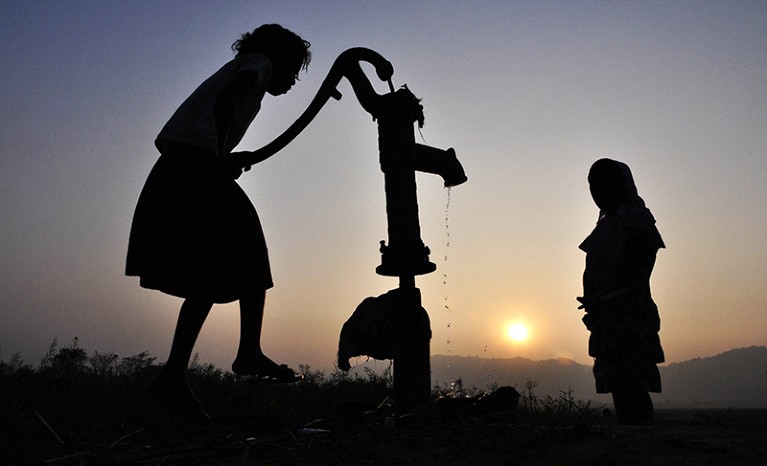
Children collect drinking water from a well in Murkata, India.Credit: Biju Boro/AFP via Getty
The Earth has lost enough groundwater to thirsty humans to measurably tilt the planet’s axis of rotation1.
The net water lost from underground reservoirs between 1993 and 2010 is estimated to be more than 2 trillion tons. That has caused the geographic North Pole to shift at a speed of 4.36 centimetres per year, researchers have calculated. The results appeared on 15 June in Geophysical Research Letters.
The tilt of the axis on which any celestial object spins tends to be stable. But small changes can occur when large masses shift location inside a planet and on its surface. “Every mass moving around on the surface of the Earth can change the rotation axis,” says Ki-Weon Seo, a geophysicist at Seoul National University.
Astronomers can track such motions in the Earth’s axis by observing quasars, the bright centres of distant galaxies that constitute practically immobile points of reference. The largest axis change is seasonal and is triggered by the motion of atmospheric masses as the weather and seasons change. This effect causes the Earth’s geographic poles to wobble by up to several metres every year.

The world faces a water crisis — 4 powerful charts show how
Shifts in water masses can cause smaller but still measurable changes in the tilt of Earth’s axis. Until recently, researchers thought that these water-driven effects would be caused mainly by the melting of glaciers and ice caps. But when Seo and his collaborators tried to model the Earth’s water content to account for how much the axis has tilted, they could not fully explain the data. Adding the effects of changes in surface reservoirs did not help, says Seo, “so I just scratched my head and said, ‘probably one effect is groundwater’”.
Gravitational surveys have measured the depletion of underground reservoirs, which is caused in large part by irrigation, especially in northwestern India and western North America. These surveys show that groundwater pumping shifted enough mass into the oceans to cause 6.24 millimetres of global sea-level rise between 1993 and 2010.
By including these changes in their model, the authors calculated that they should have a substantial impact on the Earth’s rotation axis. They predicted that the displacement of groundwater alone causes a shift in the North Pole of 4.36 centimetres per year, roughly in the direction of Russia’s Novaya Zemlya islands.
The research “distills the magnitude of groundwater extraction across the globe to a significant, relatable metric,” says Allegra LeGrande, a climate scientist at the NASA Goddard Institute for Space Studies in New York City. Seeing yet another global impact of people on the world, she says, gives her a sense of “grief and awe.”