x




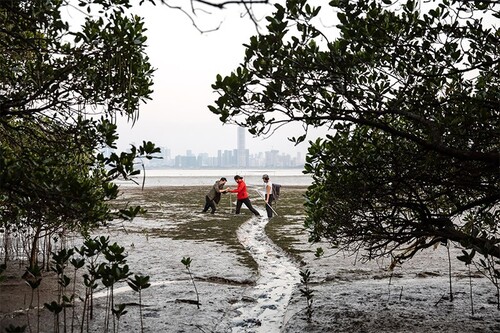
Thanks to huge investments in science, China is the region’s scientific growth engine and collaboration magnet.
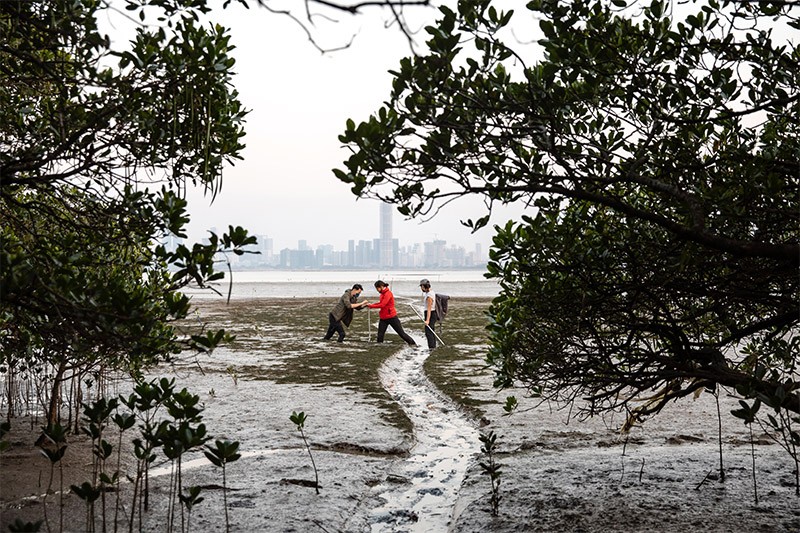
Howard Yu, Nicole Khan and Kayla Murai in the mudflats of Mai Po Nature Reserve, Hong Kong.Credit: Suzanne Lee/PANOS for Nature
Proximity matters. The COVID-19 pandemic, with consequent restrictions on international travel, has placed obstacles in the way of borderless science. But the inability to jump on a plane for a lab visit or conference may add impetus to a related big idea: a more interconnected scientific research system in the Asia-Pacific region.
Nature Index 2021 Asia Pacific
Sustainability and climate-change mitigation in a southeast Asian geographical and cultural framework, and biomedical science focused on Asian or southeast Asian populations are areas for future research prowess, says Tan Eng Chye, president of the National University of Singapore (NUS), southeast Asia’s pre-eminent research institution. Brian Schmidt, vice-chancellor of the Australian National University, Canberra, agrees there are vast opportunities for researchers to work more closely together on subjects of mutual interest across the region.
Regional research partnerships extend capacity by accessing more resources than are available to the partners working alone, including expertise, equipment and funding. China’s ongoing, enormous investments in science have made it not just a magnet for collaborators, but also the region’s scientific growth engine, supplanting Japan. Among the 30 institutions in Asia Pacific that have achieved the greatest increase in their Nature Index Share since 2015, the first 29 are in China; NUS is 30th.
As this supplement also illustrates, indications of scientific ambition and progress, such as increased R&D spending and higher output in the Nature Index, are growing in southeast Asian nations, including Vietnam, Thailand and Indonesia. Tan says it took Singapore decades to build its scientific research capability. But with many of its faculty members now training “in the very best places in the world”, increased investment, and a southeast Asian population exceeding 650 million, he expects neighbouring countries to quickly catch up.