x




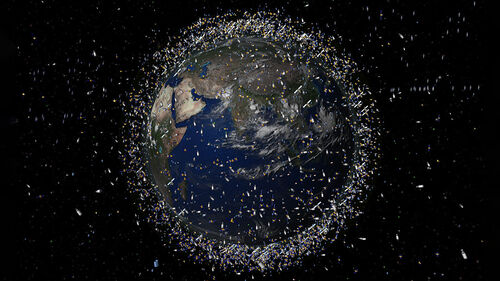

Scattered light from orbital debris (artist’s impression) may add 10% more light to a skyglow that interferes with astronomy.
ESA
By Joshua SokolMar. 28, 2021 , 8:01 PM
There appears to be nowhere left on Earth where astronomers can view the stars without light pollution from space junk and satellites, according to a new analysis. The study considered the tens of thousands of objects in orbit as of 2020—before an onslaught of thousands more satellites that companies plan to launch in the coming years.
“It’s a bit of an eye opener,” says John Barentine, director of public policy at the International Dark-Sky Association, who helped author the study, accepted today in the Monthly Notices of the Royal Astronomical Society and posted online. “As space gets more crowded, the magnitude of this effect will only be more, not less.”
Astronomers are already on edge about megaconstellations of satellites. Since 2019, SpaceX has launched more than 1000 Starlink communications satellites for a global internet service. Tens of thousands more are licensed to follow from SpaceX and other companies such as Amazon in the coming years.
So far, astronomers and advocacy groups like Barentine’s have focused their worries on how the bright trails of individual satellites overhead disrupt naked-eye observers and swamp more sensitive astronomical observations. In response, SpaceX engineers have managed to dim their subsequent satellites to about one-quarter of the brightness of the first prototypes.
But Miroslav Kocifaj, an astronomer at the Slovak Academy of Sciences, had a different concern. He wondered whether the collective cloud of satellites and debris above Earth might scatter light back into the atmosphere more generally. Even if the individual objects aren’t visible, could their presence add an additional background glow to the night sky in a way that would wash out the faintest reaches of the cosmos?
Kocifaj, Barentine, and their colleagues find that they do. Even at the darkest possible sites on Earth, the sky itself has a natural glow in the upper atmosphere from sources like ionized particles. But on top of that background glow, objects already in orbit may add about 10% more diffuse light, they estimate.
That calculation relies on several assumptions, starting with estimates of the number and size distribution of space objects in the mid-1990s, extrapolating the increasing crowdedness of space since then, and guessing how reflective these objects would be on average.
“I look forward to an independent confirmation of the result,” says Pat Seitzer, an emeritus astronomer at the University of Michigan, Ann Arbor, who has modeled the brightness of individual satellites and is collaborating with SpaceX to dim future versions. He says the team’s calculation seems reasonable, but he was surprised at the size of the effect.
In 1979, the International Astronomical Union suggested astronomical observatories should be built only where light pollution adds less than 10% more light over natural skyglow; the new study suggests nowhere on the planet meets those standards anymore.
The human eye can detect contrast differences that small, but Barentine says most stargazers won’t notice. But it could matter to astronomers searching for faint, sprawling objects on the sky such as dim galaxies, which astronomers are studying for clues to the physics of galaxy formation and the nature of dark matter. In order for those faint galaxies to stand out from the sky’s airglow, astronomers already needed long exposures on the biggest telescopes in the darkest sites available.
What matters most for this kind of research is not just the amount of added background glow, but how it varies across the globe—neither of which has yet been actually measured, says Mireia Montes, an astronomer at the Space Telescope Science Institute. A variable airglow would be difficult to subtract out. But, “If it’s uniform, it’s OK,” she says. “You just put more time in, and your images end up being more expensive.”