x





An experiment has been given the go ahead to send lasers to orbit the Sun to hunt for gigantic ripples in space-time.
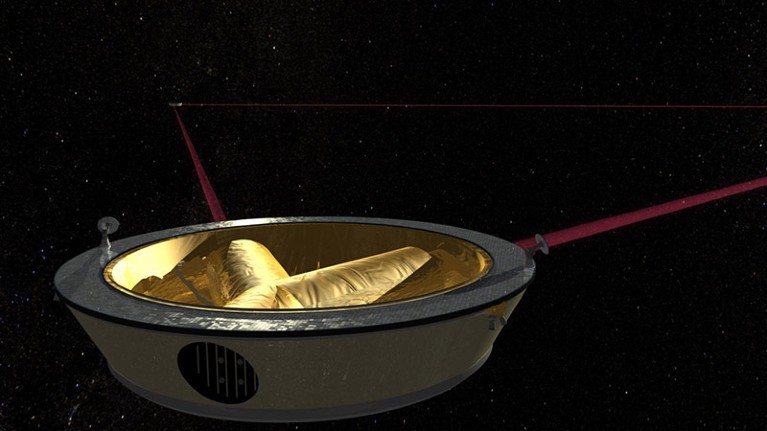
An artist’s impression of a LISA mission spacecraft. Three such satellites will make a triangle formation in orbit around the Sun.Credit: NASA
The first experiment to measure gravitational waves from space has been given the green light by the European Space Agency (ESA).
The Laser Interferometer Space Antenna (LISA) will use the precise timing of laser beams travelling across 2.5 million kilometres of the Solar System to hunt for gigantic ripples in space-time caused by mergers between supermassive black holes, among other events.
ESA announced on 25 January that construction of the multibillion-euro mission will begin in 2025, with the launch planned for 2035. “It’s extremely exciting,” says Valeriya Korol, an astrophysicist at the Max Planck Institute for Astrophysics in Garching, Germany, and a member of the LISA Consortium. “It will open a window to gravitational-wave sources that only LISA can see.”
How gravitational waves could solve some of the Universe’s deepest mysteries
The scale of LISA means that it will be able to observe gravitational waves of a much lower frequency than can be detected on Earth. This will allow the mission to spot phenomena, such as black holes orbiting each other, that are more massive and further apart than those seen by the ground-based Laser Interferometer Gravitational-Wave Observatory (LIGO), which first detected gravitational waves in 2015.
The mission has been a long time in the making. “The first time I wrote a proposal for LISA was 31 years ago,” says Karsten Danzmann, an astrophysicist at the Max Planck Institute for Gravitational Physics in Hanover, Germany, who leads the LISA Consortium. The experiment involves measuring the distance that laser light travels to pass between two masses, millions of kilometres apart, with an accuracy of one trillionth of a metre, while nothing other than space-time itself affects the movement of the masses. “People thought it was ridiculous. I said, ‘Just you wait.’”
LISA will consist of three identical spacecraft, each harbouring a 4.6-centimetre floating cube of gold and platinum, flying in an equilateral-triangle formation in orbit around the Sun. It will use lasers to measure the distance between the cubes in each craft with such accuracy that it will be able to tell when gravitational waves — subtle undulations caused by massive bodies accelerating — stretch space-time between them on the scale of picometres. (One picometre is 10−12 metres.) Other subtle shifts in the signals will allow LISA to pinpoint where the gravitational waves are coming from. “This is almost a sci-fi sort of instrument,” says Korol.
Although making such precise measurements over this distance is challenging, in many ways it is easier to do in space than on Earth, says Danzmann. “In space there’s no shaking, no atmosphere, no vibration, you’re just flying in a vacuum.” The difficult part is making the technology robust enough for all eventualities, he says. “You cannot just send a postdoc there to fix it.”
LISA will be sensitive to gravitational waves with wavelengths between 300,000 kilometres and 3 billion kilometres. This is longer than those detected on Earth by LIGO and shorter than those seen by pulsar timing arrays, studies that use ‘beacon’ stars to observe galaxies-wide gravitational waves.
All these experiments will observe different phenomena and produce complementary data, in the way that radio telescopes and visible-light instruments do, says Danzmann. LISA’s colossal scale will allow it to detect the gravitational waves produced when supermassive black holes merge, as well as the signals from systems at earlier stages of collision than LIGO can see. LISA should also be able to capture completely new phenomena, such as the spiralling of colliding white-dwarf stars, which are bigger than black holes, and systems in which two merging black holes are vastly different in mass.
Giant gravitational waves: why scientists are so excited
Cosmologists hope that the experiment will also be able to detect a background buzz of gravitational waves created in the early Universe — which has been predicted by theory — and perhaps even signals from the first black holes, says Korol. Because LISA will also measure how far away the sources it detects are, scientists hope its data will help to measure changes in the rate of expansion of the Universe.
China is also planning to launch a space-based gravitational-wave detector in the 2030s. LISA’s development boosts the case for such a mission, says Yue-Liang Wu, a physicist at the University of Chinese Academy of Sciences in Beijing and chief scientist for the Taiji project, one of two proposed missions being explored. The Taiji and LISA teams hope that the missions will overlap, so they can complement each other in a “space-based gravitational-wave-detector network”, Wu says.