x





A self-driving lab system spent half a year engineering enzymes to work at higher temperatures.
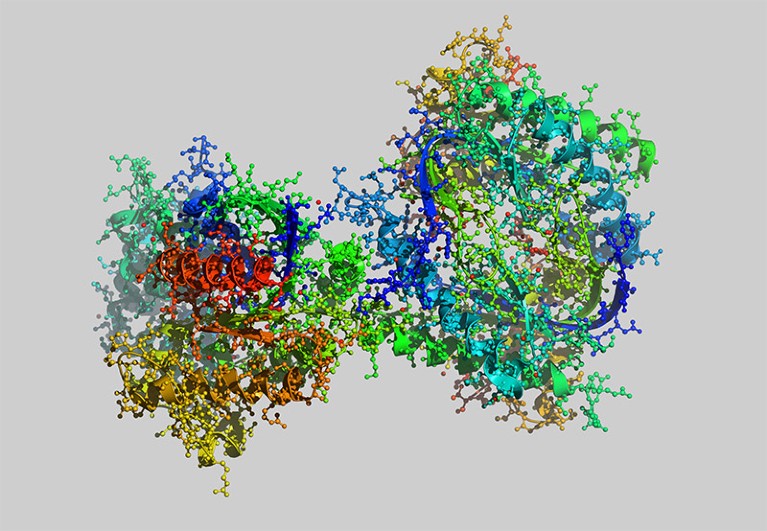
Proteins were made in a laboratory by a completely autonomous robot.Credit: Panther Media GmbH/Alamy
A ‘self-driving’ laboratory comprising robotic equipment directed by a simple artificial intelligence (AI) model successfully reengineered enzymes without any input from humans — save for the occasional hardware fix.
“It is cutting-edge work,” says Héctor García Martín, a physicist and synthetic biologist at Lawrence Berkeley National Laboratory in Berkeley, California. “They are fully automating the whole process of protein engineering.”
Self-driving labs meld robotic equipment with machine-learning models capable of directing experiments and interpreting results to design new procedures. The hope, say researchers, is that autonomous labs will turbo-charge the scientific process and come up with solutions that humans might not have thought of on their own.
Protein engineering is an ideal task for a self-driving lab, says Philip Romero, a protein engineer at the University of Wisconsin–Madison who led the study1, published on 11 January in Nature Chemical Engineering. Conventional approaches tend to rely on developing an assay for a particular property — say, enzyme activity — and then screening vast numbers of mutated versions of the protein. “So much of the field of protein engineering is monotonous,” he says.
The system that Romero’s team created is powered by a relatively simple machine-learning model that relates a protein’s sequence to its function, and proposes sequence changes to improve function. It delivers protein sequences for testing to lab equipment that makes the protein, measures its activity and then feeds the results back to the model to guide a new round of experiments. “We set and forget it,” Romero says.
In the study, the researchers tasked their self-driving lab with making metabolic enzymes called glycoside hydrolases more tolerant of high temperatures. After 20 experimental rounds, each of 4 campaigns produced new versions of the enzymes that could operate at temperatures at least 12 ˚C warmer than the proteins the autonomous lab began with.
The researchers first attempted to run their own robotic equipment, but the machines kept breaking. So they turned to a cloud-based lab in California — an existing facility containing robotic equipment that can be directed remotely with computer code — and set their AI model to send instructions there. The entire experiment took around 6 months, including a 2.5-month pause due to shipping delays, and each 20-round run cost around US$5,200, the researchers estimate. A human might spend up to a year doing the same work.
Increasing the sophistication of self-driving biology labs might require a new generation of hardware, because existing automated lab equipment tends to be made with a human overseer in mind, says García Martín. A more fundamental challenge is to create self-driving labs able to generate knowledge that can be interpreted by machines, as well as humans.
Making proteins more heat stable is relatively simple, says Huimin Zhao, a synthetic biologist at the University of Illinois Urbana–Champaign. It’s not clear how easily the self-driving lab can be adapted to alter enzymes in other ways.
Romero says his team is working on applying its self-driving lab to other protein-engineering challenges. The group also wants to incorporate more-sophisticated deep-learning tools that have driven advances in protein design.
The researchers are not, however, trying to slim down the scientific workforce. “We’re not making humans redundant,” said study co-author Jacob Rapp, a University of Wisconsin–Madison protein engineer, at an online seminar presenting the work. “We’re replacing the boring parts, so that you can focus on the interesting bits of doing your engineering work.”