x





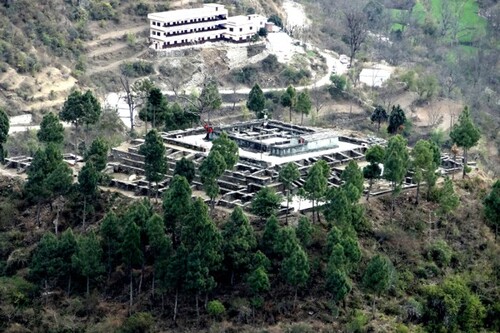

An analysis suggests that Chandpur Fort was part of a network of high-altitude security outposts. Credit: N. Singh Rawat et al./Antiquity
A survey reveals clusters of mountainside forts that could have relayed signals to each other by fire or smoke.
With the Dark Tower of Sauron, the capital of Gondor and many more, J. R. R. Tolkien’s Middle-earth is full of fortified citadels and imposing fortresses. Hundreds of years ago, a region in the central Himalayas might have resembled Tolkien’s fictional realm.
Nagendra Rawat at Hemvati Nandan Bahuguna Garhwal University in Srinagar, India, and his colleagues analysed the distribution of the remnants of 193 medieval strongholds in northern India. The researchers identified at least 12 clusters of forts. In each cluster, the forts were located 15–25 kilometres from one another — distances over which fire and smoke signals would be visible.
Most fortified sites were built on ridges or hilltops, and some would have been visible from several other forts. These ‘hubs’ could have served to relay information about enemy incursions or other events to a large number of nearby sites.
Each network of strongholds could represent either a state within the Katyuri kingdom, which controlled the region from the eighth to the twelfth century, or an independent chiefdom from the eleventh century. The visually linked forts might have facilitated the region’s fifteenth-century unification, the authors say.