x






Research on blocking sunlight needs a dose of realpolitik.
In April 2022, the start-up company Make Sunsets launched balloons into the stratosphere to release sulfur dioxide to make the atmosphere more reflective. This and other solar-geoengineering techniques aim to bounce solar radiation into space to partially counteract climate change. Make Sunsets’s experiments were not public knowledge until MIT Technology Review published a piece on them last December (see go.nature.com/3xvcb).
Make Sunsets’s release was commercially driven: the aim was to grab attention for the technique, to sell ‘cooling credits’ for future balloon flights. The amount of sulfur dioxide involved was environmentally negligible. But this publicity stunt shows why it’s a dangerous moment for solar-geoengineering science.
Solar geoengineering is a frightening yet tantalizing prospect. Techniques such as creating sulfuric acid aerosols in the stratosphere or spraying seawater into marine clouds seem relatively cheap, fast-acting and easy. Computer modelling studies have found that reflecting sunlight could greatly reduce regional temperature and precipitation changes caused by greenhouse gases (S. Tilmes et al. Earth Syst. Dynam. 11, 579–601; 2020). But we have very little evidence on how this would affect weather, agriculture, human health or other living things.
As a climate scientist who studies the regional effects and policy implications of solar geoengineering, I find these facts disconcerting. If we start geoengineering instead of mitigating emissions, other effects of carbon dioxide in the atmosphere — notably ocean acidification — would still happen. And without appropriate governance, elite interests could control the technique’s use and ignore the consequences for vulnerable people.
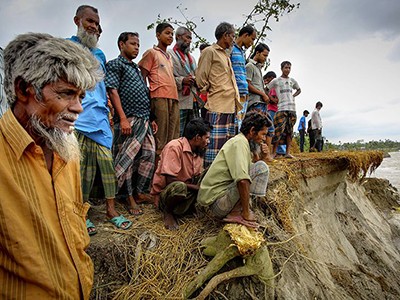
Developing countries must lead on solar geoengineering research
Many climate scientists think that solar-geoengineering research comes with unacceptable risks, but I disagree: shunning this research is riskier than studying it.
This is an area in which climate scientists can still make a fundamental difference in decision-making: large uncertainties remain, and there are presently no massive financial interests invested in geoengineering in the way that fossil-fuel companies are invested in blocking emissions reductions. But solar-geoengineering research needs to change in at least three ways.
First, real-world field testing is needed. Current research is too idealistic and based almost entirely on computer modelling. Problems with solar geoengineering are much more likely to emerge when theories meet physical realities. The story of ocean iron fertilization is instructive. In the 1990s and 2000s, 13 field experiments tested the outcomes of adding iron to nutrient-poor areas of the ocean’s surface. The researchers confirmed that they could stimulate phytoplankton blooms that sucked carbon dioxide out of the atmosphere, but found that most of the carbon was not stored in the deep ocean and was re-released. Much better for comparable problems with solar geoengineering to emerge during research — not publicity stunts or last-ditch measures to save treasured ecosystems.
Second, we must diversify the field to avoid bias. For example, women are, on average, more risk averse than men, so a field dominated by men will have overly optimistic framings. Researchers from powerful, well-resourced countries might be more optimistic about agency in global decision-making than those from poorer places.
Without diversity, research won’t be seen as legitimate by the full range of global stakeholders. If you are a scientist working on solar geoengineering in Europe or North America, where most of the research has been done, you should work to broaden participation in the field, geographically and demographically.

Should we fertilize oceans or seed clouds? No one knows
Finally, model-based research should reflect geopolitical realities. Current models tend to assume there will be global cooperation, which is difficult to achieve in the real world. Models should instead reflect the likelihood that, without governance, schemes will be uncoordinated and regional.
A few studies have modelled regional approaches — one by my group found that reversing a drought in northern Africa causes one in East Africa (K. Ricke et al. Geophys. Res. Lett. 48, e2021GL093129; 2021). More are needed, and different research groups should tackle regional possibilities in their own ways. The patterns that emerge can inform policy.
This approach has resonated with decision-makers, such as a group of diplomats and civil servants in Latin America and the Caribbean that I met with last summer. In turn, these interactions help to generate salient research questions.
Scientists working on solar geoengineering should welcome — indeed, demand — governance. A 2021 US National Academies committee report (see go.nature.com/3ykj7) that I helped to write laid out how to govern this type of science. The American Geophysical Union is beginning to establish protocols for self-governance of solar-geoengineering research, but as others have pointed out, scientific governance on solar geoengineering should not be led by the United States. Governance should be international, facilitated by the United Nations.