

Orbiting satellites are all the more susceptible, their electronics can be damaged until the total failure. "The more we become dependent on technology - think of self-driving cars that rely on navigation satellites - the stronger the impact of a solar flare," says Joachim Woch from the Max Planck Institute for Solar System Research (MPS) in Göttingen.
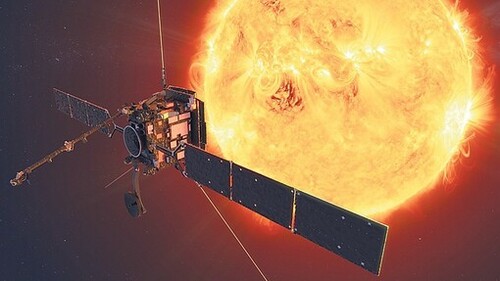
He is instrumental in the construction of the " Solar Orbiter " research probe , which was launched on Monday morning as planned at 5:03 a.m.CET from the Kennedy Space Center in Cape Canaveral, Florida with a NASA Atlas V rocket.
On its mission, largely funded by the European Space Agency Es with around 500 million euros, the probe is to orbit the sun for at least seven years and explain how the magnetic fields of our mother star “work” that lead to the sun flares. The researchers involved hope that these findings can help to arm themselves against particle bombardment in good time, for example by turning satellites out of the "solar wind" or temporarily switching them off.
Start scheduled for Monday morning, 5:03 a.m.CET
Solar Orbiter is technically very demanding . The probe will come as close as 42 million kilometers to the sun , which is about a quarter of the distance from the Earth to the Sun and closer than the orbit of the planet Mercury. It carries a heat shield made of titanium, which is coated with a calcium-phosphate compound and can withstand 500 degrees Celsius permanently. There are holes in the sign, behind which there are ten measuring instruments and work at around room temperature.

Less than an hour after the launch at 5:03 a.m. (CET), the probe is separated from the rocket and on its way to the sun alone. GRAPHIC: ESA
Not all “look” towards the sun, some also measure the effects of the solar wind at a greater distance, so to speak next to the probe. Most have filters that allow only a fraction of the radiation to reach the sensitive devices.
The 1.8-ton probe will examine the sun's magnetic fields closely. Where they change abruptly, sun eruptions occur . The sun cycle, in which a time with many sun spots alternates with a rather quiet phase within eleven years, is also related to this.
Woch is involved in the instrument "PHI" (Polarimetric and Helioseismic Imager). It looks like a telescope at the outside photosphere of the sun. It should measure the polarization, i.e. the direction of vibration of the light waves . This changes depending on the orientation and strength of the magnetic field. The closer PHI comes to the sun, the better the resolution, the more details of the interwoven magnetic fields can be seen.

Solar Orbiter before launch to the sun: information about the probe and the mission. / AFP / Jonathan WALTER AND Kun TIAN AND Claudia SMIGAJ PHOTO: AFP
The apparatus can also explore deeper layers indirectly. Because the interaction between plasma currents and magnetic fields cause the star to vibrate , which can be seen on the surface and which the PHI can measure. The researchers hope to better understand how the fields are created.
Another important instrument is "STIX" (Spectrometer / Telescope for Imaging X-rays). It analyzes hard X-rays that arise in the corona of the sun and also depend on the properties of the magnetic fields. "With this we want to clarify processes that lead to the formation of flares - sudden bursts of energy on the sun's surface, " says Gottfried Mann from the Leibniz Institute for Astrophysics in Potsdam, whose team is responsible for the imaging unit of the STIX.

The solar orbiter probe in the tip of an Atlas V 411 rocket is being launched near the Kennedy Space Center in Florida ... PHOTO: ESA – S. CORVAJA
A first look at the poles of the central star
For him, a dream comes true . "In 1994, I made a first proposal for a solar orbiter mission with colleagues from the Max Planck Institute in Göttingen," he says. The usual ups and downs followed : the mission came on suggestion lists, fell down, came back on until Esa finally decided in 2011.
By observing the same sun regions together, the various instruments enable the researchers to check and improve their models based on the various data. As the probe rotates almost synchronously with the star for a few days while flying by, it can follow the events in the respective regions over a longer period of time.
Initially, Solar Orbiter will orbit on the equatorial plane of the sun and look at its "belly". In the course of the mission, it will leave this orbit and fly more steeply to look towards the poles - a premiere in solar research .
Even basic properties from these latitudes are still unknown, such as the magnetic fields on the surface of the hot plasma ball or its rotational speed. "Without the piece of the puzzle that we lack at the poles, the sun as a whole cannot be understood," says Sami Solanki, head of the PHI instrument.In the sunNASA's “Solar Parker Probe” has been researching the sun since 2018 and is getting even closer to it. The previous record is 24 million kilometers, in the future it should go up to 6.2 million kilometers. Parker doesn't have cameras though - they wouldn't survive the heat . However, the probe is not a competitor to the Solar Orbiter. Both will exchange their data - so that we can better understand how our central star works.