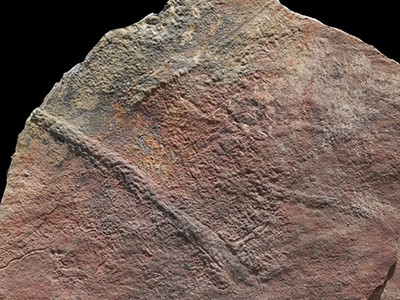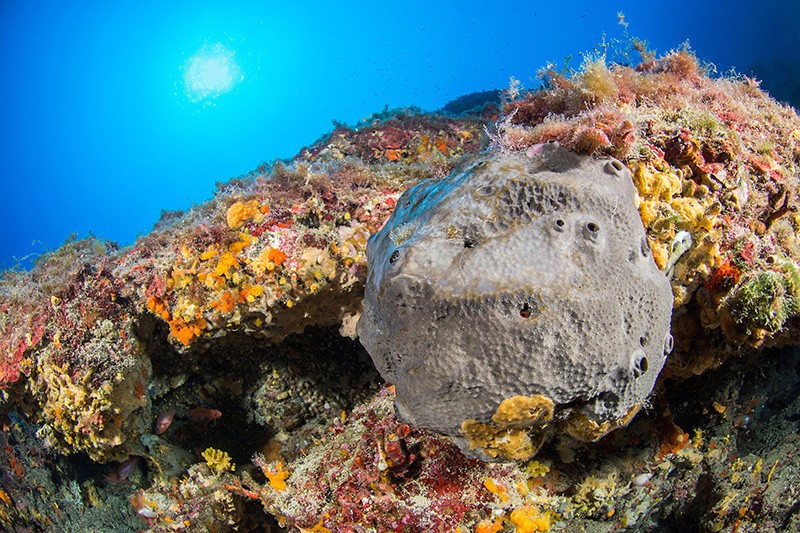
A black horny sponge (Scalarispongia scalaris) growing off the coast of France. Some types of horny sponge are today harvested for bath sponges.Credit: Biosphoto/Alamy




A black horny sponge (Scalarispongia scalaris) growing off the coast of France. Some types of horny sponge are today harvested for bath sponges.Credit: Biosphoto/Alamy
Most major groups of animals — including arthropods, molluscs and worms — first appear in the fossil record during the Cambrian explosion, 541 million years ago. But according to a paper published today in Nature1, sponge fossils from northwestern Canada could be 350 million years older, significantly pushing back the date of Earth’s earliest-known animals.
The ancient discovery is igniting debate among palaeontologists, who have long contested when complex animal life first evolved.
“If I’m right, animals emerged long, long before the first appearance of traditional animal fossils,” says study author Elizabeth Turner, a sedimentary geologist at Laurentian University in Sudbury, Canada. “That would mean there’s a deep back history of animals that just didn’t get preserved very well.”
Some scientists, however, are not convinced that the microscopic patterns in Turner’s 890-million-year-old fossils indicate an ancient sponge, given the evidence provided in the study.
“It’s such a big claim that you really have to eliminate all the other possibilities,” says Rachel Wood, a geoscientist at the University of Edinburgh, UK, who researches fossil reefs. “Microbes, for example, produce weird and wonderful shapes and forms.” Sometimes crystals also grow in a way that looks like patterns formed by living organisms, she says, meaning that the rock samples Turner found might not be fossils at all.
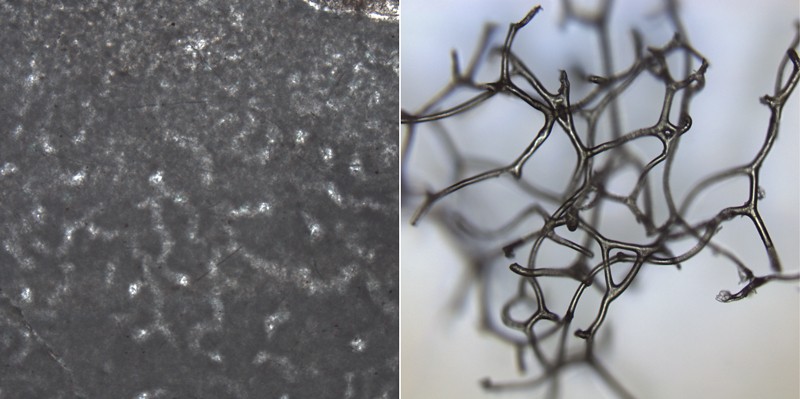
Crystalline tubes seen in rocks (left) might have been formed when the collagen-like skeleton of an 890-million-year-old sponge decayed and fossilized. Some modern sponges have internal scaffolding (right) that resembles the shapes in the rocks.Credit: Elizabeth C. Turner
Turner counters that none of the known reef-building organisms that existed 890 million years ago, such as cyanobacteria or algae, can explain the complex structures in her samples.
She collected the purported fossils from ancient microbial reefs preserved in the rocks of Canada’s remote Northwest Territories, starting during her graduate studies in the 1990s.
When Turner examined slices of the rock under a microscope, she saw branching networks of crystalline tubes. She later realized that these structures resemble the internal scaffolding of modern horny sponges, and line up with the expected decay and fossilization patterns of spongin, a collagen protein that forms their scaffolding.
“These rocks are beautiful, but you don’t expect to find something that complicated or weird in them,” she says.
It wasn’t until the past few years, when she saw studies that described similar structures in much younger rocks — from a time when sponges were known to exist — that Turner felt confident in publishing her results. But those studies, too, are disputed on the grounds that they might not be actual sponge fossils.
The authors of one of these papers2 took photographs of many thin slices of their rock sample and used them to generate a 3D model of the purported sponge. Wood says that a similar piece of evidence would have strengthened Turner’s claim.
If Turner’s structures do prove to be sponge fossils, says David Gold, a geobiologist at the University of California, Davis, “it would be very exciting, and help us nail down the early story of animal evolution”, a subject that has been hotly debated for decades.
But although “it’s easy to find things that look like sponges in the fossil record”, he says, it’s more difficult to back them up with other evidence. He and other researchers, for instance, have supported3 fossil claims by pointing to rock samples containing traces of biological molecules that are linked to sponges. Unfortunately, given the sheer age and type of Turner’s rock samples, this type of preservation isn’t really possible, he adds.
It’s not inconceivable that sponges could have pre-dated the Cambrian explosion, says Phoebe Cohen, a geobiologist at Williams College in Williamstown, Massachusetts. Scientists estimate how long ago the ancestors of groups of living animals diverged using ‘molecular clocks’, which measure the rate of mutation in DNA and proteins over time.
The majority of these estimates suggest that the last common ancestor of all animals alive today evolved before the Cambrian explosion, but not by as much as 350 million years, says Cohen. Nevertheless, she says she could be convinced that Turner’s samples are sponge fossils if she saw more evidence, including studies on how horny sponges fossilize.
The palaeontological community is split on whether the dearth of animal fossils from before the Cambrian period is because the creatures that lived then rarely survived as fossils to the present day, or because molecular-clock estimates of animal origins are wrong. Gold is convinced there were sponges before the Cambrian, but says that exactly how far back is a big, unresolved question.
If the ancestors of modern sponges really were alive 890 million years ago, then it means early animals survived through very trying conditions for life, such as extremely low levels of oxygen and ‘snowball Earth’ periods during which the surface of the planet almost entirely froze over, says Gold.
Turner argues that sponges could have survived the low-oxygen environment by eking out a living in cavities and crevices in the microbial reef next to photosynthetic cyanobacteria, which release oxygen. The sponges might also have been nourished by organic ooze that the bacteria produced. “There was probably a delicious and very copious supply of ‘snot’ for these filter-feeding organisms to have eaten,” she says.
Scientists are passionate about their views of when animal life started on Earth. The paper could reinvigorate the debate that has been quietly simmering for decades, says Gold. “But I suspect it’s not going to change a lot of minds for those who have made a decision about how old animals are.”